28 February 2026
How to Use Influencer Marketing to Get More Google Reviews: A Simple Playbook
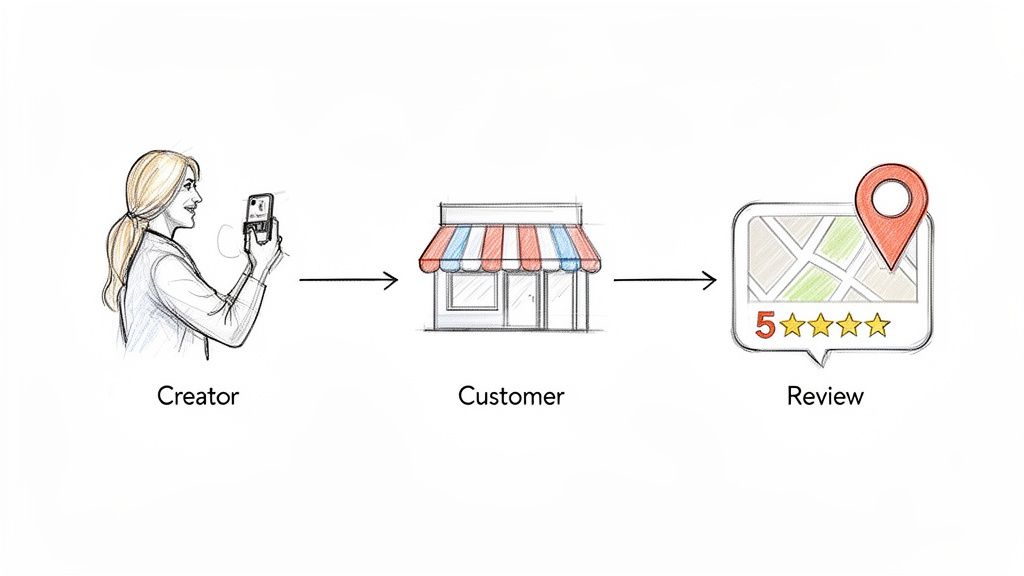
To get more Google Reviews using influencer marketing, you need a system. It's a system where creators drive real customers to your business, and those customers are then prompted to share their genuine experience. The goal here is to build trust through authentic feedback, not to pay for fake reviews. This entire approach hinges on using an influencer's credibility to kickstart a customer journey that ultimately leads to valuable social proof on your Google Business Profile.
Why Influencers Are Your Secret Weapon for Reviews
Not too long ago, influencer marketing felt like a game of vanity metrics. It was all about chasing likes and follower counts with little to show for it. Now, savvy UK brands are seeing creators as a direct line to customer acquisition and, crucially, a way to generate authentic user feedback. It’s a complete mindset shift, moving from "look at this product" to "go experience this for yourself and share what you think."
This works because today’s consumers, especially the younger ones, put a huge amount of trust in the creators they follow. A recent study found that one in four UK adults (that's a massive 25%) are swayed by influencer partnerships when making a purchase. For Gen Z, that number rockets to over 50%. This makes creators an obvious and powerful choice for businesses looking to generate a surge in Google reviews.
From Content to Customer to Review
The central idea is beautifully simple yet incredibly effective. Instead of just having an influencer show off your product, their real job is to spark an actual transaction.
Here’s how it plays out:
- A local food blogger visits your restaurant, shares their amazing meal on Instagram Stories, and includes a special offer code just for their followers.
- A direct-to-consumer (DTC) brand partners with a lifestyle creator who unboxes a new product and gives their audience a unique discount link to try it for themselves.
The real magic, though, happens in the follow-up. The customers who use that offer code or discount link are later prompted to leave a Google Review about their own experience. This creates a legitimate, trackable, and repeatable engine for generating reviews that fully respects both Google's guidelines and the audience's trust.
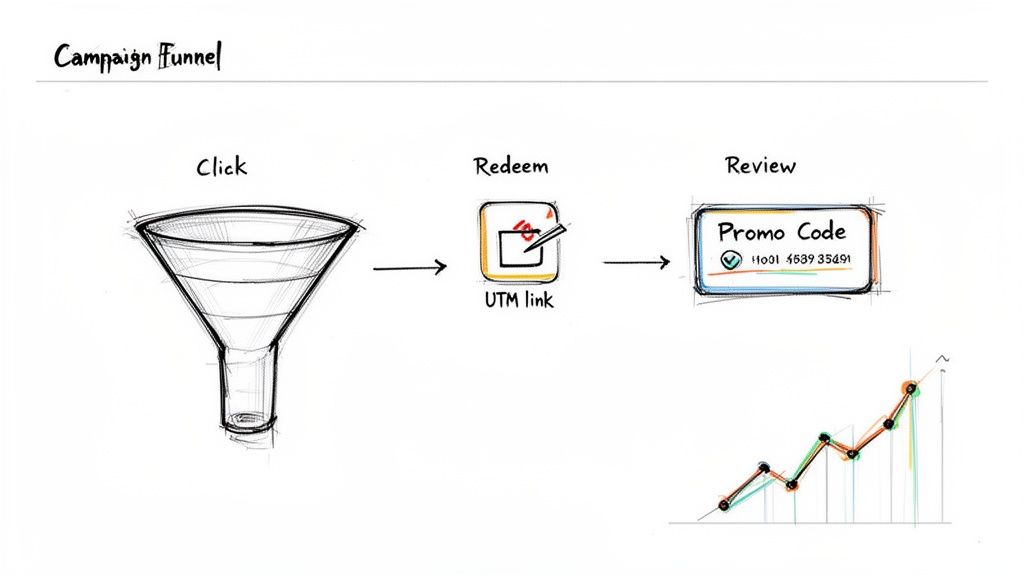
This diagram breaks down the basic flow, from the influencer's initial promotion right through to a verified customer review.
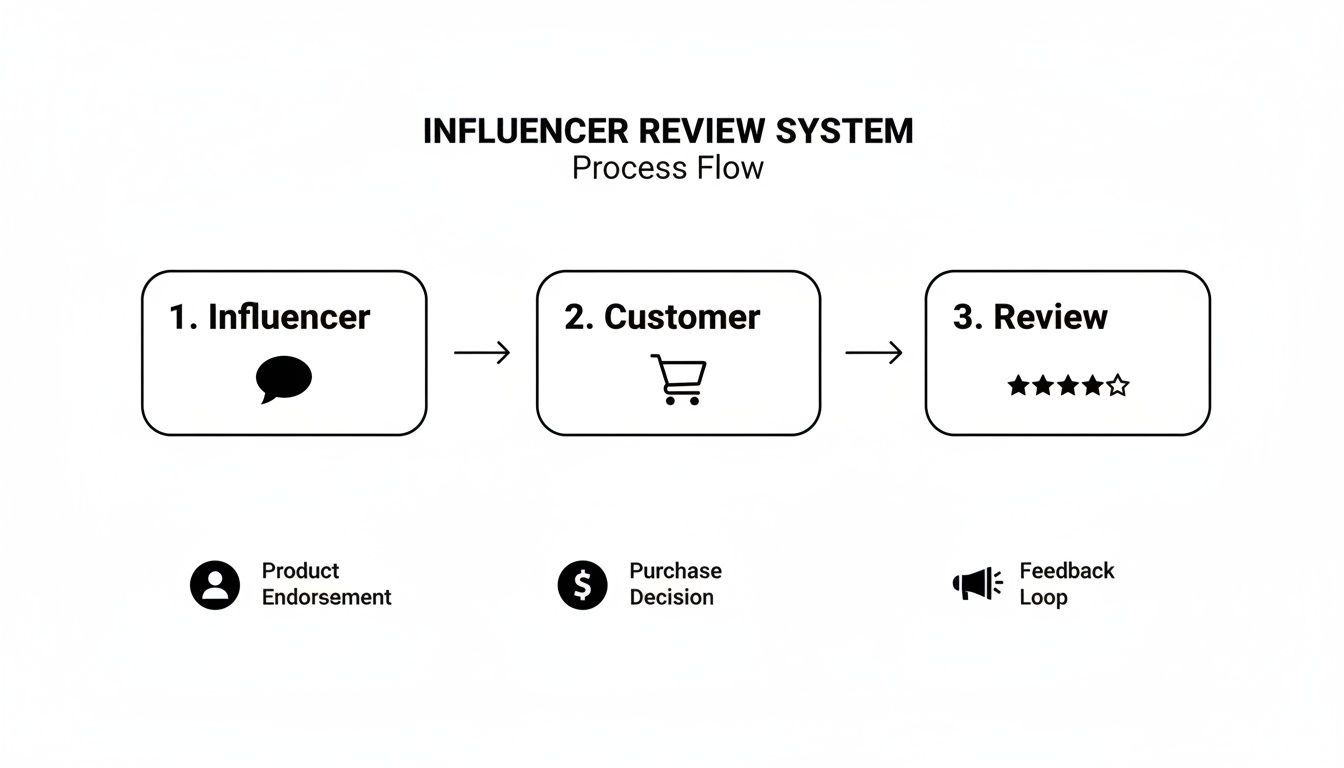
This straightforward, three-step process is the bedrock of any successful influencer-driven review campaign.
Expert Insight: Influencer-led campaigns provide a crucial layer of social proof. When potential customers see content from a trusted creator, immediately followed by positive reviews from their peers, the journey to becoming a customer becomes almost frictionless.
While this strategy is a game-changer, it’s most powerful when you understand the bigger picture of online reputation. Taking a holistic approach is the key to Mastering Google Business Reviews and building a brand that lasts. It all works together.
Designing Your Review-Focused Influencer Campaign
This is where the rubber meets the road. We’re moving from high-level strategy to a concrete plan of action. A successful influencer campaign built for Google reviews doesn't just happen; it's meticulously designed with a single, sharp focus. Forget vague ambitions like "getting more exposure". Your objective has to be specific and, crucially, measurable.
First things first, define what success actually looks like for you. Instead of just "more reviews," set a tangible goal. Aiming for something like 25 new, verified Google Reviews within the next 90 days is a brilliant starting point. It gives you a clear benchmark to measure performance against and helps you calculate a real return on your investment.
Choosing the Right Incentive Model
With your goal locked in, it's time to think about incentives. This is a two-part puzzle: how do you motivate the influencer, and how do you motivate their followers? This isn't just about paying for a post; it’s about creating a compelling reason for someone to go from a passive viewer to a paying customer who then feels inspired to share their experience.
You generally have two paths to choose from here:
- Product Gifting (Contra): This is the perfect way to dip your toes in the water, especially with micro-influencers. You provide your product or service for free, and in exchange, the creator shares their genuine, firsthand experience. For a restaurant, that could be a complimentary dinner for two. For a direct-to-consumer brand, it’s sending them your latest product.
- Paid Collaboration: Once you start working with creators who have larger, more established audiences, a fee on top of the gifted product becomes standard. This model buys you more dedicated time and specific deliverables, giving you a bit more control over the campaign's nuts and bolts.
No matter which model you choose, the real magic often happens with the offer you extend to the influencer's audience. A unique discount code, something memorable like "SOPHIE20" for 20% off, does two things. It drives sales, of course, but it also becomes your primary tool for tracking which customers came directly from that collaboration. This is fundamental to figuring out what’s actually working.
For a deeper look at these models, our complete guide on micro-influencer marketing for small businesses breaks it all down.
Key Takeaway: The incentive for the influencer gets their attention, but the incentive for their followers is what drives the customer action that ultimately leads to a review. Make that audience offer irresistible.
Crafting a Clear and Compliant Creative Brief
The creative brief is easily the most critical document in your entire campaign. Think of it as the instruction manual that tells the influencer exactly what you need from them. A vague brief gets you vague content and, you guessed it, zero reviews. A clear, focused brief is the key to hitting your goals.
Your brief absolutely must spell out the two-part call to action. First, the influencer needs to drive their followers to your business with that compelling offer. Second, and this is the part people forget, they need to prompt those new customers to leave a review.
Here’s an example instruction for a restaurant influencer’s brief:
"We'd love for you to share an Instagram Story of your dining experience. On your final Story slide, could you use the 'link' sticker to point followers to our website and add this text: 'Loved my meal at [Restaurant Name]! If you visit, use my code FOODIE15 for 15% off and don't forget to leave them a Google Review to share what you thought!'"
This instruction is direct, actionable, and gives them the exact wording without sounding robotic. It makes the ask crystal clear while still giving them room to be authentic.
Staying Compliant with UK Advertising Codes
In the UK, transparency isn't just a good idea. It's the law. The Competition and Markets Authority (CMA) and the Advertising Standards Authority (ASA) both have strict rules for influencer marketing. Getting this wrong can lead to hefty fines and, just as bad, serious damage to your brand’s reputation.
The core rule is simple: if content is promotional, it must be obvious to the person seeing it. The influencer has to disclose their connection to your brand, period.
In practice, this means:
- Clear Disclosure: Any post that comes from a gifted product or payment must be clearly labelled. Think #ad, #gifted, or a similar, unambiguous tag. Crucially, this needs to be placed prominently, not buried in a mountain of other hashtags.
- Honest Opinions: While you can guide the content and the key messages, you can't tell an influencer their opinion must be positive. Their account of their experience has to be genuine.
- Encouraging Honest Feedback: This is vital. Your brief should encourage followers to leave honest reviews based on their own experience. You are not asking the influencer to tell people to leave five-star reviews; you're asking them to encourage genuine feedback from real customers.
By building these compliance steps into your campaign design from day one, you protect your brand, respect the audience, and build a foundation for trustworthy, long-term collaborations. It’s the only sustainable way to approach this.
Finding and Partnering with the Right UK Influencers
Let's be honest: even the most brilliantly designed campaign will fall flat if the message comes from the wrong person. Your success in getting more Google Reviews through influencers hinges entirely on one thing: finding partners whose audience perfectly mirrors your ideal customer. It’s all about precision, not just follower counts.
The days of local businesses chasing macro-influencers with millions of followers are long gone. The real power now lies with micro-influencers (10k-100k followers) and nano-influencers (1k-10k followers).
These creators have smaller but fiercely loyal and, crucially, geographically-concentrated audiences. An endorsement from them feels less like a polished advert and more like a genuine recommendation from a friend you trust.
This isn't just a trend; it's a proven strategy. Recent findings show that UK brands are overwhelmingly prioritising these smaller creators. In fact, 93% are already partnering with them, and 54% plan to increase their investment specifically for this kind of niche targeting. These collaborations deliver much higher engagement rates, which is exactly what you need to turn a follower into a customer who leaves a review.
Identifying Authentic Local Creators
So, where do you actually find these hyper-local, high-impact creators?
You could take the manual approach, which means spending hours scrolling through hashtags like #manchesterfoodie or #londonstyle on Instagram and TikTok. It’s possible, sure, but it's incredibly time-consuming and gives you no real guarantee of quality.
A far more efficient method is to use a dedicated platform. For instance, a tool like Sup is specifically designed to filter creators not just by their niche, but by their precise location. This lets a restaurant in Bristol instantly find foodies who live in and create content about Bristol, ensuring their message hits a truly relevant local audience.
Beyond just location, you have to properly vet potential partners for authenticity. A high follower count can be very deceptive. I always look for these signs of a genuinely engaged community:
- Meaningful Comments: Are people asking questions and having actual conversations, or is it just a wall of fire emojis and generic "love this!" comments? You want to see real dialogue.
- Consistent Engagement Rate: A good benchmark for micro-influencers is typically between 3-6% (likes + comments ÷ followers). Does their engagement stay steady across their posts, or do some have suspiciously high numbers while others have almost none?
- Audience Quality: Take a minute to scan their followers and the accounts that comment. Do they look like real people who would actually be interested in your business? Fake followers are easy to spot once you know what to look for.
When you're sizing up potential partners, also pay attention to the quality of their work. Notice the platforms they use and see if they're using advanced tools for creators to produce polished, compelling content that will represent your brand well.
Crafting Outreach That Actually Works
Once you’ve built a shortlist of promising creators, it's time to reach out. Generic, copy-pasted DMs are the fastest way to get your message ignored. Your outreach needs to be personal, professional, and crystal clear about the value you're offering.
Keep your initial message brief and to the point. Most importantly, show them you’ve actually done your research.
Here’s an example script I’ve seen work wonders: "Hi [Influencer Name], love your content on the Birmingham coffee scene, especially your recent post about [Specific Cafe]! My name is [Your Name] from [Your Business]. We’re launching a new menu and would love to invite you for a complimentary experience. We're running a small campaign to gather honest feedback from local food lovers on Google. Is this something you'd be open to discussing?"
This approach is effective because it:
- Shows you have genuine appreciation for their specific work.
- Quickly introduces you and your business.
- Presents a clear, low-commitment offer (a gifted experience).
- Subtly introduces the campaign goal (gathering feedback on Google).
This opens the door for a real conversation, where you can then dive into the full brief and incentives. For more specific examples, you can learn how to find local food influencers in your city and tailor your outreach from there.
Moving From One-Offs to Ambassador Programmes
While one-off campaigns are great for a quick boost, the most sustainable flow of Google Reviews comes from building long-term relationships.
The real goal is to turn your best-performing micro-influencers into brand ambassadors. This creates a powerful, ongoing source of authentic promotion that feels natural to their audience.
An ambassador programme typically involves a longer-term agreement where the creator promotes your brand consistently over several months. This deepens their audience’s trust and keeps your business top-of-mind. Instead of a single post driving a handful of reviews, you get a steady trickle of feedback from new customers, month after month. It's a reliable engine for local SEO growth.
Bringing Your Campaign to Life and Tracking What Matters
This is where the rubber meets the road. A great plan is one thing, but execution and tracking are what separate wishful thinking from a campaign that delivers a real, provable return on your investment. It's all about attribution: being able to draw a straight line from an influencer's post to a customer's action and, finally, to that shiny new Google Review on your profile.
If you don't have a solid tracking system, you're essentially flying blind. You might see a few new reviews trickle in, but you'll have no idea which influencer, which post, or which offer actually made it happen. That kind of guesswork makes it impossible to know what’s working, where to put your budget next, and how to justify the spend.
The entire influencer marketing scene in the UK has become a powerhouse for driving these kinds of consumer actions. In 2024, the market hit an incredible US$2.36 billion and is on a trajectory to reach $24.15 billion by 2033. This isn't just hype; it's fuelled by smart restaurants and e-commerce brands using platforms to connect with local creators. We’ve seen firsthand how UK brands are using these strategies, and you can see more on the numbers behind it at ourownbrand.co.
Building Your Tracking Foundation
To get any meaningful data, you need to give each influencer their own unique tracking tools. This is non-negotiable if you want to see who’s really driving results. The two absolute must-haves are UTM links and promo codes.
A UTM (Urchin Tracking Module) link is just a standard URL with a few extra bits of code on the end. These 'tags' tell your analytics software exactly where someone came from. For every influencer in your campaign, you’ll create a unique link that points to your website or a specific landing page.
Promo codes are crucial for tracking purchases, especially for offline businesses like restaurants. By giving each influencer a unique code (think 'SOPHIE15' or 'LIVESEATS'), you can see exactly how many of their followers came in and redeemed the offer.
Getting these set up is surprisingly simple:
- UTM Links: Head over to Google's free Campaign URL Builder. Fill in the source (e.g., 'instagram'), medium ('influencer'), and a campaign name to generate your links.
- Promo Codes: You can create these right inside your point-of-sale (POS) system or your e-commerce platform like Shopify or WooCommerce. Keep them short and easy to remember.
This basic setup is the bedrock of understanding your campaign's true impact. For a more detailed look at this, our guide on how to run a restaurant influencer campaign step-by-step breaks down the entire process.
Making it Effortless to Leave a Review
Once a customer has used their code and had a great experience, you have one final job: make leaving a review as easy as humanly possible. Any friction at this stage, like forcing them to search for your business on Google Maps, will cause a massive drop-off. You’ll lose most of them right there.
The best way to handle this is with a direct Google Review link. This special URL takes someone straight to the review pop-up for your Google Business Profile. It can even pre-fill a five-star rating (which they can easily change) to remove one more click from the process.
Pro Tip: Find your direct review link by searching for your business on Google, clicking "Write a review," and then copying the long URL from your browser's address bar. Use a tool like Bitly to shorten it into something clean and easy to share.
Keeping an Eye on Performance from One Place
With all your tracking in place, the last thing you want is to be drowning in spreadsheets. This is where a central dashboard, like the one we've built into Sup, becomes a game-changer. Instead of juggling ten different tabs, you can see everything happening in one place.
A live dashboard gives you a real-time pulse on the metrics that count:
- Content Views & Clicks: Track UTM clicks to see which influencer's content is grabbing the most attention.
- Code Redemptions: Watch how many people are using each unique promo code to make a purchase.
- Review Correlation: This is the most critical piece. You can see a timeline of campaign activity and directly connect a spike in code redemptions to an increase in new Google Reviews.
When you can see the data laid out so clearly, the ROI of your influencer programme becomes undeniable. You can confidently say, "Our work with Chloe drove 45 sales and led to 12 new five-star reviews this month." Suddenly, influencer marketing isn't just a cost. It's a proven engine for growth.
Taking Your Success and Running With It
When your first influencer campaign wraps up and the Google Reviews start rolling in, it's easy to breathe a sigh of relief and call it a day. But that's a mistake. A successful campaign isn't the finish line; it’s the starting block for something much bigger.
That initial wave of reviews and customer buzz is just the beginning. The real magic happens when you treat that success as a foundation to build on, turning a single win into a reliable engine for growth.
First, you need to realise what you've just created. The photos, videos, and stories from your influencers and their followers are more than just fleeting social media posts. They’re a goldmine of authentic social proof. We call this user-generated content (UGC), and frankly, it’s one of the most persuasive assets you can have.
Squeeze Every Drop of Value From Your New Content
Think about it. That content (from an influencer’s slick video to a customer’s quick, happy snap) is marketing gold. It's genuine, it's relatable, and it’s far more believable than anything you could create in a studio. In fact, research shows that almost 50% of shoppers find user content more influential than a brand's own posts.
So, don't just let this fantastic content fade away. Get strategic and put it to work everywhere.
- Spruce Up Your Social Feeds: Reshare the best bits on your own Instagram, TikTok, and Facebook. Always get permission and give credit, of course. This fills your channels with genuine voices and shows real people loving what you do.
- Enhance Your Website and Product Pages: Picture someone landing on your website. What’s more convincing? Stock photos, or a gallery of real customers enjoying your product? A furniture brand, for example, could show customer photos on product pages, helping shoppers see how a sofa looks in an actual living room.
- Power Up Your Ad Creative: This is where UGC can be a complete game-changer. Ads featuring authentic customer content almost always outperform polished, corporate-looking ones because they feel real. Test some influencer video clips or customer photos in your next ad campaign and see what happens to your engagement rates.
My Two Cents: User-generated content is your ticket to a cost-effective library of marketing assets. By showcasing real customer stories, you give new customers the confidence they need to trust you and make a purchase.
Go From One-Offs to an Ambassador Programme
A single campaign is great. But what you really want is a predictable, non-stop flow of reviews and fresh content. This is where you level up from one-off projects to a long-term ambassador programme.
Look back at your initial campaign. Who were the micro-influencers that really delivered? Who was just a joy to work with? These are your future brand ambassadors. Reach out and propose a longer-term partnership, shifting from a single post to a relationship that spans several months.
An ambassador programme brings some serious benefits:
- Keeps the Momentum Going: Instead of one big spike, you get a steady hum of promotion that keeps your brand top-of-mind.
- Builds Deeper Authenticity: When an influencer features your brand repeatedly, their audience sees it as a genuine part of their life, not just a paid ad.
- Creates a Predictable Review Flow: This consistent promotion means a more regular stream of new customers, which in turn leads to a steady trickle of new Google Reviews.
Suddenly, your influencer marketing isn't just a reactive tactic. It's a strategic part of your customer acquisition machine.
Scaling Your Blueprint Across Multiple Locations
For businesses with more than one location, like a restaurant chain or retail franchise, the true beauty of this model is how easily it scales. Once you’ve nailed the campaign in one city, you don't need to reinvent the wheel. The core blueprint (the brief, the incentive, the tracking) is already proven.
This is where using a central platform becomes crucial. Instead of juggling dozens of spreadsheets and email threads, a tool like Sup lets you clone a successful campaign in minutes.
The platform can then pinpoint a new group of hyper-local influencers in the next target area: swapping "Bristol foodies" for "Leeds foodies," for instance. With just a few clicks, you can launch a new, localised campaign, arming your new partners with unique tracking links and promo codes for their specific branch. This turns your review strategy into a repeatable system that boosts the local SEO for every single one of your locations.
Your Top Questions About Influencer-Driven Reviews, Answered
Mixing influencer marketing with Google Reviews can feel like walking a tightrope. A lot of businesses I talk to are keen to boost their reviews this way but are stopped in their tracks by some very valid concerns. Let’s tackle the big questions head-on.
The most important thing to get right is your approach. You absolutely cannot pay anyone (influencer or otherwise) directly for a Google Review. Doing so is a fast track to getting penalised by Google.
So, how do you do it properly? The influencer's job is to promote your business. They drive their followers to become real, paying customers. It’s those customers, based on their genuine experience, who then leave a review. Your brief to the influencer needs to make this distinction completely clear. The content is the advert; the review is the organic outcome of a real transaction.
Key Rule: Your instructions should always ask the influencer to prompt their followers who visit or purchase to share honest feedback on Google. Transparency and full compliance with the UK's ASA guidelines are completely non-negotiable.
What Is a Realistic Number of Reviews to Expect?
This is the million-dollar question, isn't it? The truth is, it varies. Your results hinge on the influencer’s connection with their audience, how good your offer is, and how simple you make the call-to-action.
From what I've seen, a well-run campaign with a single micro-influencer who has a loyal local following can realistically bring in 5 to 15 reviews. A smaller nano-influencer might generate 1 to 5.
The aim here is a steady, natural stream of feedback, not a sudden, suspicious spike. Partnering with a handful of micro-influencers over time to generate 20 to 30 reviews per month is far more powerful for your local SEO than getting 100 reviews overnight. Think consistency over sheer volume.
How Can I Track if a Review Came from an Influencer?
Pinpointing every single review back to one post is nearly impossible, but you can get very close with some smart tracking. The best method by far is to give each influencer their own unique promo code (like 'SOPHIE20'). This lets you track every single use of that code right in your sales system.
You then keep a close eye on your Google Reviews during and after the campaign. When you see a new review pop up and you've just had a flurry of redemptions for 'SOPHIE20', you can connect the dots. Some customers might even mention the influencer or the offer in their review, which is a clear win. Using a platform like Sup simplifies this massively by plotting campaign activity and new reviews on the same timeline, making it easy to prove the impact.
What Businesses See the Best Results?
This strategy works wonders for businesses that provide a hands-on, local experience. It just clicks.
- Restaurants & Cafes: The experience is highly visual and perfect for an influencer to capture and share.
- Salons & Spas: Who doesn't love a good before-and-after? This content is incredibly compelling.
- Fitness Studios: A high-energy class or personal training session makes for authentic, engaging storytelling.
- Local Service Providers: Think boutique hotels, unique shops, or any local gem.
It’s not just for brick-and-mortar, though. This is a brilliant tactic for e-commerce and DTC brands, too. An influencer unboxing a product and then asking followers who buy it to review their own delivery and product experience works incredibly well. At the end of the day, any business that relies on customer feedback can make this model a success.
Ready to turn influencer marketing into a repeatable engine for sales and reviews? With Sup, you can find local creators, launch tracked campaigns, and see measurable ROI in a fraction of the time. Book your demo today and see how it works.
More on insights
See how many creators post about you and your competitors
Type in your brand's Instagram handle and we count the creators who post about you and about your five closest competitors. It takes about a minute and it is free. Or request a demo and we will show you the creators in your niche and walk you through the dashboard.
 Book a call