23 March 2026
How to Choose Between Influencer Marketing Platforms in 2026
Picking the right influencer marketing platform isn't about finding some mythical, one-size-fits-all solution. The biggest mistake I see brands make is jumping straight into demos, dazzled by flashy features they'll never actually use.
The truth is, a local restaurant trying to get more people through the door has completely different needs than a direct-to-consumer (DTC) brand aiming for nationwide sales. It all comes down to one thing: matching the tool to your actual business goals, not the other way around. To do that, you need to move from a vague wish list to a clear-eyed, practical evaluation.
From Vague Goals to a Clear Shortlist
Without a solid plan, you're just setting yourself up for wasted time and budget. The sheer number of platforms, each with its own sales pitch and confusing jargon, can feel overwhelming. The secret isn't finding the "best" platform, but the one that fits your brand’s unique way of working and what you're trying to achieve.
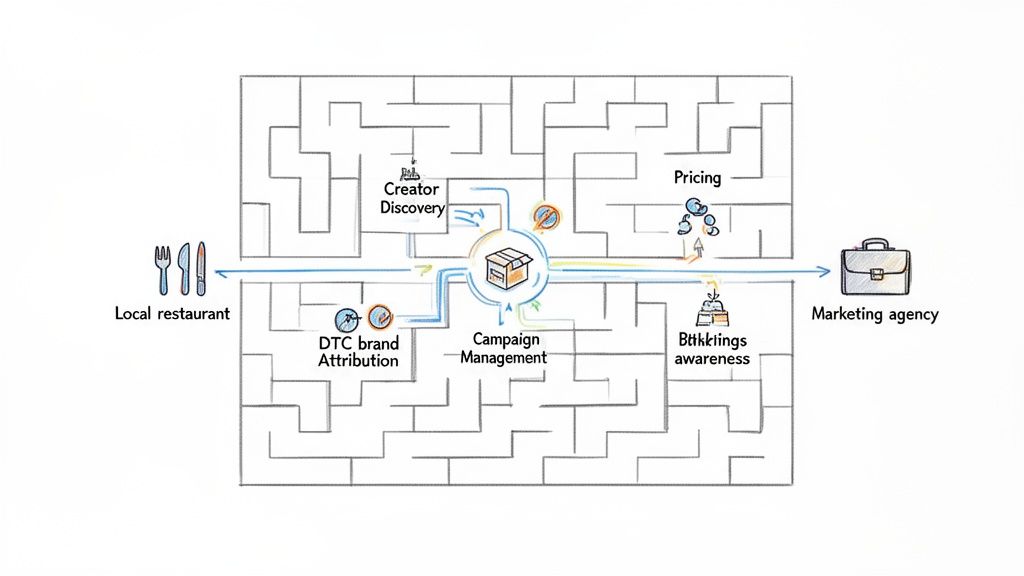
This whole process starts by getting brutally honest about what success looks like for your business. Are you trying to generate a specific number of user-generated content (UGC) assets for your social feeds? Is the goal to drive a concrete revenue figure through affiliate links? Or maybe it's as simple as increasing local bookings by 15%?
Once you have that clear goal, you can start mapping it to the features you genuinely need. Most of these will fall into a few key areas:
- Creator Discovery & Vetting: How will you actually find relevant, brand-safe creators who are in the right niche or city?
- Campaign Operations: How are you going to manage the nitty-gritty of outreach, negotiations, content approvals, and payments without it becoming a full-time job?
- Performance Tracking & Attribution: How will you measure your return on investment, track sales, and prove to your boss that the campaign worked?
Thinking this way shifts your mindset. You stop being a passive audience for a sales pitch and become an active evaluator searching for a true partner.
To give you a clearer picture, here's a quick way to connect your primary goal to the type of platform you should be looking at.
Matching Platform Focus to Your Business Goal
| Business Goal | Platform Type to Prioritise | Key Feature to Look For |
|---|---|---|
| Drive Direct Sales/Revenue | E-commerce & Affiliate Platforms | Robust tracking links, promo code generation, and real-time sales attribution dashboards. |
| Increase Brand Awareness | Creator Discovery & Marketplace Platforms | Large creator database with strong filters for audience demographics and engagement metrics. |
| Generate High-Quality UGC | Content & Campaign Management Platforms | Streamlined content approval workflows, asset libraries, and content usage rights management. |
| Boost Local Footfall | Hyperlocal or Niche Platforms | Advanced location-based search and filters for finding creators in specific postcodes or cities. |
This table is a starting point. It helps you focus your search on platforms that are built to solve your specific problem, saving you from getting distracted by tools designed for a completely different objective.
The UK's influencer marketing scene is set to hit over £1.2 billion by 2026, an incredible expansion that makes smart technology essential. With an estimated 150,000 active influencers in the country, finding the right ones is like searching for a needle in a haystack. Manually managing outreach through DMs can eat up a staggering 95% of your campaign time. This is precisely the problem that platforms built for automation (with features like ROI estimators and real-time tracking) are designed to solve. You can dig deeper into UK influencer marketing trends and regulations for more context.
Your goal isn't to find a platform that does everything. It's to find the platform that does what you need, exceptionally well.
This guide will now walk you through how to build a weighted decision matrix. It's a simple but powerful tool to compare your options objectively, making sure your final choice is backed by solid data, not just a slick presentation.
Defining Your Goals and Must-Have Features
Before you even think about booking a demo, we need to talk strategy. I’ve seen so many brands jump into platform trials without a clear plan, and it's a bit like going food shopping when you're starving. You end up with a trolley full of flashy features you'll never actually use.
Let’s get specific. Saying you want to ‘increase brand awareness’ is far too vague to be useful. What you really need are concrete, measurable outcomes. For instance, a DTC brand's real goal isn't just "awareness"; it's generating £10,000 in attributed revenue from influencer discount codes this quarter. Likewise, a restaurant chain isn't just after "buzz"; it's about sourcing 500 high-quality UGC assets from local foodies to fuel their social media for the next six months.
This process is all about goal-dependent platform selection; the right tool for one brand could be completely wrong for another, simply because their objectives are different.
Translate Goals into Core Feature Pillars
Once your KPIs are clearly defined, you can start mapping them to the specific platform features that will help you achieve them. Most platforms are built around three functional pillars. Your job is to figure out which one is your top priority.
- Creator Discovery and Vetting: Think of this as your sourcing engine. Does it allow you to find creators by specific postcodes? Can you filter by niche, engagement rate, or even the brand affinity of their audience? A local business will live or die by its hyper-local search capabilities, whereas a national e-commerce brand will care more about deep audience demographic data.
- Campaign Management and Operations: This is your efficiency engine. Does the platform automate outreach, manage contracts, and offer a smooth workflow for content approvals? If you're planning to work with more than five creators at once, you’ll quickly find that DMs and spreadsheets become an operational nightmare. This pillar is all about saving your team's time and sanity.
- Performance Attribution and Reporting: This is your ROI engine. Can the platform generate unique discount codes and tracking links on the fly? Does it provide real-time dashboards showing sales, clicks, and conversions? If you need to justify your marketing spend to a boss or client, this isn't just a nice-to-have; it's essential. Our guide on how to measure influencer marketing ROI goes into much more detail on this.
Don't Forget Integrations and Pricing Models
Beyond those three core pillars, a couple of practical details can make or break your experience with any platform.
First up are integrations. A tool that plugs directly into your existing tech stack (think Shopify for an e-commerce brand or your point-of-sale system for a restaurant) is worth its weight in gold. This kind of connection automates attribution, closing the loop between an influencer's post and an actual sale without any manual data entry.
A platform without the right integrations forces you back into manual tracking, defeating much of its purpose. Ensure it talks to the tools you already use daily.
Finally, you have to look closely at the pricing model. Is it a flat monthly subscription (SaaS)? Or is it a commission-based model where the platform takes a cut of your campaign spend? Some even use a hybrid approach. A predictable SaaS fee is brilliant for budgeting. A commission-based model might look cheaper to start, but it can quickly become expensive as you scale your influencer programme. Choose the model that aligns with your budget and growth plans.
Right, let's cut through the noise. Choosing an influencer marketing platform can feel overwhelming, but the biggest mistake I see is teams getting swayed by a slick demo instead of sticking to a plan. To avoid that, you need to move from a vague feature wishlist to a proper, structured evaluation.
This is where a weighted decision matrix comes in. It sounds a bit corporate, I know, but it’s really just a scorecard. It’s a simple tool to take the emotion and sales-pitch bias out of the equation, forcing you to compare platforms on what actually matters to your business.
The whole point is to make sure your final choice is backed by solid reasoning, not just a gut feeling.
This flowchart really nails the thought process you should be following.
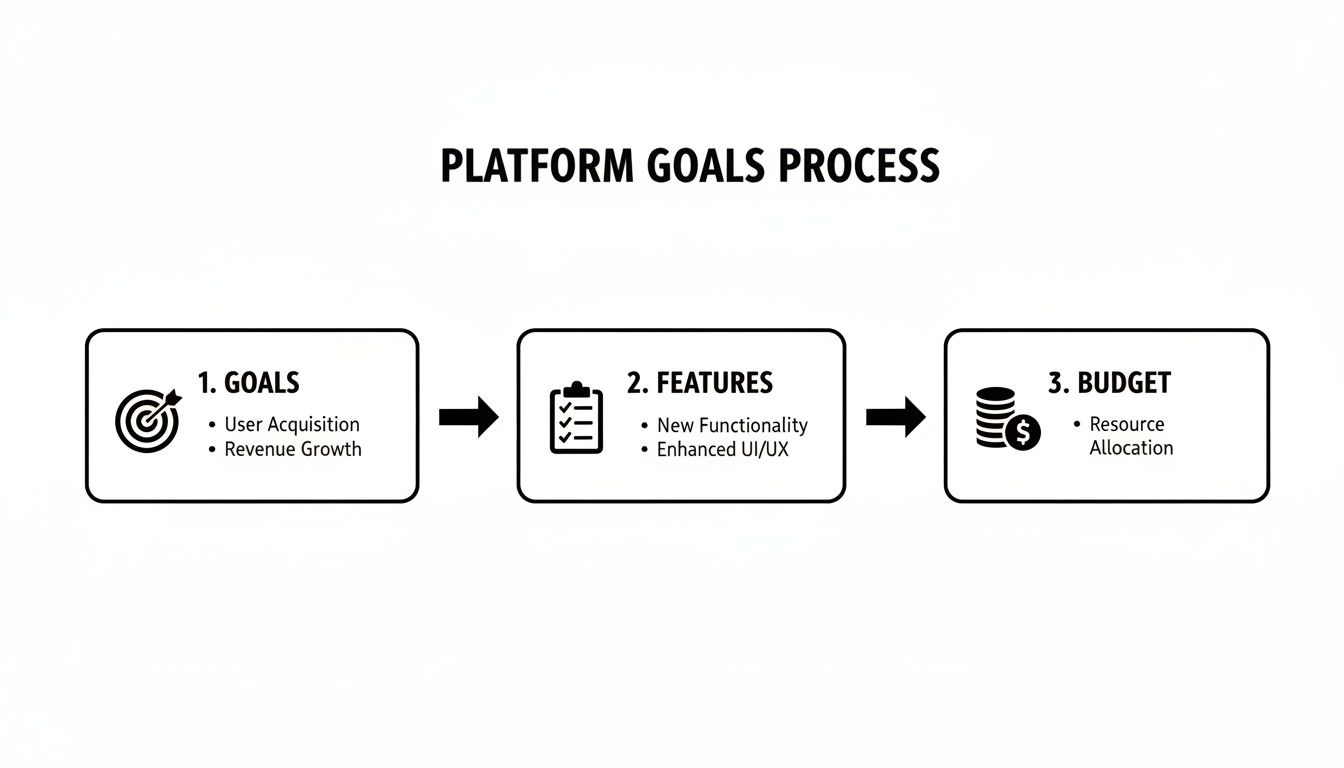
Starting with clear goals, defining the features you need to hit them, and then looking at your budget. That’s the logical sequence. Get it in the wrong order, and you're just shopping blind.
Assigning Importance Scores
First things first: you need to weigh your feature list. On a scale of 1 to 10 (where 10 is an absolute non-negotiable), how critical is each one? This is where your unique business goals turn a generic list into a personal blueprint.
Here’s what that looks like in the real world:
- A DTC brand focused on ROI? "Shopify Integration & Sales Attribution" is an easy 10/10. If you can't track sales, what's the point?
- A restaurant chain trying to get people through the door? "Hyper-Local Creator Sourcing" is a definite 10/10. You need influencers in specific postcodes, not just the same city.
- An agency juggling multiple accounts? "Multi-Client Dashboards" would get a solid 9/10 for pure operational sanity.
For every single feature, ask yourself this one question: "If a platform was missing this, would it be completely unusable for us?" If the answer is yes, that's a 10. Simple as that.
This weighting step is what makes the whole exercise worthwhile. It ensures you don't end up with a platform that excels at things you don't care about while failing at the one thing you desperately need. If you want more data to help shape your priorities, these influencer marketing statistics are a great starting point.
Scoring the Platforms and Making the Call
Once your weighted feature list is ready, you can start scoring the platforms you’re trialling. Use a simple scale, like 1 to 5 (1 being poor, 5 being excellent), for how well each one delivers on a specific feature.
Then, you just do the maths: multiply the importance weight by the platform's score. This gives you a weighted score for each feature. Add them all up, and the platform with the highest total is, logically, your best fit.
Here’s a quick example of what this might look like for a direct-to-consumer brand.
Sample Weighted Decision Matrix for a DTC Brand
| Feature | Weight (1-10) | Platform A Score (1-5) | Platform B Score (1-5) | Platform A Weighted Score | Platform B Weighted Score |
|---|---|---|---|---|---|
| Shopify Sales Attribution | 10 | 5 | 2 | 50 | 20 |
| Creator Discovery (Niche) | 8 | 4 | 5 | 32 | 40 |
| Automated Creator Payments | 7 | 3 | 4 | 21 | 28 |
| Campaign Reporting Suite | 9 | 4 | 3 | 36 | 27 |
| Content Approvals Workflow | 6 | 5 | 5 | 30 | 30 |
| Total Score | 169 | 145 |
In this scenario, Platform A wins. Even though Platform B was slightly better at discovery and payments, Platform A’s perfect score on sales attribution (the brand’s top priority) made it the clear choice.
This kind of methodical approach is becoming the standard. In the UK, 38% of brands are already using dedicated platforms. With a massive 81% of marketers planning to increase their budgets for 2026, the pressure to prove every pound is well spent is huge.
And given that 78% of consumers say they trust influencer recommendations, you can’t afford to guess at your impact. Prioritising platforms with built-in UTMs, unique promo codes, and real-time dashboards isn’t just a nice-to-have; it’s essential for survival.
Putting Theory Into Practice: Choosing a Platform for Your Business
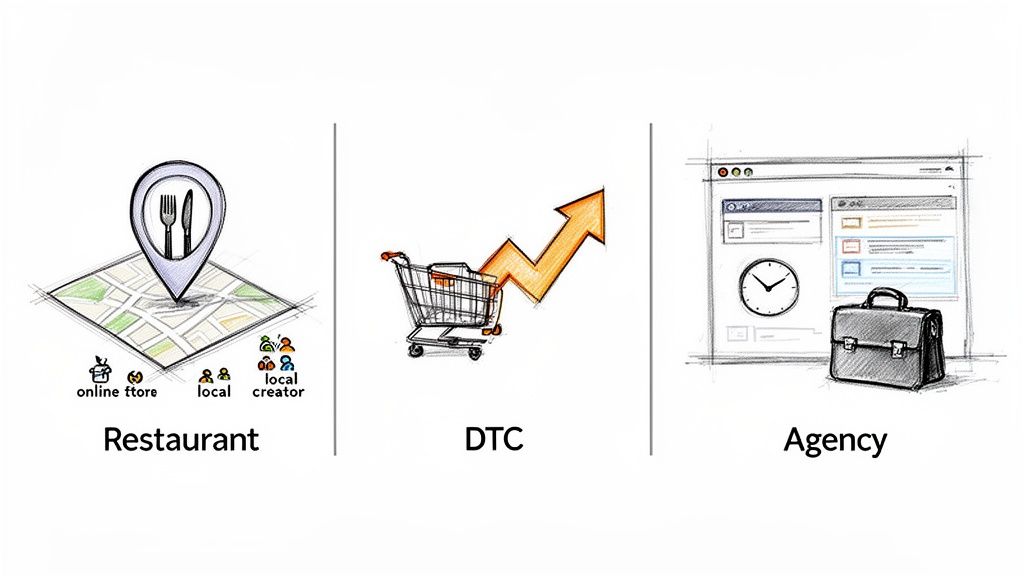
Scorecards and decision matrices are great on paper, but the real test is seeing how a platform actually performs for a business like yours. The "best" platform is never a one-size-fits-all solution; it’s entirely dependent on your business model and what you need to achieve.
Let’s walk through three common scenarios to see how your priorities shift. Getting hands-on is key here. As you weigh your options, take the time to explore different tools like Linkie to see how their features match up against your own list of must-haves. This is how abstract requirements become concrete, functional deal-breakers.
The Multi-Location Restaurant Chain
For any restaurant group, it all comes down to one thing: driving footfall. You need to get people booking tables and walking through the doors of your specific locations. Brand awareness is a nice bonus, but the real, measurable return on investment comes from local-level activation. Your scorecard needs to reflect this laser focus on geography.
Here’s what you should prioritise above all else:
- Hyper-Local Creator Sourcing: This isn't just a nice-to-have; it's your highest-weighted feature. You need a platform that can pinpoint creators not just in a city, but within a specific postcode or a few miles of each restaurant.
- Promo Code Redemption Tracking: Attributing a visit to an influencer campaign is crucial. The ability to issue unique codes and track their use at your point-of-sale system is non-negotiable.
- A Solid Content Library: You’ll be generating a mountain of user-generated content (UGC). You need a simple way to collect, organise, and repurpose all those beautiful food photos and videos for your own social media channels.
When you’re on a demo call, get straight to the point. Ask them: “Can you show me, right now, how I can find ten food bloggers who live within a five-mile radius of my Manchester restaurant and have an engagement rate over 3%?” If they hesitate or can’t demonstrate that exact workflow, it’s not the right tool for you.
For more on this, we’ve put together some specific advice on restaurant influencer marketing platforms.
The Fast-Growing DTC Brand
A direct-to-consumer brand lives and dies by its ability to track online sales and prove ROI. Your whole strategy revolves around turning clicks into customers. Because of this, your influencer platform has to act as a direct extension of your e-commerce engine.
Your key features will look quite different:
- Direct E-commerce Integrations: A seamless, out-of-the-box connection with Shopify, WooCommerce, or whatever you use is absolutely essential for real-time sales attribution.
- Automated Affiliate Links and Codes: The platform must be able to automatically generate unique tracking links and discount codes for every single creator you work with. Manually creating these is a time-sink you can't afford.
- Real-Time Sales Dashboards: You need to see which influencers are driving revenue at a glance, without waiting days for a manual report to be compiled.
Your most important question for vendors is this: “Show me exactly how your platform attributes a sale from a TikTok video to my Shopify store in real-time.” Don't settle for vague answers about ‘reporting capabilities’. Make them show you the mechanism from click to conversion.
The Busy Marketing Agency
For an agency, efficiency is the name of the game. You're juggling multiple clients, each with their own campaigns, goals, and reporting needs. You need a platform that saves you time, simplifies your team's workflow, and produces clear, client-ready reports.
Your must-have features are all about scale and management:
- Multi-Client Dashboards: The ability to manage and view all your client accounts from a single login is a lifesaver. Constantly logging in and out is a massive productivity killer.
- White-Labelling Options: Can you brand the reports, creator portals, and communications with your agency’s logo? This creates a much more professional and seamless experience for your clients.
- Streamlined Campaign Workflows: Look for tools that allow for bulk creator outreach, automated follow-ups, and templated contracts. These are the features that let you scale your services profitably.
For agencies, the most critical question is often about workflow automation. Ask vendors: "How does your platform reduce the manual time my team spends on creator outreach and follow-ups for a 50-influencer campaign?" The answer will tell you everything you need to know about its true value.
It's also worth noting how the UK market is shifting. Micro and nano-influencers are a huge focus, with 93% of marketers now partnering with micros and 60% with nanos because of their superior engagement. For busy DTC brands and agencies, this means that with the right platform and automated scripts, campaigns can be launched in as little as 20 minutes. By letting the software handle the outreach and scheduling, teams are saving up to 95% of their time, a complete game-changer for scaling up your collaborations.
Key Questions to Ask Before You Sign
You’ve done the hard yards, weighed your options, and now you have a couple of front-runners. This is where the real test begins. It's time to get past the slick sales pitch and ask the pointed questions that reveal how a platform really works day-to-day. The demo isn't just a presentation; it's your chance to pressure-test their promises.
Never let the salesperson run the show with their standard script. You need to take control. I always go into these calls with a prepared list of questions based on real-world scenarios. The goal here is simple: find any red flags or hidden costs before you've signed a contract.
Kicking the Tyres on the Tech
A beautiful user interface means nothing if the engine underneath can't do what you need it to. You've got to confirm that the features work in practice, not just in a sanitised demo. Make them show you, live on the call.
Start with the features you weighted most heavily in your decision matrix. If attribution is your number one priority, don't settle for a simple "yes, we track sales." Dig deeper.
- On Attribution: “Can you walk me through, right now, how your platform tracks a sale from an Instagram Story all the way to our Shopify checkout? I want to see you create the link, where it appears on the dashboard, and how quickly that data updates.”
- On Creator Discovery: “Let’s get specific. We're a restaurant in Bristol. Show me how I can find 20 food influencers who have more than 5,000 followers, an engagement rate over 4%, have posted about vegan food in the last 90 days, and are based within the BS1 postcode.”
- On Campaign Workflow: “Imagine I’m launching a campaign with 30 micro-influencers. Walk me through the exact process for sending out a bulk message, generating contracts, and approving content. Show me what's automated and what I'd have to do manually.”
Asking such direct, demanding questions leaves no room for vague answers. If a vendor gets flustered or says, "that's on our future roadmap," you know it can't solve your problem today.
A vendor’s hesitation to show you a specific workflow live on a demo call is a massive red flag. It often means the feature isn't as robust as they claim, or worse, it's a nightmare to actually use.
Getting Clarity on Support and Contracts
A great platform is more than just software; you're buying into a partnership. The level of support you get and the small print in the contract are just as crucial as the features. I’ve seen great tools become unusable because of poor support and unexpected fees.
Before you even think about signing, you need total clarity on the human and financial side of the arrangement.
Questions About Support & Onboarding:
- What does the full onboarding process look like, and how long does it realistically take?
- Will we get a dedicated account manager, or are we just another ticket in a general support queue?
- What are your guaranteed response times for support queries? Is that different for "urgent" issues?
Questions About Pricing & Contracts:
- Talk me through all the potential extra costs. Are there fees for adding users, tracking more creators, or running more campaigns than our plan includes?
- What are the exact terms for cancelling the contract? Are there break clauses or financial penalties?
- Does the price go up if we have a successful month and collaborate with more creators than planned?
One last thing I always ask is to see their product roadmap. A company that’s actively investing in and improving its platform is a far better long-term partner than one that's standing still. Ask what they're releasing in the next six to twelve months. You want to make sure their vision for the future aligns with where you want to take your brand.
Common Questions About Influencer Platforms
Alright, so you’ve done your homework, narrowed down your shortlist, and you're close to a decision. But a couple of nagging questions might still be floating around. That’s completely normal. Let's tackle some of the most common ones I hear from brands so you can feel confident in your final choice.
Marketplace Versus Management Platform
So, what's the real difference between a marketplace and a full-on management platform? It's a crucial distinction.
Think of an influencer marketplace as a digital address book. It’s a database where you can search for creators, but once you find them, you're pretty much on your own. All the outreach, negotiation, campaign logistics, and payments still have to be handled manually.
A management platform, on the other hand, is your mission control. It's an end-to-end solution designed to automate the entire workflow. Beyond just finding creators, it handles communications, tracks affiliate links and discount codes, processes payments, and even collects all your approved content in one place. It’s the difference between being given a list of names and being handed the keys to a fully equipped campaign headquarters.
How Much Should You Expect to Pay
Pricing is all over the map, which can be confusing. Most platforms fall into one of two buckets.
- Monthly SaaS (Software as a Service) fee: This is a flat subscription that can range from a few hundred to several thousand pounds, depending on the features you need.
- Commission model: Others take a percentage of your total spend on influencers for each campaign you run through them.
The right model really depends on your budget and campaign frequency.
For brands running continuous, always-on influencer programmes, a flat SaaS fee often provides better long-term value. A commission-based model can end up penalising you for scaling up your spend, becoming more expensive as your campaigns grow more successful.
Can You Use a Platform for Nano-Influencers
Yes, and honestly, this is where a platform truly earns its keep. If you’ve ever tried to manually manage even 10 to 15 collaborations with nano-influencers, you know the pain. It quickly spirals into a mess of DMs, follow-up emails, and chaotic spreadsheets.
This is exactly the problem a good platform solves. It brings order to the chaos by automating the entire workflow, which is the only way to scale up local or niche collaborations without hiring a full-time coordinator. Many platforms that focus on nano and micro-influencers now have pricing tiers built for smaller businesses, so you don’t have to pay an enterprise-level fee to get the organisational power you desperately need.
Ready to turn influencer marketing into a repeatable, ROI-proven growth channel? Sup combines AI with a human team to launch and manage campaigns that drive real results. Launch in minutes and save 95% of your time. Get started with Sup today.
More on tools
See how many creators post about you and your competitors
Type in your brand's Instagram handle and we count the creators who post about you and about your five closest competitors. It takes about a minute and it is free. Or request a demo and we will show you the creators in your niche and walk you through the dashboard.
 Book a call