31 May 2026
Choosing Your Hospitality Marketing Agency: 2026 Guide
You already know how to run service. That's rarely the problem.
The problem is that modern hospitality businesses have to win twice. First, on the floor: good food, clean rooms, smooth check-in, fast table turns, staff who handle pressure well. Second, online: search visibility, review response, direct booking conversion, CRM follow-up, creator content, and a website that doesn't leak demand.
If creator campaigns are the part you want to hand off, that is what Sup does for restaurants and bars and for hotels. We find the creators, agree the fees and track every post, and you approve each step.
A new hotel GM or restaurant operator often walks into a familiar situation. The venue is decent. Guests are happy enough. Weekends may even look strong. But midweek occupancy drifts, private dining enquiries come through three different inboxes, social posts feel random, and paid media reports show clicks without telling you whether any of them became covers or room nights.
That's where a hospitality marketing agency can help. But it's also where plenty of operators make expensive mistakes. Some hire a generic agency that knows ads but not guest behaviour. Others try to build everything in-house too early. Others buy software and assume the platform itself will create strategy.
The right answer depends on your margins, your pace of growth, your internal team, and how much control you need over the guest journey.
Your Restaurant Is Full But Is Your Marketing?
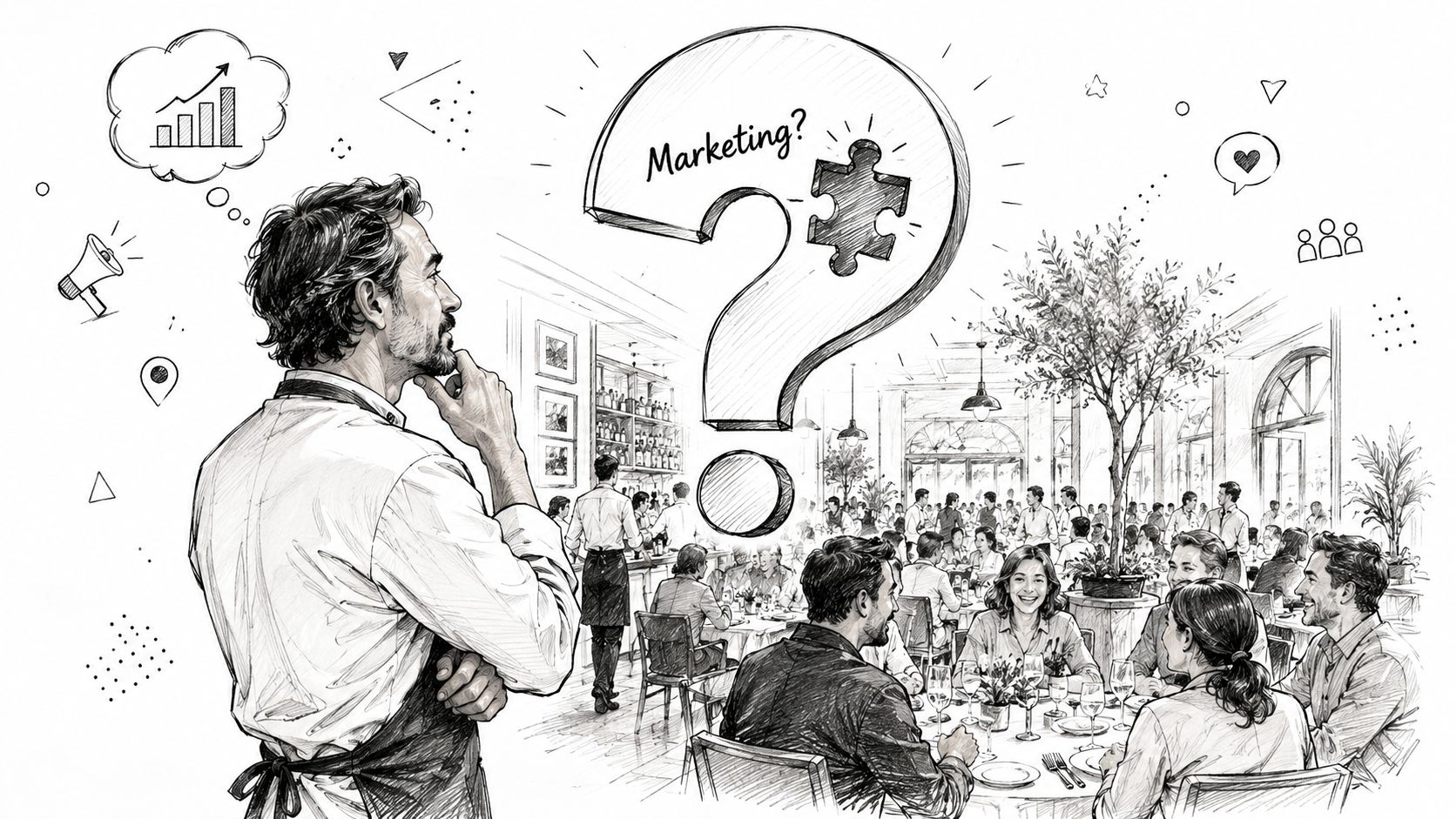
A lot of hospitality businesses look healthy from the dining room and fragile from the dashboard.
Friday night is busy. Sunday lunch is solid. The team knows regulars by name. Then Monday arrives and the phone slows down, paid bookings flatten, and nobody can say with confidence whether last month's marketing spend drove profitable demand or just more noise. If you're running a hotel, the pattern is similar. Strong dates mask weak ones, and occupancy can hide a poor channel mix.
Good operations don't automatically create demand
Operators usually underestimate how specialised marketing has become. Filling a room or a table now involves local search, review platforms, mobile-first booking journeys, retention messaging, and content that works across both discovery and conversion.
That matters because the UK hospitality market is large enough that small gains aren't trivial. The sector was estimated to contribute about £93 billion to the UK economy in 2024 and supported roughly 3.5 million jobs, according to hospitality market figures cited here. In a market of that scale, minor improvements in conversion, occupancy, and repeat visits can move real revenue.
A practical example: many restaurants don't lose demand because the food is weak. They lose it because demand slips through operational cracks. Missed calls are one of them, and the TastyVox blog on restaurant missed calls is worth reading because it connects a basic front-of-house issue to lost bookings.
Practical rule: If guests want to book, call, message, browse menus, and check reviews before they commit, marketing and operations can't be treated as separate systems.
What a serious partner changes
A strong agency doesn't just make your brand look nicer. It tightens the full path from discovery to booking. That can include fixing weak landing pages, aligning campaigns to low-demand periods, improving response flows, and making sure your reporting reflects actual covers or room nights rather than vanity metrics.
If you need a broader list of tactical channel ideas before deciding whether to hire outside help, these restaurant marketing ideas that actually drive covers in 2026 give a useful picture of the work involved.
For many operators, the first useful shift is mental. Stop thinking of marketing as the poster outside the building. Think of it as a revenue system with inputs, bottlenecks, and measurable output.
What Exactly Is a Hospitality Marketing Agency?
A hospitality marketing agency is not just a general digital agency with a hotel tab added to its website.
The key difference is operational context. A generic agency may understand paid search, email flows, or social production. A genuine hospitality specialist understands those tools in environments shaped by seasonality, local intent, perishability of inventory, review sensitivity, and booking windows that change by segment.
Hospitality knowledge changes the strategy
A restaurant campaign often hinges on local discovery and immediacy. “Near me” search intent, map visibility, review recency, menu relevance, and booking friction matter more than broad brand awareness by itself.
Hotels add another layer. You're not only selling rooms. You're managing channel mix, direct bookings, midweek compression, event periods, and guest segments with different stay patterns. That affects every decision, from creative to landing pages to remarketing cadence.
The digital side of travel demand makes this specialisation hard to fake. In 2024, the UK welcomed about 42.6 million inbound visits, and digital visibility and reviews are closely tied to how that demand gets captured, as noted in these UK travel and hotel marketing statistics.
What they should understand without being taught
A proper hospitality marketing agency should already know how to think about:
- Local intent. Restaurant demand often comes from people ready to decide now.
- Guest journey timing. A wedding venue, boutique hotel, and neighbourhood bistro don't share the same booking cycle.
- Revenue pressure. Empty inventory today can't be sold tomorrow.
- Reputation effects. Reviews influence both trust and conversion, not just brand image.
- Offer design. A campaign with the wrong package, wrong daypart, or wrong audience wastes budget even if the creative looks good.
A lot of businesses are moving away from the old agency model of siloed services and soft reporting. This piece on the death of the traditional marketing agency and what's replacing it captures why buyers now expect more accountability and integration.
The agency should speak in commercial terms. Not just reach, but room nights, covers, enquiries, repeat guests, and direct revenue.
If an agency can't connect its activity to the way a hospitality business makes money in practice, it may still produce nice work. It just won't help you manage the business.
Core Services a Hospitality Agency Provides
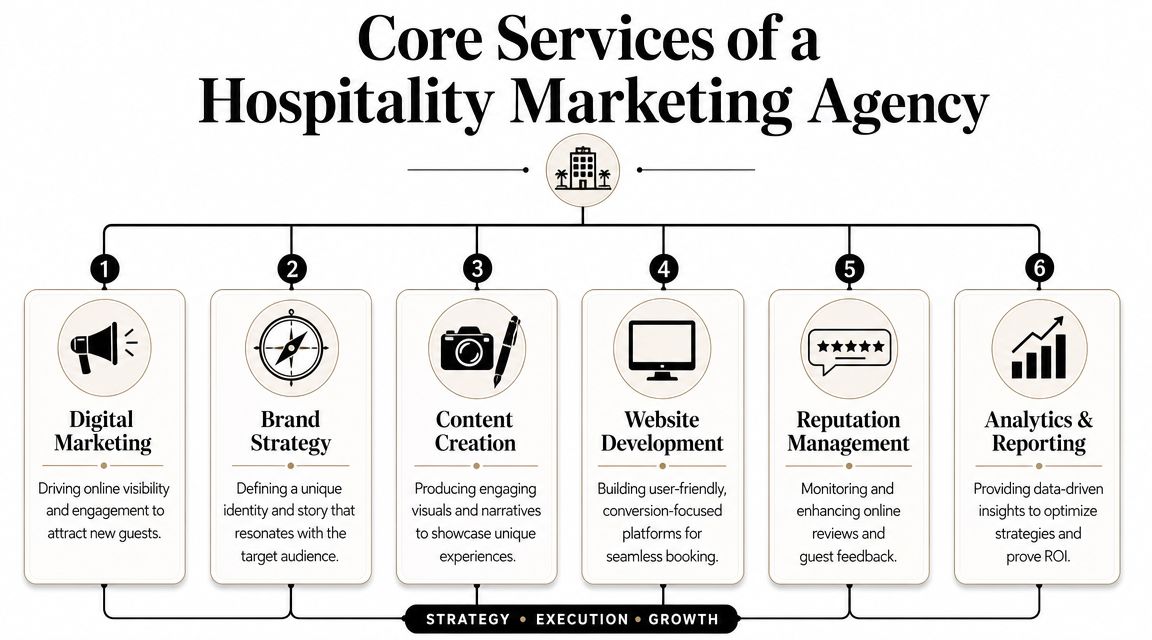
The service list matters less than the way the parts work together.
Weak agencies sell disconnected tasks. One team runs paid media. Another posts on Instagram. Someone else sends an occasional email campaign. The hotel or restaurant ends up with activity everywhere and a coherent strategy nowhere.
Demand capture services
These are the channels that help guests find you when intent already exists.
- Local SEO and search visibility For restaurants, this usually means map presence, branded and non-branded search, menu indexing, and location pages that match how people search. For hotels, it includes direct-booking pages, venue pages, and content aligned to destination and occasion intent.
- Paid search and paid social Useful when the offer is clear and the landing page converts. Wasteful when ads are used to compensate for weak positioning or a clumsy booking path.
- Website and conversion work A hospitality site should remove friction. Menus must be current. booking buttons should be obvious. Room pages should answer the questions guests ask before they leave for an OTA or competitor.
Demand creation services
At this stage, agencies shape preference before the guest is ready to book.
Brand and content
Positioning matters more than many operators think. If your property looks interchangeable, your campaigns will force discounting. Strong agencies sharpen what makes the venue distinct, then translate that into photography, video, copy, and campaign messaging.
Social content also has a different job in hospitality than in other sectors. It doesn't just entertain. It helps people imagine themselves there.
Creator and UGC campaigns
For venues with visual appeal or local buzz potential, creator partnerships can generate social proof and reusable assets. The important part isn't chasing follower counts. It's matching the right local or niche creators to the right audience, then tracking what that content drives.
One option in this category is Sup, which combines creator sourcing, campaign management, tracking links, promo codes, and a content library in one workflow. That's useful when a restaurant group or hotel team wants creator campaigns with clearer attribution and less manual admin.
Retention and revenue support
The best agencies don't stop at acquisition.
- Email and CRM help you bring guests back, reactivate lapsed demand, and segment by behaviour.
- Review and reputation management protects conversion at the point guests compare options.
- Offer planning aligns campaigns to low-demand periods, events, and guest segments instead of pushing the same message all year.
The integration layer most operators miss
A top-tier hospitality agency acts as a data-integration layer, combining website analytics, reservation history, and social signals so campaigns can target the most valuable guest segments more precisely, as explained in this hospitality marketing analysis.
That's the difference between generic promotion and useful marketing. The agency isn't just publishing content. It's using signals from your actual business to decide who should see what, when, and why.
Measuring Success and What KPIs Actually Matter
Most agency reports are too easy to admire and too hard to use.
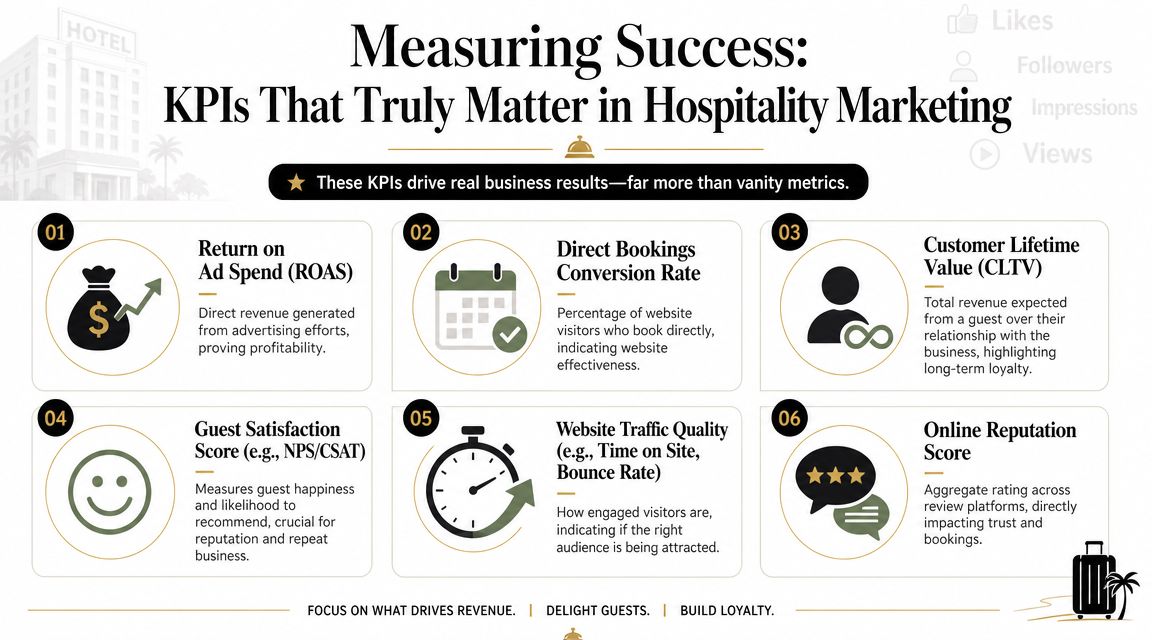
They show impressions, clicks, reach, follower growth, video views, and engagement charts. Those numbers can have value, but they don't answer the question a GM has: did this activity produce profitable demand?
Outcome metrics come first
For UK hospitality, the benchmark is outcome-tier attribution. That means tracking direct booking percentage, revenue per campaign, and review sentiment, not just clicks and impressions, as outlined in this guide to hotel marketing KPIs.
If your agency can't report at that level, you're buying activity rather than accountability.
Here's a useful explainer on restaurant key performance indicators if you want a sharper operational lens before reviewing marketing reports.
A quick video version helps if your team needs a shared baseline:
What to ask for in a report
A useful agency report should show cause and effect, not just channel activity.
| KPI area | What it should tell you |
|---|---|
| Direct bookings or direct reservations | Whether marketing is shifting demand into your owned channels |
| Revenue by campaign | Which offer, audience, or creative actually produced money |
| Review sentiment | Whether guest perception is supporting or hurting conversion |
| Lead quality | Whether event or group enquiries are relevant and bookable |
| Channel mix | Whether spend is building resilience or over-relying on one source |
Vanity metrics still have a place, but not the top line
Engagement can indicate that creative is resonating. Traffic quality can show whether targeting is improving. Social saves or shares can reveal intent.
But those should sit lower in the hierarchy.
Operator test: If a metric improves and you still can't explain what happened to bookings, revenue, or guest quality, it's not a primary KPI.
The cleanest reporting systems usually connect campaign data with booking engine, CRM, reservation, and reputation signals. Without that, optimisation becomes guesswork. With it, you can cut channels that are noisy, protect the ones that convert, and identify where operational issues are undermining good demand generation.
Understanding Agency Pricing Models and Costs
Pricing is where many hospitality operators get vague answers and vague scope. That usually ends badly.
A hospitality marketing agency will normally charge in one of three ways, and each model suits a different kind of business problem.
Monthly retainers
This is the most common structure. You pay a fixed monthly fee for an agreed scope, usually covering some mix of strategy, channel management, reporting, creative, and meetings.
A retainer works when you need ongoing support and steady optimisation. It's less useful if you only want one defined output, such as a website rebuild or a launch campaign.
Project fees
Project pricing fits a contained job. Rebrand. Website relaunch. Photography rollout. Pre-opening campaign. CRM setup.
This model is easier to budget for, but it often stops short of ongoing performance management. A hotel may end up with a better website and the same weak demand generation six weeks later.
Performance-based structures
These sound attractive because they suggest shared risk. In practice, they're harder to structure well in hospitality because attribution is messy when bookings can come through multiple channels and guest journeys are not linear.
Some agencies will mix a base fee with performance incentives. That can work if the attribution rules are clear and both sides agree what counts as a win.
Costs aren't just fees
The invoice is only one part of the cost. Also consider:
- Management time. Someone on your side still needs to approve offers, review reporting, and feed the agency commercial context.
- Asset production. New photography, video, landing pages, and brand work may sit outside monthly scope.
- Tooling. CRM, booking tech, call handling, analytics, and creator tools can carry separate costs.
- Delay risk. Cheap agencies often create hidden costs through slow execution and weak prioritisation.
The cheapest proposal is often the most expensive if you still need to explain the business to the agency every week.
When reviewing pricing, ask what is included, what is excluded, who does the work, and what the agency needs from your team to make the engagement effective.
How to Choose the Right Agency for Your Business
You don't choose a hospitality marketing agency by asking who has the best-looking proposal. You choose by asking who can improve commercial performance without creating extra management drag.
That matters even more under margin pressure. The ONS reported consumer price inflation for restaurants and hotels at 5.9% in March 2026, which makes revenue accountability and margin protection central when evaluating agencies, as discussed in this overview of hospitality marketing agencies and ROI pressure.
The questions that expose substance
Ask these in the first meeting, not after the contract arrives.
- What kind of hospitality businesses do you serve? A city hotel, a destination spa, a pub group, and a fine dining restaurant need different channel strategy. Sector familiarity should be specific.
- How do you measure commercial impact? If the answer leans on awareness metrics without tying them to bookings, enquiries, direct revenue, or repeat visits, keep looking.
- What data will you need from us? Good agencies ask for booking data, CRM access, offer calendars, review context, and operational constraints. Weak ones ask mainly for logos and passwords.
- Who will run the account day to day? Senior people often sell. Junior people often deliver. That's not always bad, but you need clarity.
- What won't you own? This question is underrated. The best agencies define boundaries well. They'll tell you where internal ops, revenue management, or front-of-house execution must support the plan.
What strong answers usually sound like
Strong agencies are precise. They'll talk about segmentation, booking friction, low-demand periods, review trends, campaign attribution, and creative testing in commercial language.
Weak agencies often default to broad promises about visibility, storytelling, and brand growth without pinning those ideas to a revenue model.
If you want another viewpoint on selecting a digital marketing partner for hotels, that checklist is useful because it pushes beyond credentials and into fit.
Red flags worth taking seriously
| Red flag | Why it matters |
|---|---|
| They can't explain reporting simply | Confusion often hides weak attribution |
| They offer every service to every venue | Lack of focus usually means lack of depth |
| They don't ask about margins or channel mix | They're not thinking commercially |
| They promise speed without needing data | They're guessing |
| They rely on generic hospitality examples | They may have little direct experience |
Hire the agency that asks the hardest questions about your business, not the one that flatters your brand most convincingly.
The right partner should make decision-making clearer. If the process feels opaque before the contract is signed, it usually gets worse after.
Considering Alternatives In-House vs Agency vs Platforms
An agency is not automatically the right answer.
Some businesses need an internal marketer with direct access to operations. Others need specialist help for a narrow channel. Others need a platform that gives structure, tools, and attribution without the cost or complexity of a full-service relationship.
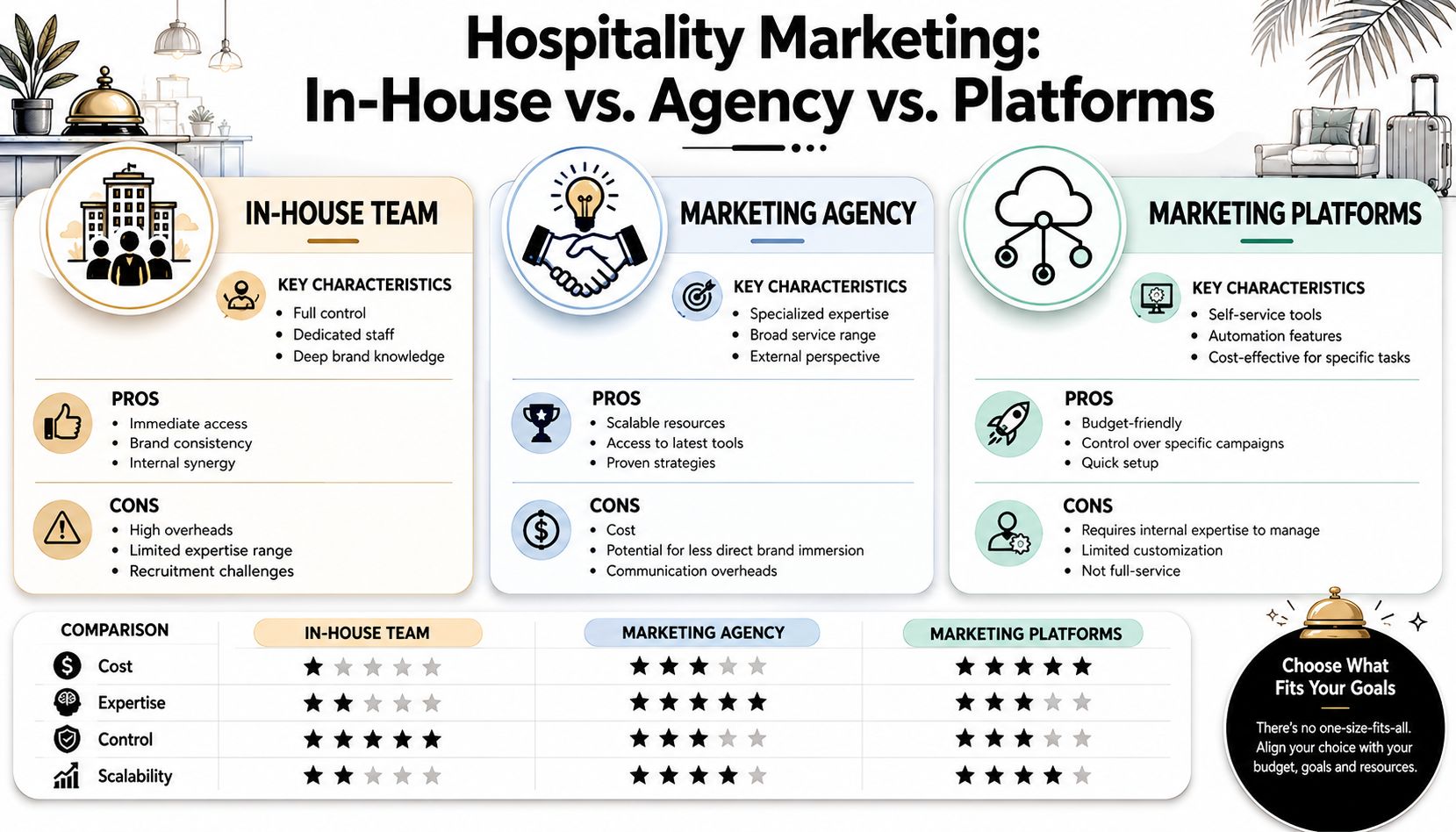
Marketing models compared
| Criteria | In-House Team | Agency | Platform (e.g., Sup) |
|---|---|---|---|
| Control | High | Shared | High on selected workflows |
| Hospitality expertise | Depends on hires | Usually broader if specialist | Narrower, task-specific |
| Speed to launch | Slower if recruiting | Faster once onboarded | Often fast for defined use cases |
| Scalability | Limited by team size | Easier to scale across channels | Scales well within platform scope |
| Cost structure | Salaries and overhead | Retainer or project fee | Software or managed-platform spend |
| Best fit | Ongoing brand ownership | Multi-channel execution and strategy | Specific, measurable campaign types |
When each model makes sense
- In-house works when you need close coordination with operations, frequent on-site content, and full brand control. The trade-off is narrower skill coverage.
- Agency works when you need strategy plus execution across several channels and don't want to build a full team.
- Platform works when one part of the system needs standardising, automating, or attributing better than your internal process currently allows.
If creator campaigns are the sticking point, the internal workload is often bigger than expected. This look at the real cost of running influencer campaigns in-house is useful because it breaks down where teams usually lose time.
The best setup is sometimes hybrid. Internal ownership for brand and operations. External agency support for strategy and paid media. Platform support for one measurable growth channel.
If you want a more structured way to run creator-led hospitality campaigns without stitching together spreadsheets, DMs, codes, and manual reporting, Sup is one option to evaluate. It combines software with a managed workflow for sourcing creators, launching campaigns, and attributing results back to clicks, bookings, and revenue.
More on tools
See how many creators post about you and your competitors
Type in your brand's Instagram handle and we count the creators who post about you and about your five closest competitors. It takes about a minute and it is free. Or request a demo and we will show you the creators in your niche and walk you through the dashboard.
 Book a call