3 June 2026
Cost Per Action CPA: A Practical Guide for 2026
You're looking at the monthly numbers. Spend is up. Clicks look healthy. Reach looks even better. The dashboard says people engaged. But when someone asks the obvious question, “What did we get from that budget?”, the answer gets fuzzy fast.
That's where many organizations get stuck. They've got platform metrics, channel reports, creator posts, maybe some promo code redemptions, and a few bookings or orders in Shopify, Squarespace, or a POS system. What they don't have is a clean way to connect spend to a business outcome that matters.
Cost per action, or CPA, fixes that problem. It forces marketing to answer a simple operational question: how much did we pay to get a result we care about?
For an ecommerce brand, that action might be a purchase, an email signup, or a product trial. For a restaurant, it might be a booking request, a voucher redemption, a call, or a review generated after a local promotion. Once you define the action properly, CPA stops being jargon and starts being a budget control tool.
If you're also trying to make sense of creator campaigns, paid social, and blended reporting, it helps to understand $how influencer marketing ROI is measured in practice/$. A lot of confusion around CPA comes from using good-looking engagement metrics as a substitute for commercial outcomes.
Moving Beyond Hope in Your Marketing Spend
A familiar pattern shows up in both ecommerce and local marketing teams.
An online store launches Meta ads, gets traffic, sees some add-to-baskets, and still can't tell whether the campaign is profitable enough to scale. A restaurant runs an Instagram push with local creators, gets comments and saves, and then spends the next week guessing whether those posts drove bookings or just attention.
The problem isn't that the campaigns did nothing. The problem is that the team measured too much activity and not enough outcome.
What the dashboard usually hides
Most ad platforms are built to show movement. Impressions, clicks, views, video completion, engagement rate. Those metrics matter, but only as supporting signals. They don't tell you whether the campaign produced something the business can bank.
CPA gives you a harder standard. It asks whether your spend produced a completed action that maps to revenue, pipeline, footfall, or repeat demand.
For a new team member, this is the mindset shift that matters most:
- Traffic is not the win. Traffic only matters if the right people arrive and convert.
- Cheap clicks can still be expensive. Low-cost traffic often turns into wasted budget when intent is weak.
- A “good” campaign needs a business result. If nobody bought, booked, registered, or signed up, the campaign didn't finish the job.
Practical rule: If a campaign report leads with impressions and not actions, ask one more question before approving more spend.
Why teams rely on CPA
CPA is useful because it works across very different businesses.
An ecommerce manager can use it to compare a paid search campaign against creator content. A hospitality marketer can use it to compare table-booking offers against event promotion. An agency can use it to explain performance to a client without hiding behind soft metrics.
It doesn't remove all the mess. Attribution is still messy. Customer journeys are still messy. Privacy changes made tracking harder. But CPA at least gives you a disciplined starting point for deciding what to keep, what to cut, and where to investigate.
What Exactly Is Cost Per Action (CPA)
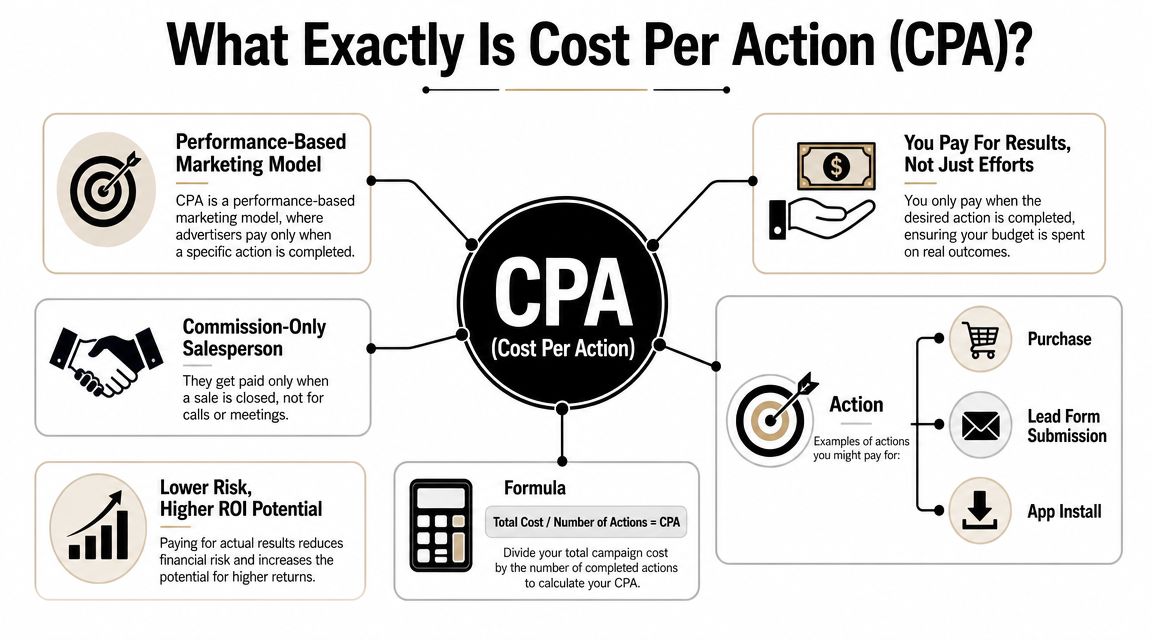
Cost per action means you're measuring what it cost to generate a defined action. The action can be whatever your campaign is built to produce, as long as it's specific and measurable.
The easiest way to think about it is a commission-only salesperson. You don't pay them for making calls. You pay them when they produce the outcome you hired them for. CPA works the same way. It focuses on the result, not the activity around it.
The practical definition marketers actually use
In UK digital advertising, CPA is defined as spend divided by the number of completed actions, and Google Ads notes that the action can be a purchase, registration, or signup. That's why CPA is a conversion-focused metric rather than a click metric. Google also gives a simple budgeting example: if a campaign spends £1,000 and generates 250 sign-ups, the CPA is £4 per action. See $Google Ads on target CPA and how the metric works/$.
That definition matters because it keeps the metric tied to an outcome the business chose in advance.
What counts as an action
The word “action” is flexible. That's useful, but it also causes confusion if teams get sloppy.
For ecommerce, actions often include:
- Purchase completed: The cleanest option when you can track checkout completion reliably.
- Email signup: Useful if the campaign's job is list growth before a launch or promotion.
- Trial or sample request: Common when the first conversion happens before the sale.
For local businesses, actions can look different:
- Table booking: Strong if bookings are confirmed and tracked.
- Call generated: Better for service-led businesses where calls turn into appointments.
- Voucher redemption: Helpful when you need a direct bridge from promotion to in-store response.
A broader acquisition lens can also help when you're separating marketing efficiency from wider customer economics. This $HiveHQ guide on acquisition costs/$ is useful for understanding where CPA sits alongside adjacent metrics.
You're not measuring how busy the campaign looked. You're measuring what it got done.
Why this framing matters
When teams define CPA properly, decisions get cleaner. You can compare campaigns based on what they delivered, not on which platform tells the best story. You can also spot mismatches fast, like a campaign that drove a lot of low-intent traffic or a creator post that got attention but no bookings.
That's why cost per action CPA is one of the most practical metrics in performance marketing. It makes spend answer to outcomes.
CPA Compared to Other Key Marketing Metrics
A lot of reporting problems come from using the wrong metric for the job.
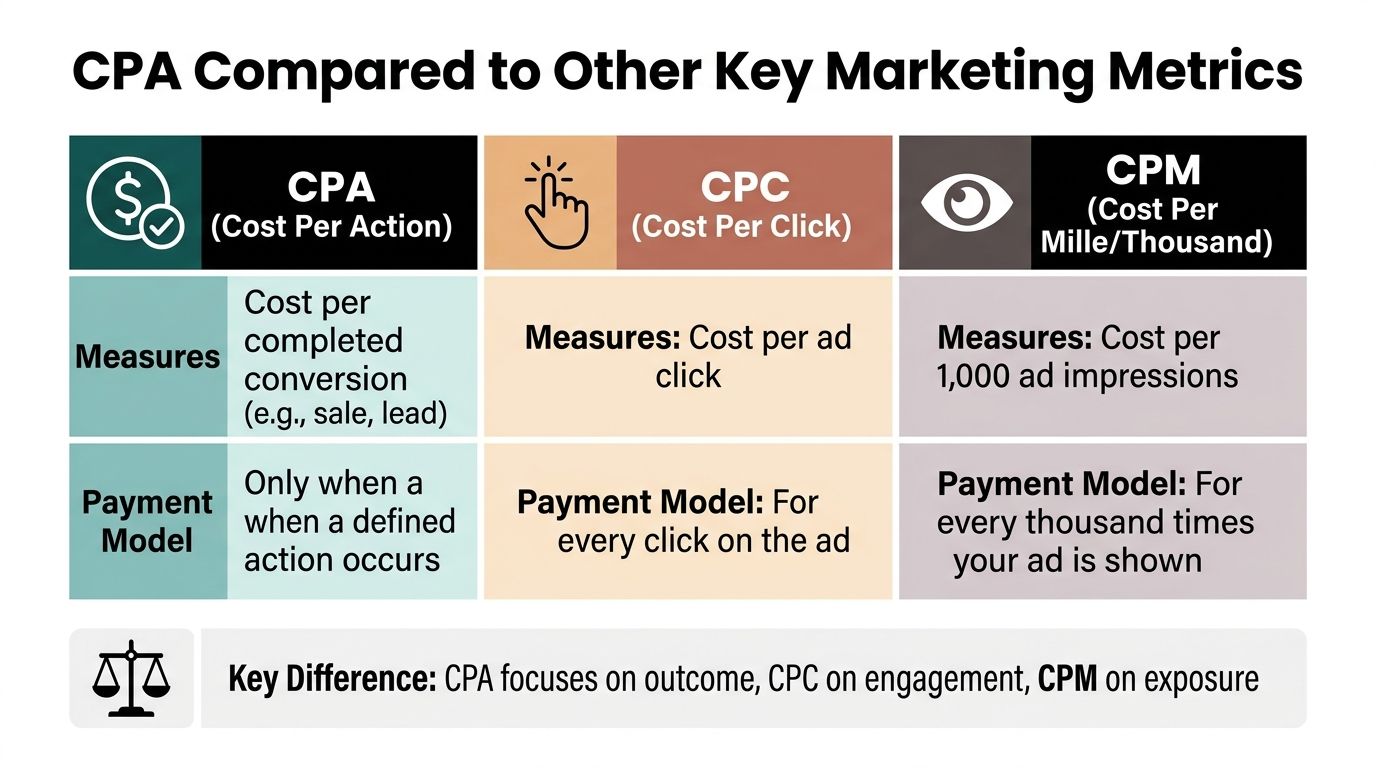
If the campaign goal is awareness, CPM can be fine. If the goal is traffic, CPC is useful. If the goal is a business action, those metrics help with diagnosis, but they shouldn't be your finish line.
The quick comparison
| Metric | What it measures | Best used when | Main limitation |
|---|---|---|---|
| CPM | Cost per thousand impressions | Brand awareness, reach campaigns, launch visibility | Tells you nothing about intent or conversion |
| CPC | Cost per click | Traffic generation, testing offers, landing page demand | Clicks can be cheap and still low quality |
| CPL | Cost per lead | Lead generation where a form fill is the handoff | Not every lead becomes revenue |
| CPS | Cost per sale | Direct-response selling where purchase is the only goal | Too narrow if earlier actions also matter |
| CPA | Cost per defined action | Performance campaigns tied to a measurable outcome | Only useful if the chosen action is genuinely valuable |
Where marketers usually go wrong
Teams often compare CPC and CPA as if they're interchangeable. They aren't.
A paid social campaign can have a low CPC because the creative gets curiosity clicks. That doesn't mean it's efficient. If those visitors bounce, abandon basket, or never book, the click cost was a distraction. The same issue shows up with CPM. A local venue might reach a lot of people in a postcode radius and still fail to drive enough reservations to justify the spend.
Here's the practical distinction:
- Use CPM when you need exposure.
- Use CPC when you need visits.
- Use CPL, CPS, or CPA when you need accountable outcomes.
A short visual explainer can help if you're training juniors or clients on the difference:
Why CPA tends to win the internal debate
CPA is usually the metric that survives scrutiny because finance teams, founders, and operators can work with it. A restaurant owner may not care about click-through rate, but they care what it cost to generate a booking. An ecommerce founder may appreciate lower CPMs, but they'll still ask what it cost to acquire an order or email subscriber.
That's why CPA often becomes the operating metric, even when you still monitor CPC and CPM underneath it.
How to Calculate Your CPA With Real-World Examples
The formula is simple:
CPA = total campaign cost / total actions
The hard part isn't the maths. It's deciding what costs to include and what action counts.
Example for ecommerce
Say you run a campaign for an online skincare brand. You spend on ad delivery, creative production, and a creator fee. If the campaign objective is direct purchase, the action is the completed order, not the product page visit and not the add-to-basket.
You total the campaign cost, count the completed purchases attributed to that campaign, and divide one by the other.
A clean working process looks like this:
- Define the action before launch. For ecommerce, that's often purchase, but it could be signup for a preorder list.
- Include full campaign cost. Don't only count media if the campaign also needed content, landing page work, or creator payment.
- Use one attribution rule per report. If one report uses platform conversions and another uses ecommerce backend sales, your CPA comparison breaks.
If your team is comparing CPA with wider acquisition economics, it also helps to understand $how to calculate customer acquisition cost/$. CPA is often campaign-level. CAC is broader.
Working rule: If you had to spend it to get the action, include it in the cost base.
Example for a local restaurant
Now take a restaurant running a weekend booking push.
The campaign includes paid social, one local creator collaboration, and a booking offer tied to a dedicated landing page. In this case, the most useful action might be a confirmed booking, not a click to the menu page and not a DM asking about opening hours.
The process is the same:
- Add the full campaign cost
- Count only confirmed bookings tied to the campaign
- Divide cost by bookings
That gives you a booking CPA. If the restaurant also tracks code redemptions or post-visit reviews, those can be secondary actions, but they shouldn't be mixed into the same CPA unless the business intentionally defines them that way.
What to use instead of generic benchmarks
Asking for benchmark numbers too early is a common practice. That's usually the wrong move.
Without your margin, average order profile, repeat visit behaviour, and conversion rate, someone else's “good CPA” won't help you much. For a fashion brand, a profitable CPA may differ sharply from a supplements brand. For a restaurant, a booking CPA that works for a premium tasting menu may not work for weekday lunch traffic.
A better approach is to build internal benchmarks:
- By action type: purchase, signup, booking, call
- By channel: search, paid social, creators, email
- By audience: new customers, returning customers, local radius, broad prospecting
If you're comparing CPA with awareness pricing, tools like this $video marketing CPM calculator/$ can help you separate exposure costs from conversion costs. That distinction matters when teams keep mixing upper-funnel metrics into performance reporting.
Proven Strategies to Optimise and Lower Your CPA
Most CPA problems don't come from one catastrophic mistake. They come from small leaks across the funnel.
The audience is a bit too broad. The creative gets attention from the wrong people. The landing page loads slowly on mobile. The offer is clear in the ad but weak on the page. By the time you add those leaks together, the CPA climbs.
Tighten the campaign before you scale it
A lot of teams scale too early. They find one ad that gets movement and immediately add budget. If the conversion path isn't stable, more spend just buys more inefficiency.
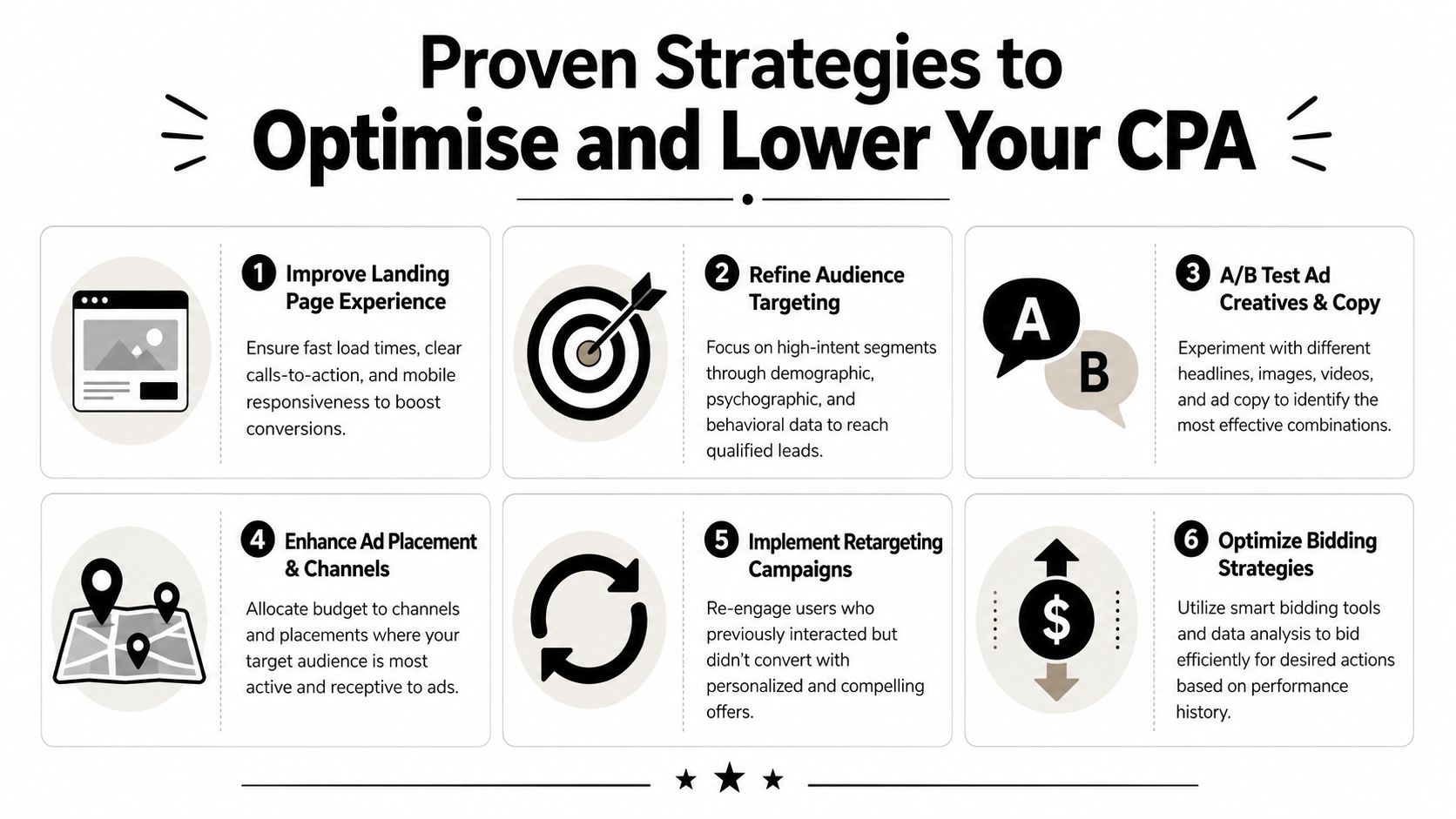
Focus first on these campaign-level checks:
- Audience quality: Narrowing isn't always the answer, but irrelevance is expensive. Exclude people who are unlikely to convert and split campaigns by intent where possible.
- Offer-message fit: If the ad promises one thing and the landing page leads with another, CPA rises quickly.
- Placement discipline: Some placements drive cheap engagement without meaningful actions. Keep them only if they support the chosen action.
Fix the handoff from ad to page
The ad doesn't close the conversion alone. The page finishes the sale, booking, or signup.
For ecommerce, common friction points are weak product page proof, confusing delivery information, and checkout clutter. For local businesses, it's often a poor booking flow, missing location details, or too many steps between interest and reservation.
A good review pass asks:
| Funnel stage | Common issue | What usually helps |
|---|---|---|
| Ad click | Curiosity clicks from weak targeting | Sharper audience exclusions and stronger qualifying copy |
| Landing page | Mismatch between ad and page | Repeat the offer, headline, and CTA clearly |
| Checkout or booking | Too much friction | Remove fields, simplify choices, reduce uncertainty |
“Lower CPA usually comes from removing friction, not from begging the algorithm to be cheaper.”
Test in a way that teaches you something
Random testing wastes time. Structured testing lowers CPA.
A practical testing rhythm:
- Change one meaningful variable at a time. Don't rewrite the headline, image, audience, and CTA all at once if you want to learn what mattered.
- Keep a control. You need a stable version to compare against.
- Review by action quality, not only volume. A cheaper signup that never buys isn't an improvement.
Creative testing matters more than many teams admit. For creator-led or UGC-style campaigns, small shifts in hook, framing, or proof often change conversion quality more than targeting tweaks do. The same is true for local offers. “Book now” and “claim your table offer” don't create the same response, even when the spend is identical.
The fastest route to a lower cost per action CPA is usually boring, repeatable optimisation. Better audience fit, stronger message, less page friction, cleaner conversion flow.
Using Advanced Attribution to Uncover Your True CPA
The headline CPA in your ad account is rarely the whole story.
A customer might discover your brand through a creator post, search for you later, click a retargeting ad, then finally convert through branded search or direct traffic. If your reporting gives all credit to the final click, you'll overvalue the closer and undervalue the channel that created demand in the first place.
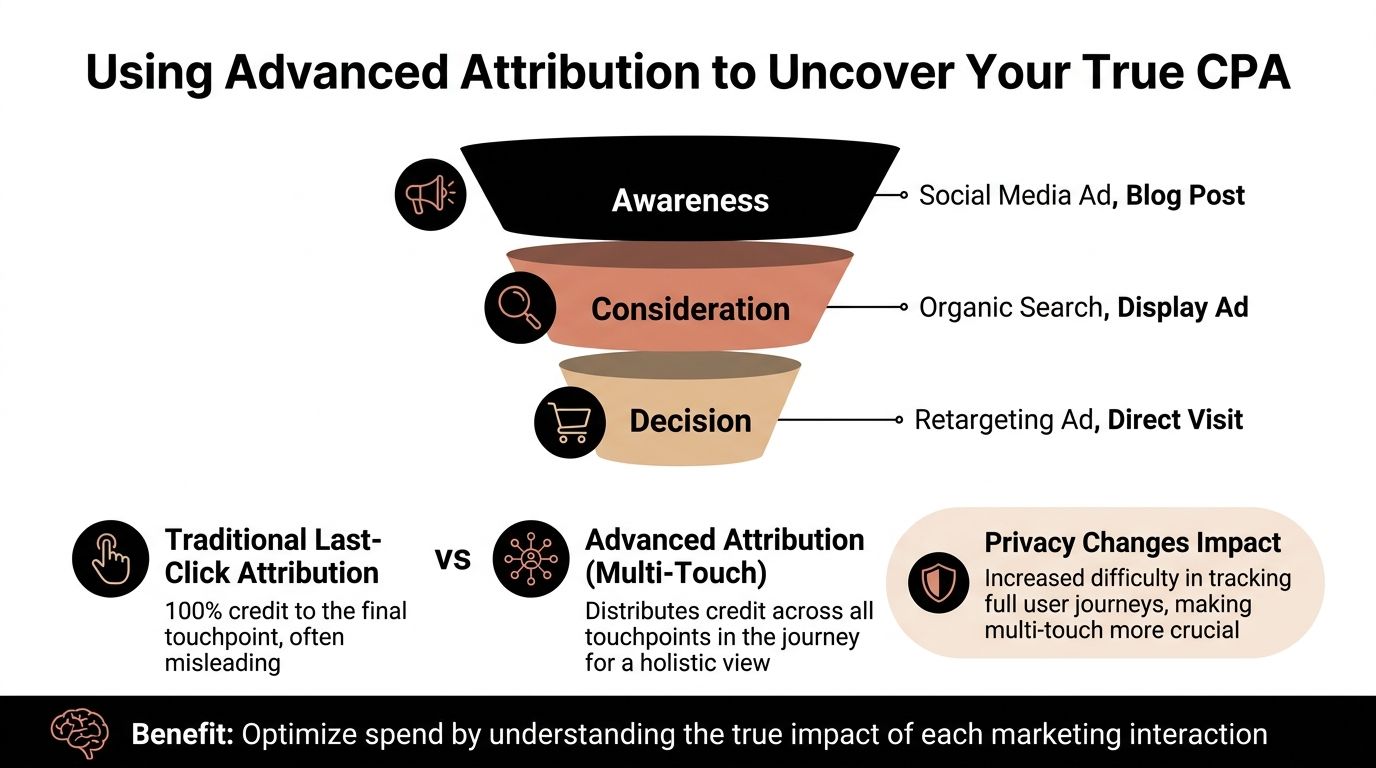
Why last-click CPA can mislead you
Many UK teams find this frustrating. The metric itself is simple. The measurement environment isn't.
Piwik PRO highlights a problem most basic CPA guides skip. Standard CPA may tell you the cost per action, but effective CPA can include all acquisition costs, and the lowest CPA channel isn't always the most valuable. That matters even more in the UK because marketers are dealing with partial attribution, post-cookie limitations, and measurement approaches shaped by privacy expectations. The same source also notes that teams increasingly rely on modeled conversions and blended attribution rather than last-click CPA alone. See $Piwik PRO on CPA, eCPA, and attribution trade-offs/$.
That changes how you should read channel performance.
What a more useful attribution setup looks like
You don't need perfect attribution to improve CPA. You need attribution that is consistent enough to make better decisions.
For creator campaigns, direct attribution methods are often the most practical because they reduce ambiguity. Useful examples include:
- Unique promo codes: Good for ecommerce orders and local offer redemption.
- UTM-tagged links: Useful when you want source-level traffic and conversion visibility.
- Dedicated landing pages: Helpful for local campaigns, launches, and multi-location reporting.
- Channel-specific booking links: Strong for restaurants, salons, clinics, and events.
If you're running Meta and need channel-specific cost discipline, this guide on $optimizing Meta ad costs/$ is a useful companion to attribution work. Lowering CPA isn't only about attribution, but attribution tells you where to focus the optimisation.
How this changes decisions for ecommerce and local brands
For ecommerce, advanced attribution often reveals that creator content assisted conversions that paid search later captured. If you only reward the last click, you'll cut the content that introduced the customer and keep funding the channel that harvested demand.
For local businesses, the distortion can be even worse. Someone sees a local creator mention your venue, remembers it, then books later through Google, a saved Instagram post, or direct search. Last-click reporting makes the booking look “organic” when the campaign clearly influenced it.
That's why teams increasingly combine direct response tracking with simpler operational signals:
- Promo code redemptions
- Tracked bookings
- Location-level landing pages
- Offer-specific links
- Blended reporting across touchpoints
A practical guide to this setup is $tracking influencer attribution with promo codes and UTM links/$. It's especially useful when you need evidence that creator activity drove sales or bookings beyond vanity engagement.
Reality check: A low reported CPA can hide a weak growth engine if another channel did the hard work earlier in the journey.
The goal isn't to chase perfect certainty. The goal is to stop making budget decisions on partial credit.
Common Questions About Cost Per Action
What is a good CPA
A good CPA is one your business can afford while still leaving room for margin and growth. That means the answer depends on the value of the action.
For ecommerce, a purchase CPA has to make sense against what that order is worth and what the customer is likely to do next. For a restaurant, a booking CPA has to make sense against expected spend, no-show risk, and repeat visit potential.
Is a lower CPA always better
No. A lower CPA can be worse if it comes from lower-quality customers, weaker average orders, or channels that don't scale.
A campaign that acquires bargain hunters may look efficient in the dashboard and still hurt the business. The better question is whether the CPA is buying actions that lead to worthwhile customers or bookings.
How long should I wait before judging CPA
Long enough to let the campaign gather stable conversion data, but not so long that you let obvious waste continue. The right timing depends on sales cycle length, traffic volume, and action type.
For fast ecommerce conversions, you can often spot major issues quickly. For considered purchases or local campaigns with delayed bookings, you need more patience and cleaner attribution rules.
Should I optimise for one CPA across every channel
Usually not. Different channels do different jobs.
Search often captures demand. Paid social can create and capture demand. Creator activity may influence consideration before the final click happens somewhere else. If you force every channel into one target CPA without accounting for role, you'll make bad cuts.
Sup helps brands, restaurants, agencies, and multi-location teams run creator campaigns with clearer attribution through unique promo codes, UTMs, booking links, and a central reporting view. If you want influencer activity to show up as measurable sales, bookings, and ROI instead of vague “awareness”, explore $Sup/$.
Book a strategy call today
We'll show you the creators in your niche, build a campaign plan, and walk you through the dashboard. All within 15 minutes, no commitment.