22 May 2026
Brand Ambassador Definition: Your 2026 Guide
Your paid social is still spending. Your creators are still posting. The reports still show reach, views and engagement. Yet revenue barely moves, repeat purchases stay flat, and the team keeps asking the same question: who is driving sales?
That's usually the moment when brands start searching for a proper brand ambassador definition. Not because they need another marketing term, but because their current setup isn't behaving like a system. It behaves like a pile of one-off activations.
A lot of businesses still treat ambassadors as glorified shout-outs. They send free product, ask for a post, and hope the audience converts. That can create noise. It rarely creates a dependable growth channel. The modern ambassador model works differently. It's structured, tracked and built around repeated advocacy from people whose audience already trusts them.
When you build it well, an ambassador programme stops being a fuzzy awareness play. It becomes a measurable operating layer that sits between content, community and conversion.
Beyond the Hype What Is a Brand Ambassador?
A familiar pattern shows up in growth teams. Ads get more expensive, branded content starts looking interchangeable, and the audience scrolls past polished creative without much urgency. The brand keeps publishing, but trust doesn't compound.
That's where a brand ambassador changes the dynamic. Instead of renting attention for a moment, you build an ongoing relationship with someone who can represent the brand credibly in the places where buying decisions happen. Sometimes that person is a creator. Sometimes it's an employee, a customer, a local community figure or a niche expert.
The useful version of the brand ambassador definition isn't “someone who promotes your brand”. That's too loose to help anyone make decisions. A better working definition is this: a brand ambassador is a formally engaged advocate who repeatedly represents your brand in a way that can influence awareness, trust and action.
That repeated part matters.
A single sponsored post can create a spike. A real ambassador programme creates familiarity. The audience sees the product in use over time, across different contexts, from someone they already pay attention to. That's what makes the message feel less like an interruption and more like a recommendation.
Practical rule: If the partnership isn't designed to repeat, learn and improve, it's probably an influencer placement, not an ambassador programme.
In practice, the strongest ambassador setups don't start with follower count. They start with fit. The person already speaks to the right corner of the market. They already know how to communicate with that audience. And they can tell the truth about the product in a way your paid ad account can't.
That's why ambassador programmes often outperform more expensive endorsement thinking. They humanise the brand, create trackable touchpoints and give the team something far more valuable than vanity metrics. They give you attributable advocacy.
The True Brand Ambassador Definition
Most definitions are too broad to be useful. They lump together celebrity deals, affiliate links, event reps and creators posting one sponsored Reel. That creates confusion inside the business. The social team says ambassador. The performance team hears influencer. Legal hears endorsement. Finance hears untracked spend.
A practical brand ambassador definition needs to be operational.
A true brand ambassador is a long-term, formally structured representative who promotes the brand through repeated advocacy, clear alignment and measurable activity. They aren't just borrowing your brief for a day. They're carrying your message through their own credibility over time.
Trusted local guide versus roadside billboard
The easiest way to separate a real ambassador from a short-term promotion is this.
A roadside billboard gets seen. It may even be memorable. But nobody assumes it has lived experience or honest preference. It broadcasts.
A trusted local guide works differently. People listen because the recommendation sits inside a relationship. The guide knows the area, understands the audience and keeps showing up. That's much closer to what a modern ambassador does.
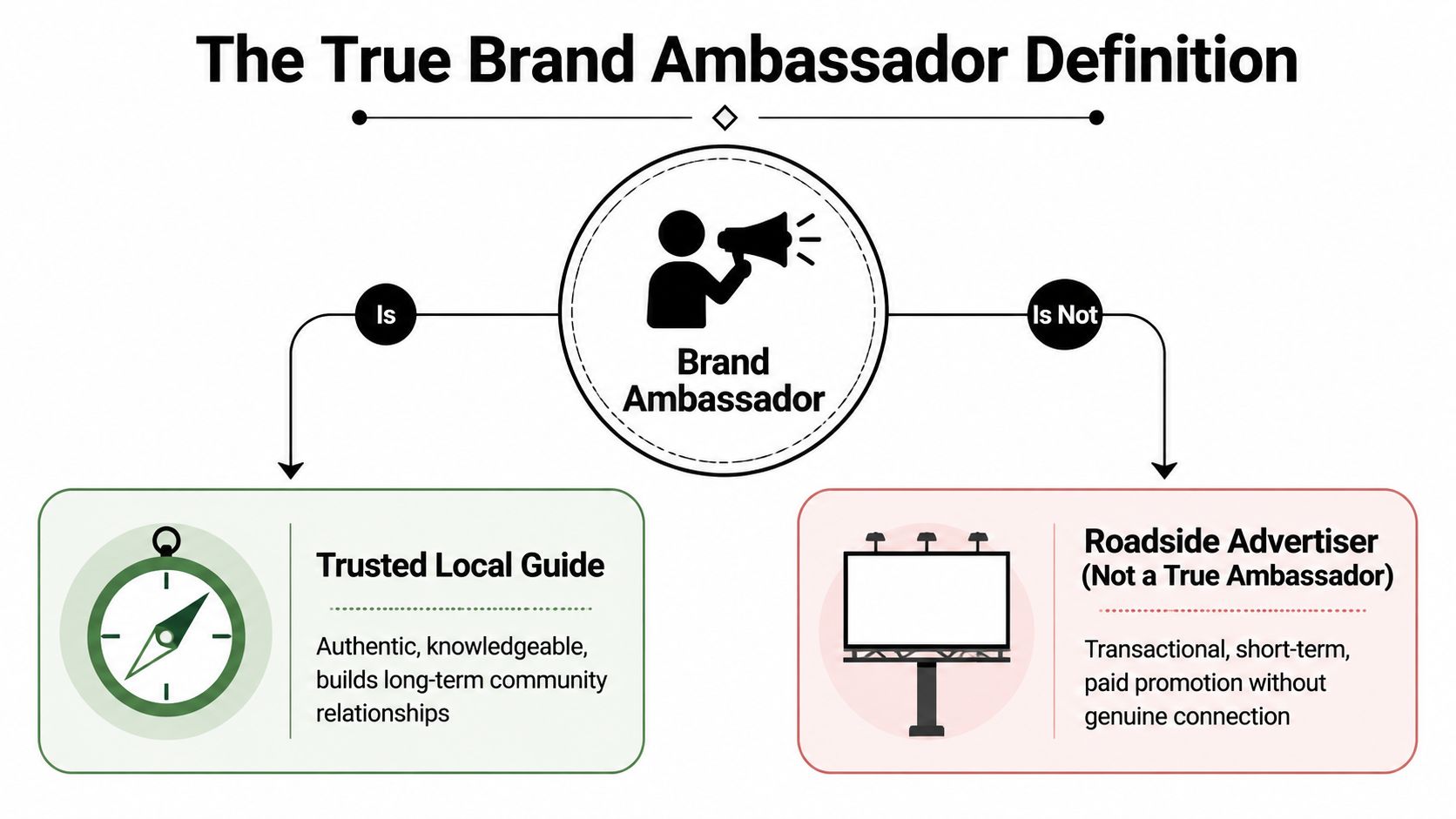
When brands miss this distinction, they recruit for reach and then act surprised when performance is weak. Reach can help. Trust is what moves people from post to purchase.
What changed in the UK market
The role also changed because consumer behaviour changed. Indeed's overview of successful brand ambassadors notes that Ofcom's UK research has repeatedly shown that adults and teens spend substantial time on social platforms, making those channels the main environment for ambassadors to operate. That shift moved the role from physical representation at trade shows and launches to repeated digital advocacy that can build awareness, trust and purchase intent.
That's why the old mental model no longer fits. In the UK, ambassadors aren't just people handing out samples in-store or appearing at a branded event. They now operate across Instagram, TikTok, YouTube, group chats, local communities and private recommendation loops.
What a brand ambassador is not
Use this quick filter when someone proposes an “ambassador” partnership:
- One-off paid placement means campaign support, not necessarily ambassadorship.
- No brief or disclosure structure means unmanaged promotion, which creates risk.
- No tracking method means you can't judge business value.
- No brand fit means you're paying for borrowed audience, not trusted advocacy.
The title matters less than the relationship. If the person is trusted, aligned, repeatable and trackable, you're close to a real ambassador model.
That's the definition worth using internally because it gives each team something concrete to work from. Marketing gets a channel. Operations gets a process. Legal gets structure. Finance gets attribution.
The Spectrum of Modern Brand Ambassadors
Not every ambassador should do the same job. Some are built for broad visibility. Others are built for niche conversion. The mistake is treating them as interchangeable because they all sit under the same label.
In practice, modern ambassadors sit on a spectrum. At one end, you have high-reach names that create immediate awareness but can feel distant. At the other end, you have highly specific people with smaller audiences who often feel more believable and easier to attribute.
UK audience trust data makes this trade-off hard to ignore. Only 4% of UK adults said they trust influencers more than celebrities, while 22% trusted celebrities more than influencers, and 36% trusted neither equally. That tells you the market is sceptical of obvious promotion. It doesn't mean ambassadors don't work. It means credibility has to be earned.
Brand Ambassador Types Compared
| Ambassador Type | Audience Size | Typical Cost | Perceived Authenticity | Best For |
|---|---|---|---|---|
| Celebrity | Very large | High | Often lower unless there's obvious fit | Broad awareness, launches, national visibility |
| Macro creator | Large | Medium to high | Mixed | Category awareness, polished content, wider reach |
| Micro creator | Niche to mid-sized | Moderate | Often stronger | Local campaigns, ecommerce conversion, repeat content |
| Employee ambassador | Varies by personal network | Low to moderate | High when genuine | Employer brand, trust, expertise-led storytelling |
| Customer advocate | Small but relevant | Low to moderate | Often highest | Referrals, reviews, community proof, retention |
Where most ROI programmes are heading
For measurable growth, micro creators, employees and customers usually give teams more to work with. They're easier to brief, easier to test across locations, and more likely to show the product in a believable setting.
That matters if you're trying to drive bookings, code redemptions, footfall or sales, not just impressions.
A restaurant group, for example, doesn't need a famous face talking vaguely about dining out. It needs local people who already post about food in that area, can visit repeatedly and are willing to use a trackable booking link or code. An ecommerce brand often benefits from creators who can demonstrate product use naturally over several weeks, then hand over usable UGC for paid media.
If your programme includes creators who want to package their audience into a business, it also helps to discover merch solutions for creators so the partnership can extend beyond sponsored content into community-building and incentives.
How to choose the right point on the spectrum
A simple rule works well here.
- Choose celebrity or macro talent when the problem is attention.
- Choose micro creators when the problem is conversion efficiency and local relevance.
- Choose employees when the problem is trust in expertise or culture.
- Choose customers when the problem is proof and advocacy.
For brands deciding whether to bias toward smaller creators, this breakdown of micro-influencer marketing is useful because it matches the way many high-intent ambassador programmes now operate.
The strongest programmes usually blend two or three ambassador types, then assign each a clear job. One creates reach. Another creates trust. A third drives attributed sales.
Key Ambassador Roles and Responsibilities
A brand ambassador shouldn't be left guessing what the role involves. Loose expectations create weak content, messy approvals and impossible reporting. Strong programmes give ambassadors enough room to sound like themselves while still making the business outcome clear.
Indeed's description of what brand ambassadors do is useful because it frames the role as relationship-building through pop-up events, trade shows, in-store demos and social posting tied to brand awareness and sales. That's the right lens. The ambassador is an execution layer between the brand and the audience.
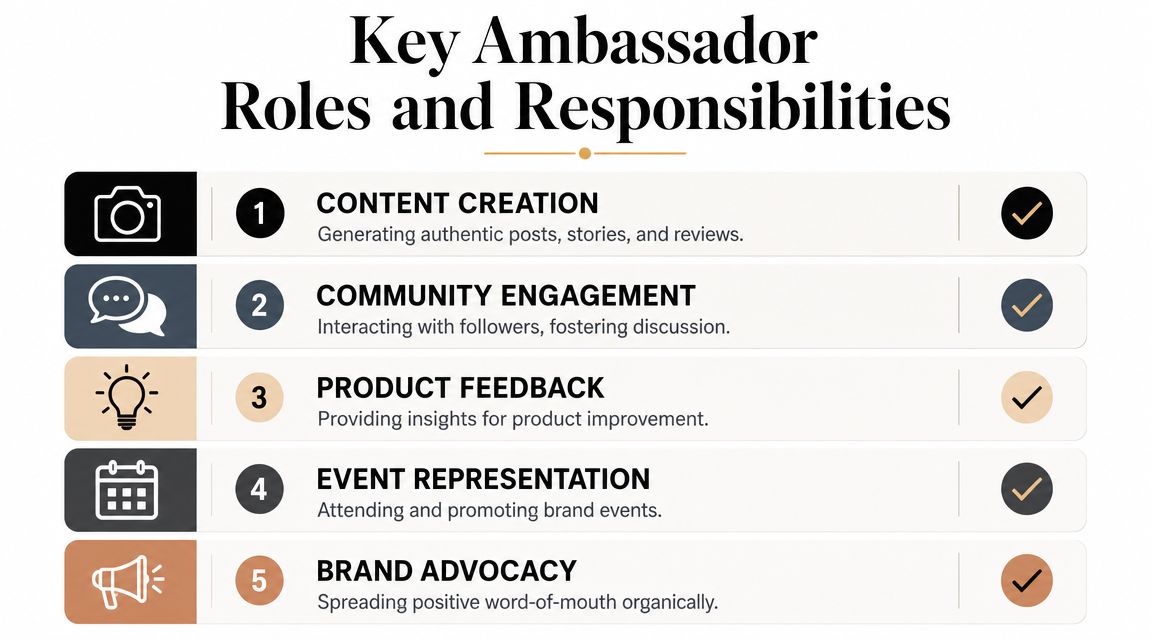
The day-to-day work that actually matters
Some responsibilities are visible to the audience. Others happen behind the scenes and are just as valuable.
- Content creation means producing posts, Stories, short-form video, reviews or testimonials that show real product use.
- Community engagement means replying to comments, answering questions and keeping the conversation active after a post goes live.
- Event representation matters when the brand needs a person on the ground who can create both attendance and content.
- Feedback loops matter because ambassadors hear objections, product questions and language customers use naturally.
- Advocacy beyond campaign dates is what separates a partner from a contractor. The product appears again later, without every mention feeling scripted.
How to brief without flattening their voice
Most weak ambassador content comes from one of two errors. Either the brief is so vague that the creator improvises the value proposition, or it's so rigid that the output sounds like a compliance document.
A workable brief usually covers:
- The business goal such as sales, bookings, app downloads or retail visits.
- Non-negotiables such as claims to avoid, disclosure requirements and brand safety points.
- Creative direction with examples of what the brand likes, not a word-for-word script.
- Tracking setup so the ambassador knows which links, codes or landing pages matter.
A good ambassador brief protects the message. It shouldn't erase the messenger.
Responsibilities brands often forget
The programme owner also has responsibilities. If you want repeatable output, the brand needs to supply enough structure to make delivery easy.
That usually includes product access, a contact person, approval timing, usage rights, payment clarity and a consistent reporting rhythm. Ambassadors do better when they aren't chasing answers in DMs or waiting for a code to be issued after content is already live.
The clearest ambassador programmes treat the role like a channel with named responsibilities on both sides. That's when performance starts becoming predictable.
Measuring the Business Value and ROI
If you can't connect ambassador activity to business outcomes, you don't have a growth channel. You have content that feels promising.
That's why most serious teams move away from vanity metrics quickly. Likes can signal creative resonance. Follower counts can suggest potential distribution. Neither tells you whether the programme deserves more budget.
Start with the metric that finance cares about
The cleanest approach is to map ambassador activity to a small set of commercial KPIs.
- Traffic quality through link clicks, landing page behaviour and on-site actions
- Conversions through purchases, bookings, lead forms or sign-ups
- Acquisition efficiency by comparing spend against attributed outcomes
- Retention signals through repeat purchases, repeat bookings or returning customers
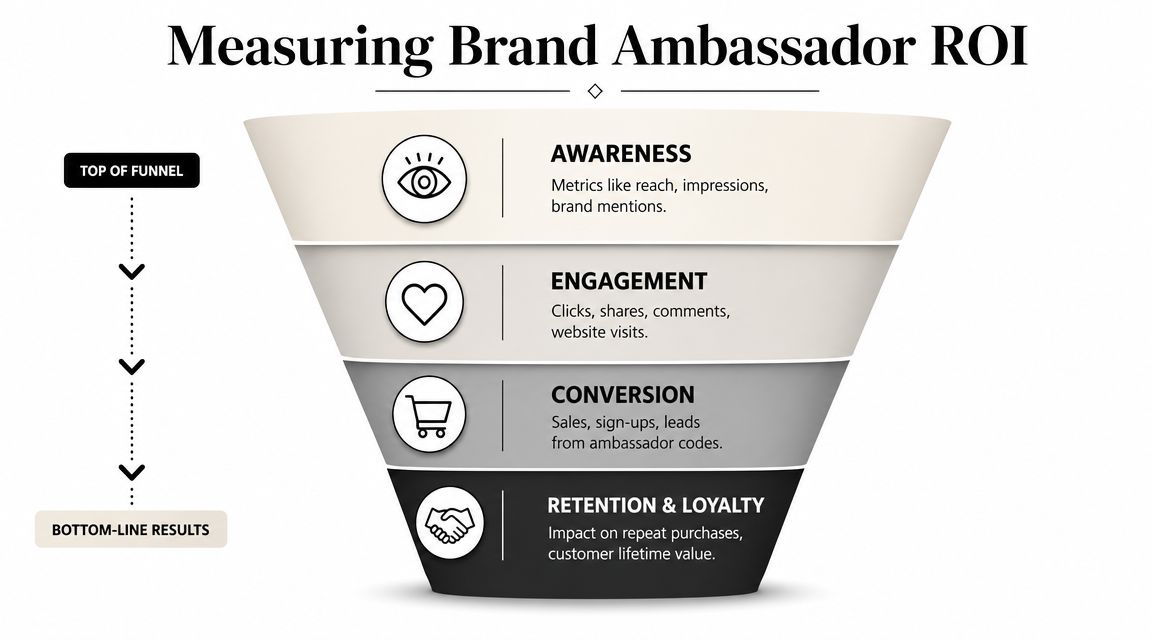
Awareness still matters, but it should sit at the top of the funnel, not dominate the conversation. A high-performing ambassador might not be the person with the most views. It might be the person whose audience clicks, redeems and buys.
Use two attribution methods from day one
For most brands, two tracking methods cover the majority of needs.
Unique promo codes are simple and visible. They work well for ecommerce, hospitality, local services and any offer with a clear redemption point. They also let you compare ambassadors side by side.
UTM-tagged links capture traffic behaviour in more detail. They show where visits came from, which content drove the session and whether users converted later in the journey.
Used together, they solve different problems. Codes are easy for the creator to say on video and easy for the audience to remember. UTMs help your analytics stack separate one ambassador from another.
Don't ask “did this creator perform?” Ask “which posts, messages, offers and landing pages produced attributable action?”
Build a reporting cadence that improves output
Monthly reporting is usually more useful than campaign-end reporting for ambassador programmes. By the time a long-term partnership ends, it's too late to fix weak positioning or poor offer design.
A practical dashboard should show:
- Content output by ambassador and platform
- Clicks and visits from tracked links
- Code redemptions or purchases
- Creative patterns such as formats, hooks and offers that convert better
- Cost versus attributed return at ambassador level
If you need a framework for the economics side, this guide on influencer marketing ROI and what actually works is a solid reference point. For improving the top and middle of the funnel, these PhotoMaxi tips for engagement can help tighten the content side before you judge conversion performance.
One operational option is Sup, which handles ambassador-style creator campaigns with unique promo codes, UTM links, outreach workflows and a dashboard that ties content to clicks, conversions and revenue. That kind of setup matters when the team wants to stop stitching together reports manually.
The key is simple. Measure ambassadors the same way you'd measure any other acquisition channel. If it can't be compared, it can't be scaled confidently.
Compensation Models and Legal Essentials
Most ambassador problems that look like performance issues are fundamentally structure issues. The wrong incentive creates the wrong behaviour. A vague agreement creates delays, content disputes and awkward payment conversations. Then the programme gets blamed when the underlying issue was poor setup.
Compensation should match both the ambassador type and the business goal.
The four models most teams use
- Product gifting works when the product itself has genuine value to the ambassador and the ask is light. It's common for early testing, but it can attract people who want free stock more than a real partnership.
- Flat fees work when you need guaranteed deliverables and clear budgeting. This suits planned campaigns, event attendance and content production with fixed outputs.
- Commission structures work when attribution is strong and the ambassador can influence purchase behaviour directly.
- Hybrid models combine a base payment with performance upside. In practice, this often creates the healthiest incentive because the ambassador gets security while the brand keeps a link to results.
What doesn't work is copying one model across every ambassador type. A local customer advocate, a creator with production costs and an employee ambassador should not all be rewarded in exactly the same way.
Contracts are not the enemy of authenticity
Some teams avoid contracts because they think formalising the relationship will make the content feel stiff. The opposite is usually true. Clear agreements remove uncertainty, which lets the ambassador focus on making better content.
A solid agreement should cover deliverables, payment terms, content usage rights, disclosure expectations, timelines, cancellation terms and any approval process. If you need a practical reference, this guide to influencer contracts and agreements is useful because it translates legal structure into day-to-day operating terms.
UK disclosure isn't optional
In the UK, ambassador activity sits inside a regulated advertising environment. CleverFrame's glossary summary notes that the ASA's influencer-monitoring work generated tens of thousands of pieces of content review in recent years, showing how often brand representatives appear across social platforms. It also points out that this transparency framework means ambassadors are treated as a regulated promotional channel.
That has practical consequences.
- Disclose paid relationships clearly
- Brief ambassadors on how and when disclosure must appear
- Avoid hidden commercial intent
- Keep records of agreements, assets and approvals
Clear disclosure protects trust. It doesn't weaken the content. Audiences usually react worse to concealment than to sponsorship.
Legal and performance teams should want the same thing here. A fair agreement, transparent disclosure and clean tracking. That combination protects the brand and gives the partnership room to last.
How to Find and Recruit Your First Ambassadors
Most brands already have potential ambassadors around them. They just haven't organised the search. The first wave usually comes from people who already know the brand, already talk about the category or already participate in the local or niche community you care about.
UK-focused employer-brand guidance from Radancy frames this well. Ambassadors work best when they are authentic employees or advocates who share culture and values, because trust transfers from a known person to the brand. That's a strong benchmark for recruitment.

Identify
Start with signals, not follower size. Look at tagged posts, repeat customers, existing UGC, employee social presence, local creators in your niche and people who already mention the product without being prompted.
For a wider search process, this guide to identifying brand ambassadors gives a useful set of sourcing ideas.
Good candidates usually show three things at once. They already talk to the right audience. Their content style suits the brand. And they can represent the product without sounding like they've borrowed somebody else's personality.
Vet
Once you have a shortlist, review them like a channel partner.
Check audience relevance, posting consistency, comment quality, brand safety, how they disclose paid work and whether they've promoted too many direct competitors. If they already use the product or understand the category, that's a major advantage because the content won't need to fake familiarity.
A short scorecard helps here. Fit, quality, reliability, local relevance, conversion potential.
Recruit
Outreach should feel specific. Generic copy gets ignored because it reads like bulk creator spam.
A better message references something they've posted, explains why they're a fit, states what the partnership would involve and makes the tracking and compensation model clear. Ambassadors take the opportunity more seriously when the brand sounds organised.
This walkthrough can help your team think through the process before outreach begins.
The first programme doesn't need to be large. It needs to be learnable. Recruit a small group, standardise the brief, assign tracking to each partner and compare who creates the best mix of believable content and attributable action. Then expand from evidence, not enthusiasm.
If you're building a measurable ambassador programme and need help sourcing creators, structuring outreach, setting up tracking and proving results, Sup gives teams a done-with-you way to run creator and ambassador campaigns with clearer attribution from post to purchase.
More on programs
See how many creators post about you and your competitors
Type in your brand's Instagram handle and we count the creators who post about you and about your five closest competitors. It takes about a minute and it is free. Or request a demo and we will show you the creators in your niche and walk you through the dashboard.
 Book a call