30 April 2026
Best Influencer Marketing Platforms 2026: Honest Comparison
Most platform round-ups still answer the wrong question. They rank databases, dashboards, and interface polish, but they skip the issue that decides whether influencer marketing survives budget review: can you trace creator activity to revenue without building a manual reporting system around the software?
That gap matters more in 2026 because the category is large enough to attract budget, scrutiny, and fraud in equal measure. Best Influencer Marketing Platforms 2026: Honest Comparison isn't really a software shopping exercise. It's an operations and attribution problem.
Navigating the 2026 Influencer Marketing Landscape
In the UK, Instagram still dominates campaign planning. It holds 67% of brand campaign volume, yet the same platform carries a 16.8% fake follower rate. For accounts with heavy fake audiences, true engagement can drop by 47%, while cost per acquisition can rise by 3.1x, according to Digital Applied's 2026 influencer marketing data.
That single set of numbers changes how you should evaluate platforms. A creator marketplace isn't useful just because it helps you find profiles fast. It's useful if it helps your team avoid buying inflated audiences, attach tracking to every collaboration, and separate visible activity from profitable activity.
The platform mix reinforces that point. Instagram remains central for brand campaigns, but short-form video has pushed marketers to think more like performance teams than sponsorship buyers. If you're also building a broader short-form content engine, Satura AI for viral Shorts is a useful companion read because it focuses on format mechanics rather than creator procurement.
Why vanity metrics fail in 2026
Follower count never told the full story. In 2026, it tells even less.
Three habits usually create wasted spend:
- Buying reach without verification. Teams select creators based on audience size, then discover too late that fake followers distorted expected results.
- Treating engagement as the finish line. Likes and comments can indicate resonance, but they don't explain whether the campaign drove checkouts, bookings, or footfall.
- Running influencer work outside the revenue stack. Once tracking lives in spreadsheets, screenshots, and direct messages, finance sees cost but not contribution.
The winning brands don't ask whether influencer marketing works. They ask whether their setup can prove what worked, who drove it, and whether the process can scale.
What the market is actually rewarding
For ecommerce brands, hospitality groups, and agencies, the commercial question is now straightforward. Can the platform connect creator discovery, campaign execution, fraud filtering, and attribution into one operational loop?
That's why generic software comparisons miss the point. The hard part isn't finding a platform with creator search. The hard part is finding one that turns creator work into a repeatable channel instead of a recurring reporting dispute.
Our Evaluation Methodology for an Honest Comparison
An honest comparison starts by rejecting broad claims that don't survive a UK operating environment. A 2025 UK Influencer Marketing Report found that 67% of UK marketers struggle with real-time attribution because of fragmented tools, while 80% of top-listed platforms lack native UK privacy dashboards, as summarised in G2's influencer marketing platform category context.
That matters because a platform can look strong in a feature matrix and still fail where UK teams feel pain: campaign approval chains, privacy handling, reporting for finance, VAT-aware workflows, and attribution that doesn't collapse once a campaign spans multiple locations.
The six pillars that matter
I evaluate platforms against six operational criteria.
- Creator discovery and vetting The question isn't database size alone. It's whether the tool helps you find creators by niche, geography, and business fit, then screen for credibility before outreach starts.
- Campaign management and automation Some platforms still assume a team can tolerate heavy manual coordination. That's unrealistic for agencies, multi-location brands, and restaurant groups managing parallel campaigns.
- Attribution and revenue tracking This is the decisive pillar. If a platform can't connect codes, links, clicks, bookings, sales, and content output into one view, the reporting burden shifts back onto your team.
- UGC handling and content reuse Creator output now feeds ads, organic social, and landing pages. Platforms that treat content as a by-product rather than an asset library leave value on the table.
- Business-model fit A strong DTC workflow may still be weak for hospitality. A good enterprise platform may be excessive for a local chain. Fit matters more than breadth.
- Pricing and total operating cost Subscription fees are only part of the cost. The hidden expense is labour. If your team still chases creators manually, reconciles links by hand, and prepares client reports outside the platform, the software is underperforming.
Why UK context changes the ranking
A lot of influencer software content is written as if every buyer is a US ecommerce brand with a dedicated creator manager. That's not how many UK teams operate.
Restaurant groups need local creator matching. Agencies need client-safe reporting. Retail chains need location-level tracking. Brands in regulated or privacy-conscious categories need cleaner handling of campaign data.
Practical rule: If a platform's reporting looks polished but still forces your team to export, stitch, and explain basic performance manually, it isn't solving attribution. It's just relocating the admin.
What I weighted most heavily
I gave the highest weight to two issues.
- Verifiable attribution because revenue proof determines whether the channel grows or gets cut.
- Operational efficiency because inefficient influencer programmes break before they scale.
Everything else matters, but those two factors decide whether a platform becomes infrastructure or shelfware.
Top Influencer Platforms Side-by-Side Analysis
Influencer software only looks interchangeable until you map it to the operating model behind the campaign. The practical split in 2026 is not feature depth versus price. It is whether a platform can prove revenue cleanly and reduce the labour needed to run creator activity across multiple locations, teams, or client accounts.
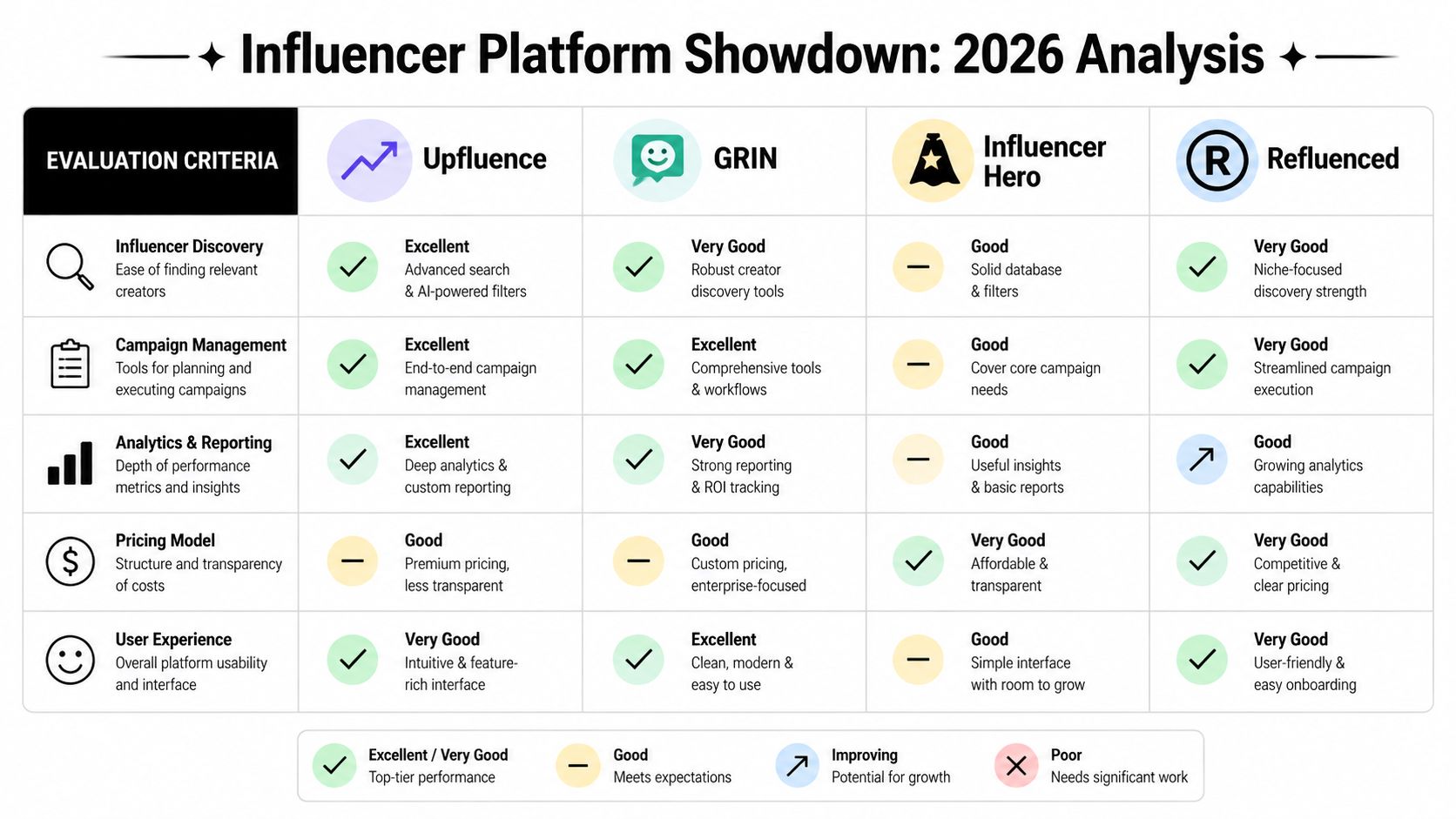
| Platform | Best fit | Discovery and vetting | Workflow efficiency | Attribution depth | UGC and reuse | Commercial read |
|---|---|---|---|---|---|---|
| Upfluence | Ecommerce brands with affiliate logic | Strong ecommerce-oriented discovery | Good for structured brand teams | Strong where affiliate and conversion tracking matter | Useful for ongoing creator content | Best when influencer sits close to affiliate and ecommerce ops |
| GRIN | DTC brands building long-term creator relationships | Strong relationship-led management | Good for teams with dedicated ownership | Useful for codes and links in ongoing programmes | Solid for creator relationship continuity | Better for mature in-house teams than fast-moving local operators |
| Influencer Hero | Agencies and lean teams needing automation | Broad creator access and AI support | High automation for outreach and scale | Good unified reporting posture | Practical for campaign execution | Best when team efficiency matters as much as software breadth |
| Refluenced | Brands prioritising measurable marketplace performance | Verified creator application model | Strong end-to-end flow | Strong evidence of campaign output | Built for ongoing collaboration | Best for brands that want proof of marketplace efficiency, not just tooling |
Upfluence
Upfluence is strongest in businesses that already treat influencer as a commerce channel rather than a brand-only channel. The platform makes more sense for ecommerce teams that already run affiliate structures, issue trackable links, and expect influencer reporting to sit beside broader partnership reporting. Its value comes from connecting creator activity to conversion logic the finance team can recognise.
That distinction matters. A tool can be excellent at finding creators and still be a weak fit for a brand that needs line-of-sight from post to sale.
For UK hospitality groups or multi-location retail operators, the limitation is not quality. It is fit. Upfluence works best when campaigns are standardised, products are easy to attribute online, and the internal team has the discipline to manage the software properly. Businesses that need local store activation, city-level creator sourcing, or more hands-on execution support may find the operating model too software-led.
Upfluence’s published terms are set beside ours in Sup vs Upfluence.
GRIN
GRIN remains one of the clearer options for brands that invest in creator continuity. It is built for teams that want relationship history, repeat collaborations, gifting workflows, and ambassador management in one place. That suits DTC brands with an internal creator function and enough time to build long-term partner value.
Its weakness is narrower than critics usually claim. GRIN does not fail on workflow. It can fail on commercial speed if the business expects immediate proof across many small campaigns, locations, or client accounts. A central brand team can work around that. A restaurant group trying to compare creator performance across multiple venues usually needs faster local reporting and less manual interpretation.
GRIN changed how it charges in 2026. Its current plans are set beside ours in Sup vs GRIN.
Influencer Hero
Influencer Hero is the most operationally interesting platform in this group for lean teams. According to Uplodio's platform comparison of influencer marketing software, its pricing is structured around creator contact volume, with tiers ranging from contacting 1,000 creators per month to 10,000 creators per month. That matters because usage-based pricing is easier to model than vague enterprise quotes, especially for agencies managing fluctuating client demand.
The appeal is straightforward. It compresses admin.
For agency operators, that usually means fewer hours lost to outreach coordination and status chasing. For in-house teams, it reduces the risk that campaign operations live inside one person's spreadsheets and inbox. For multi-location businesses, it can create a more repeatable process across regions, although local relevance still depends on who sets the briefs and approves the creators.
Hero is a strong process tool. It is less convincing as a full answer to market-specific nuance. A hotel group in Manchester and a quick-service restaurant chain in London still need local judgement, timing, and creator fit that software alone cannot standardise.
Refluenced
Refluenced stands out because it publishes campaign output indicators rather than relying only on workflow claims. In Refluenced's 2026 platform review, the company describes campaign click volume, campaign count, and average CTR across its marketplace activity. Public performance benchmarks do not remove the need for brand-side validation, but they do give buyers more to assess than a generic promise of efficiency.
Its marketplace model also changes the economics of sourcing. Verified creators apply to campaigns, which can reduce wasted outreach and improve response quality compared with cold prospecting-heavy systems. That is particularly relevant for hospitality and retail businesses running recurring local campaigns where speed of activation matters as much as creator reach.
Refluenced looks strongest where a business wants one operating environment for sourcing, briefing, collaboration, and reporting, and where the team values measurable campaign throughput over highly customised relationship management.
A note on alternatives and blind spots
Some buyers are not choosing between software products at all. They are choosing between licensing another platform and shifting to a more managed operating model with clearer reporting and less internal admin. If such is the choice, this review of an Upfluence alternative for influencer marketing without software bloat is useful because it evaluates the workload created around the platform, not just the platform itself.
Bottom-line comparison
| Decision factor | Strongest option in this group | Why it matters |
|---|---|---|
| Affiliate-style ecommerce measurement | Upfluence | Best suited to brands that already organise partnerships around ROAS and conversions |
| Relationship-led DTC creator management | GRIN | Better fit for internal teams building longer creator lifecycles |
| Team efficiency and scalable outreach | Influencer Hero | Strongest labour-saving logic with clearer usage-based planning |
| Marketplace proof and measurable output | Refluenced | Offers the clearest public evidence of campaign activity and throughput |
Each platform reflects a different operating theory. Upfluence treats influencer as commerce infrastructure. GRIN treats it as partner management. Influencer Hero treats it as process automation. Refluenced treats it as a verified performance marketplace.
That is why the ranking changes by business model. A DTC brand with a creator team, a restaurant chain with local site-level needs, and an agency reporting across multiple clients should not buy from the same scorecard.
Choosing the Best Platform for Your Business Model
Platform fit decides whether influencer spend becomes a reporting problem or a repeatable acquisition channel. The wrong tool rarely fails on features. It fails because its workflow, attribution model, and staffing assumptions do not match how the business makes money.
By 2026, that mismatch shows up fastest in two places. Finance asks for cleaner proof of revenue. Operations asks why the team is still doing manual outreach, creator follow-up, and reporting in spreadsheets. A platform should reduce both pressures.
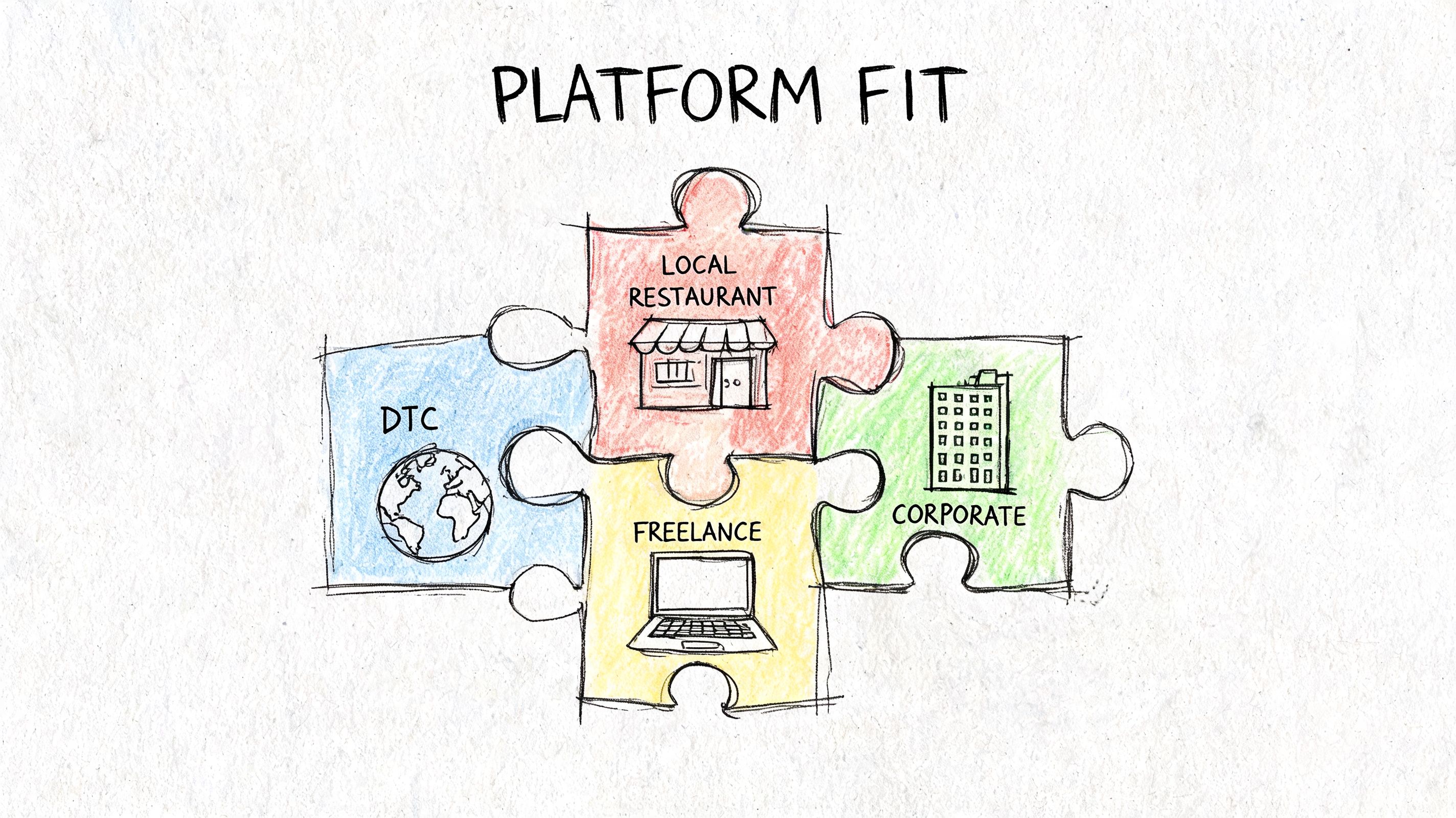
Ecommerce and DTC brands
For ecommerce brands, the first question is simple. Are you buying software to manage creator relationships, or to measure and increase conversion volume?
Brands with established affiliate programmes, product seeding, and discount-code reporting usually get more value from platforms built around transaction visibility. In that setup, Upfluence fits teams that already treat creator activity as a commerce channel. GRIN fits better when the internal goal is to build a stable creator roster and the team has enough bandwidth to manage those relationships over time.
That distinction matters because the same creator campaign can look efficient or expensive depending on the operating model behind it. A relationship-heavy tool can produce strong brand value while still creating too much admin for a lean performance team. A conversion-led system can improve financial reporting while feeling restrictive to a brand team that wants deeper creator collaboration.
Restaurants and hospitality groups
Hospitality has a different failure point. Reach is easy to buy. Local footfall is harder to produce and harder to prove.
A restaurant group needs creators with geographic relevance, fast approval cycles, and a clear path from post to booking, redemption, or walk-in demand. Large creator databases matter less than local match quality and execution speed. That is why broad enterprise suites often underperform in hospitality. They were built for national ecommerce workflows, not location-level trading realities.
If you are assessing platforms from an operator's point of view, this guide to what restaurant owners should look for in influencer marketing platforms frames the decision around footfall, bookings, and admin load rather than vanity metrics.
Restaurants should buy for local creator relevance and evidence of venue-level outcomes.
Marketing and PR agencies
Agencies sell confidence as much as campaign output. Clients want to know what ran, what it produced, and how much work it took to deliver.
That changes the buying criteria. Influencer Hero suits agencies whose margin is being squeezed by labour, especially when account teams repeat similar campaign formats across several clients. Refluenced is more attractive when the agency needs visible marketplace activity and clearer proof that campaigns are moving through a measurable system.
The non-obvious point is that agencies often overvalue creator discovery and undervalue internal throughput. If reporting still depends on account managers pulling screenshots, reconciling codes, and explaining weak attribution after the fact, the platform is not solving the agency's real commercial problem.
Multi-location chains
Multi-location brands sit between local hospitality and centralised retail. Head office wants consistency, budget control, and reporting. Individual sites need creators who are credible in their catchment area.
Many platforms struggle here because they force a choice between central control and local flexibility. Chains need both. The better fit is a system that lets central teams approve processes, templates, and reporting rules while giving local operators or regional managers room to activate relevant creators without rebuilding the campaign from scratch each time.
This is especially important in UK retail and hospitality groups, where regional variation affects creator fit, offer relevance, and redemption patterns more than software demos suggest.
The practical rule for selection
Choose the platform that matches the constraint slowing growth.
- If board pressure is tied to revenue proof, prioritise platforms built around conversion tracking, codes, and attributable sales.
- If team capacity is the main issue, prioritise workflow automation, outreach efficiency, and reporting controls.
- If local demand is the growth target, prioritise geography-specific creator matching and simple execution at site level.
- If client retention depends on clarity, prioritise platforms that reduce manual reporting and make outcomes easier to defend.
Teams still overpay for platform reputation when they should be buying operational fit. In 2026, database size is rarely the deciding factor. The better question is whether the software helps your specific model produce attributable revenue with less internal friction.
The ROI Question Unpacked: Attributing Real Revenue
Teams often don't fail at influencer marketing because creators underperform. They fail because attribution is weak enough that nobody can defend the spend with confidence.
Good attribution isn't one metric. It's a chain of evidence. A creator posts. Someone clicks. A code is redeemed, a booking lands, or a purchase completes. The platform records that path in a way finance, leadership, and client teams can all understand.
What a workable attribution setup includes
A practical model usually combines several signals.
- Unique promo codes help connect creator activity to purchases or in-store redemptions.
- UTM-tagged links show traffic source and campaign path inside analytics tools.
- Affiliate-style tracking adds a cleaner conversion layer when ecommerce is the main goal.
- Post-purchase or post-booking questions can capture influence that happened without a direct click.
No single method is perfect. Codes can be shared outside the original audience. Links miss view-through influence. Surveys rely on self-reporting. Used together, they give you a usable commercial picture.
The right question isn't “Which attribution method is perfect?” It's “Which combination gives us enough confidence to scale or stop spend quickly?”
What the dashboard should actually show
A strong dashboard shouldn't drown teams in social metrics while hiding commercial outcomes. It should make a few decisions easier.
You should be able to see which creators drove clicks, which offers converted, which locations performed, and which pieces of content deserve reuse. For hospitality, the dashboard also needs to show whether creator activity maps to bookings, footfall proxies, or code redemption. For ecommerce, the path to checkout matters most.
That also changes how you brief campaigns. Once attribution is visible, creative strategy improves. You stop asking creators for generic awareness content and start asking for offers, hooks, landing-page alignment, and post formats that can be tracked cleanly.
Why attribution changes platform choice
Attribution isn't an analytics add-on. It reshapes the software decision itself.
Platforms that stop at discovery force your team to build the rest manually. Platforms that combine discovery, links, codes, reporting, and content collection reduce both execution friction and internal debate. If you want a practical framework for measuring creator performance beyond surface engagement, this guide on how to measure influencer marketing ROI and what actually works covers the operational side in more depth.
The deeper point is simple. A platform becomes valuable when it shortens the distance between a creator post and a business decision.
The Verdict: How Sup Delivers A Repeatable Growth Engine
The market gap is clearest in hospitality and multi-location programmes. UK data shows that hospitality brands using location-matched nano-influencers drive 4.1x more bookings, yet 72% still struggle with manual outreach, according to Duda's 2026 software comparison coverage.
That combination explains why many software-first platforms feel incomplete for operators. The opportunity is local and measurable, but the execution burden still sits with the team.
Where the hybrid model changes the economics
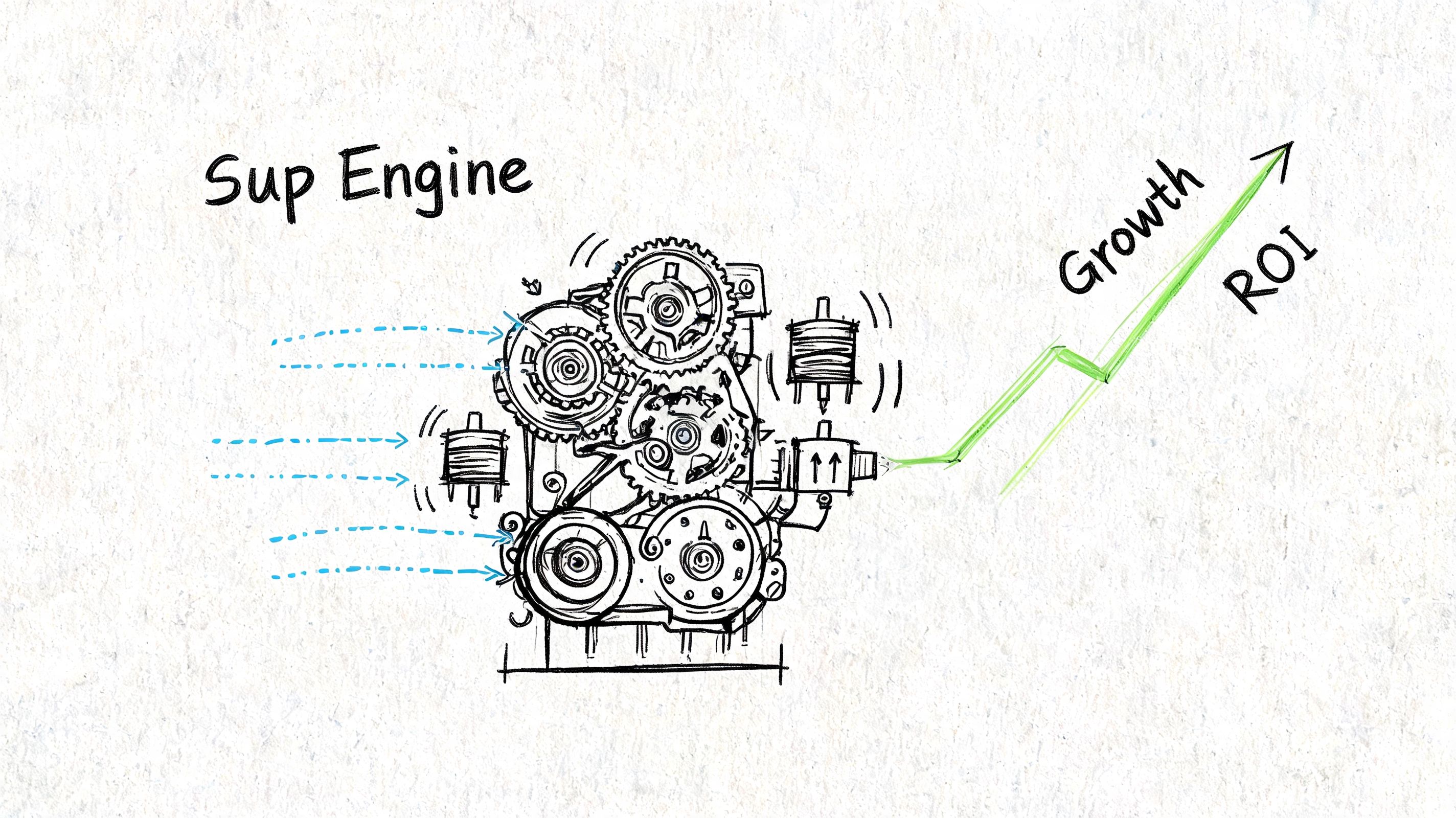
A hybrid operating model holds more importance than just another feature list. Sup combines AI with a human team to source verified micro and nano creators on Instagram and TikTok, prebuild campaigns with outreach scripts, promo codes, UTM tracking, and estimated ROI, then manage communication, scheduling, follow-ups, payments, and content collection in one workflow. For teams that don't want to run campaigns through manual DMs and spreadsheets, the model is built around operational relief as much as reporting.
The distinction is important. A lot of platforms help you do influencer marketing. Fewer reduce the amount of internal project management required to do it well.
Why this matters for specific business models
For restaurants and multi-location chains, local creator recruitment is the hard part. Not because creators don't exist, but because the matching, outreach, chasing, scheduling, and reporting create too much admin for small teams.
For agencies, the challenge is similar but multiplied. Each client wants bespoke creator fit and clear reporting, yet the agency still needs a repeatable internal process. A done-with-you model can be more practical than adding another dashboard to an already fragmented stack.
Decision lens: If your team already has the staff, process discipline, and analyst time to run software-heavy workflows, a self-serve platform may be enough. If the work keeps stalling at outreach, follow-up, and attribution, the operating model matters more than the interface.
What makes the approach repeatable
The strongest part of this model isn't only that it saves time. It's that the time saved happens in the least strategic work: finding local-fit creators, handling repetitive communication, organising links and codes, and consolidating results.
Once those tasks are systematised, influencer activity starts to look less like a one-off campaign channel and more like a repeatable acquisition and content engine. That's the key shift many brands are trying to make in 2026.
Frequently Asked Questions about Influencer Platforms
How much should brands expect to pay for influencer platform software in 2026
Pricing varies widely by platform model. Some tools charge based on creator contact volume, some quote custom enterprise contracts, and some wrap software inside managed support. Don't compare subscription price alone. Compare total operating cost, including the staff time needed to source creators, chase replies, build reports, and reconcile performance.
What's the difference between done-for-you and done-with-you
Done-for-you usually means the provider runs the work with limited client involvement. Done-with-you means the provider still handles heavy execution, but the brand keeps visibility, approvals, and reporting access. For performance-focused teams, that second model is often easier to govern because it keeps the campaign close to internal marketing and revenue data.
How quickly can a business see ROI from influencer campaigns
It depends on the business model, offer strength, creator fit, and attribution setup. Ecommerce brands with strong landing pages and clear offers can often judge early signals quickly through clicks, code use, and content performance. Hospitality brands may need to assess a mix of bookings, redemptions, and review generation over a slightly longer cycle. The key is to define decision metrics before launch.
Can you switch platforms without disrupting live campaigns
Yes, but only if you separate strategy from software. Keep your creator lists, campaign briefs, codes, content rights, and reporting logic organised outside any one tool where possible. The easiest migrations happen when the team owns the operating process and the platform supports it, rather than the other way round.
What's the biggest mistake buyers make when choosing a platform
They buy for breadth instead of fit. A platform can be impressive and still be wrong for your business. Local hospitality, DTC ecommerce, agencies, and multi-location chains each need different strengths. Start with the reporting and workflow problem you're trying to solve. Then choose the tool or service model that removes that bottleneck.
If you're comparing options and want a model built around attributable revenue and lower operational drag, Sup is worth a look. It combines creator sourcing, campaign setup, tracking, and hands-on management for brands that need influencer marketing to function like a repeatable growth channel rather than a side project.
More on tools
See how many creators post about you and your competitors
Type in your brand's Instagram handle and we count the creators who post about you and about your five closest competitors. It takes about a minute and it is free. Or request a demo and we will show you the creators in your niche and walk you through the dashboard.
 Book a call