22 April 2026
Master Your TikTok Views Count Strategy
Most advice about TikTok views gets the priority backwards. It tells brands to chase a bigger number first, then figure out whether any of those views mattered.
That’s the wrong order.
A tiktok views count is useful, but only if you understand what triggered it, how inflated it can become through loops and repeat plays, and where it fits inside a measurement system that tracks clicks, bookings, and sales. For a restaurant, that means table bookings and code redemptions. For a DTC brand, it means sessions, add-to-basket intent, and attributed purchases. For an agency, it means reporting something better than “the creator got loads of eyeballs”.
TikTok gives views away easily. Your job is to separate cheap exposure from valuable attention. Once you do that, the metric becomes far more practical.
How TikTok Actually Counts a View
TikTok counts a view almost immediately. There’s no meaningful minimum watch threshold you can rely on when reporting performance. If the video starts playing on the For You Page, that play can register as a view.
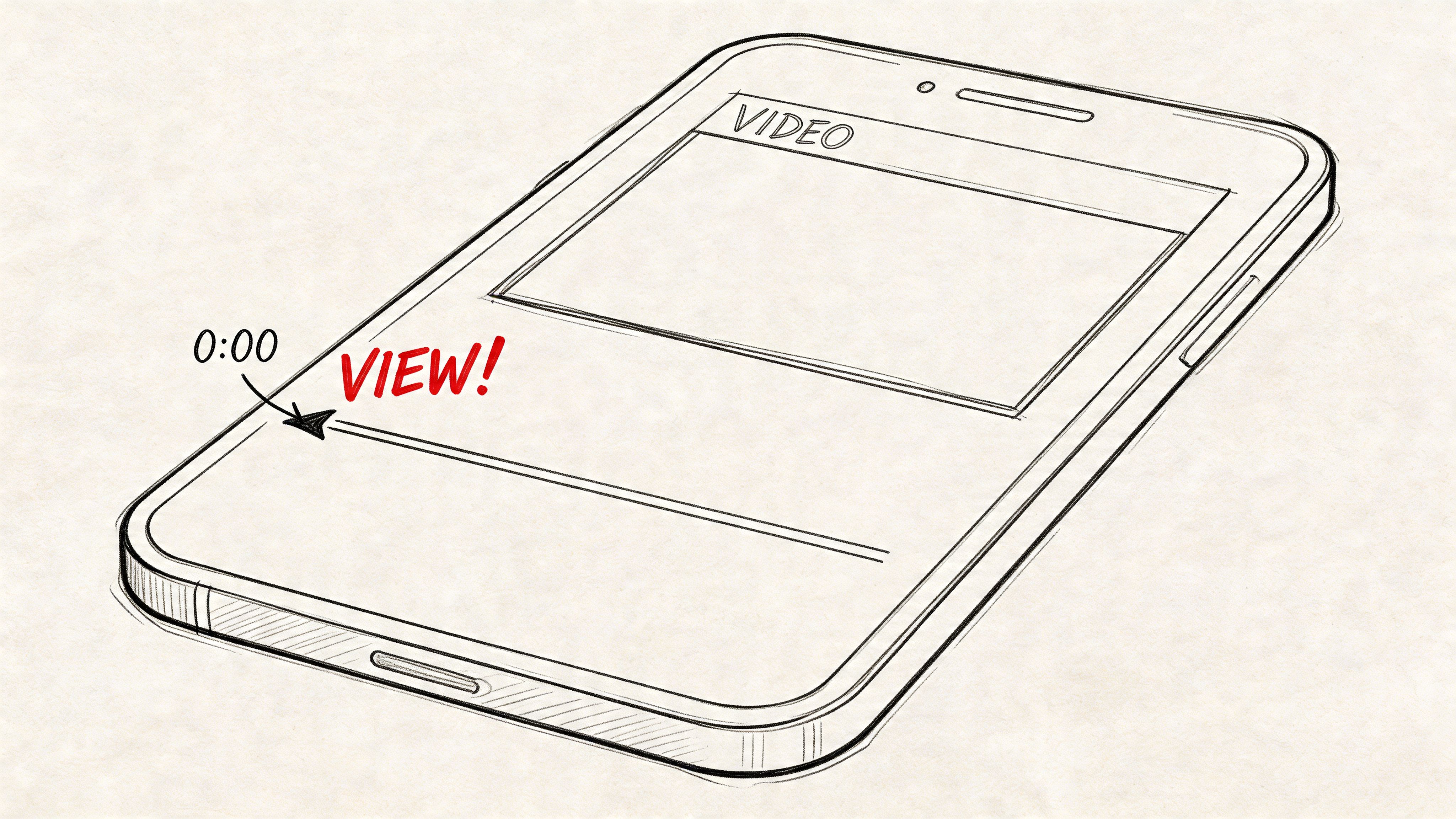
That’s why top-line view counts often look larger on TikTok than brand managers expect. The platform is built for auto-play, quick swipes, and continuous loops. According to this breakdown of how TikTok views work, a view can register from even a fraction of a second of auto-playback on the For You Page, and each replay counts as an additional view.
Why the number rises so fast
Think of a TikTok view like someone glancing into a shop window. They noticed you. That matters. But it doesn’t mean they walked in, picked something up, and bought it.
A longer watch is closer to someone stepping inside the shop. A rewatch is the equivalent of them going back to the same shelf because something caught their interest. TikTok bundles all of that into the public views number.
The same source notes that the majority of views originate from non-followers on the For You Page, which is why new posts can spike quickly when the opening seconds are strong. It also states that engaged UK viewers average 2.7 loops per video and that ecommerce brands can see 3-5x higher view velocity compared to Instagram Reels because of looping behaviour and feed mechanics, based on campaign data cited there.
Practical rule: Treat a TikTok view as an initial exposure signal, not proof of attention.
What brands should care about instead
The raw count still matters. It tells you whether content is getting distribution. But it shouldn’t be the only number in your report.
Use the public views number to answer one question: Did the creative earn enough early interest for TikTok to keep testing it?
Then use deeper analytics to answer the harder questions:
- Did people stay? Watch time tells you whether the hook matched the content.
- Did they rewatch? Replays can indicate curiosity, confusion, or strong creative structure.
- Did they act? Clicks, code use, and bookings tell you whether the view had commercial value.
If you manage campaigns for local brands, this matters even more. A creator video with fewer but more relevant local viewers can outperform a broad video with a larger public count and weak downstream action.
Views vs Reach vs Impressions A Clear Comparison
These three metrics get mixed together in campaign reports all the time. They shouldn’t.
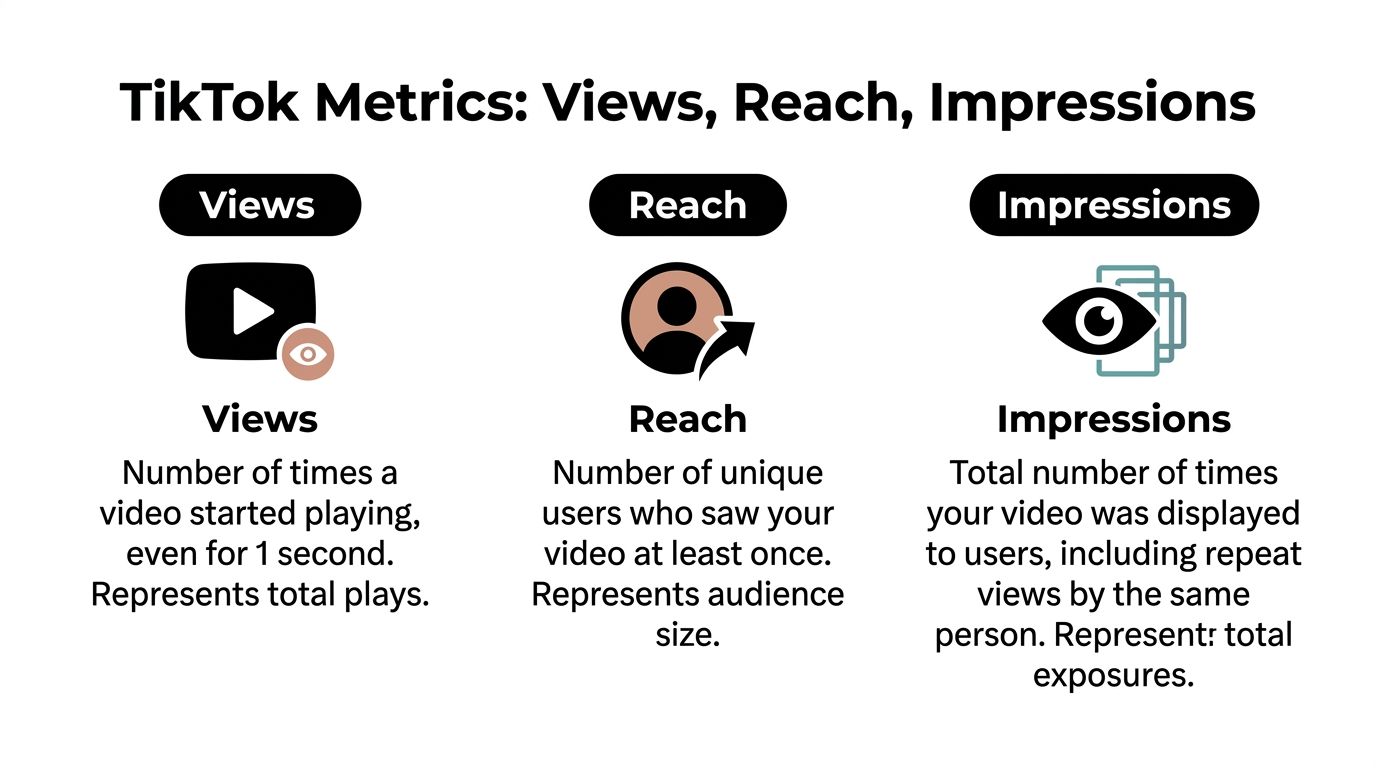
A view is a play. Reach is the number of unique people who saw the content at least once. Impressions describe total exposures, including repeat appearances to the same person. If you don’t separate them, you can’t tell whether a campaign found new people or showed the same content repeatedly.
What each metric is really telling you
Here’s the cleanest way to think about them:
| Metric | What It Measures | Key Business Question |
|---|---|---|
| Views | Number of times a video started playing | Did the content get played enough to earn distribution? |
| Reach | Number of unique users who saw the video at least once | How many individual people did we actually get in front of? |
| Impressions | Total number of times the video was displayed | How often was the content served across the audience? |
Views are useful when you’re assessing creative momentum. Reach matters when you’re trying to understand audience size. Impressions matter when you’re diagnosing frequency and repeated exposure.
Where marketers misread performance
A high views number can look impressive while hiding a small audience. That happens when the same people replay a short video, or when distribution is concentrated inside a tight interest cluster.
Reach helps correct for that. If your campaign objective is discovery in a new city, postcode area, or customer segment, reach is more informative than raw views.
A reporting deck that leads with views alone usually tells you less than the client thinks it does.
Impressions also matter in creator whitelisting or paid support scenarios, where repeated delivery can increase exposure without expanding actual audience size. If performance stalls, separating these metrics can show whether the issue is weak creative, overexposure, or narrow targeting.
For influencer programmes, I usually frame them like this:
- Views are the first signal.
- Reach is the audience truth check.
- Impressions reveal delivery pattern.
That framing stops teams from celebrating inflated totals and missing what the campaign achieved.
Finding the Real Story in Your TikTok Analytics
The fastest way to misread TikTok is to stare at the public count and stop there. Native analytics gives you the context that the profile page doesn’t.
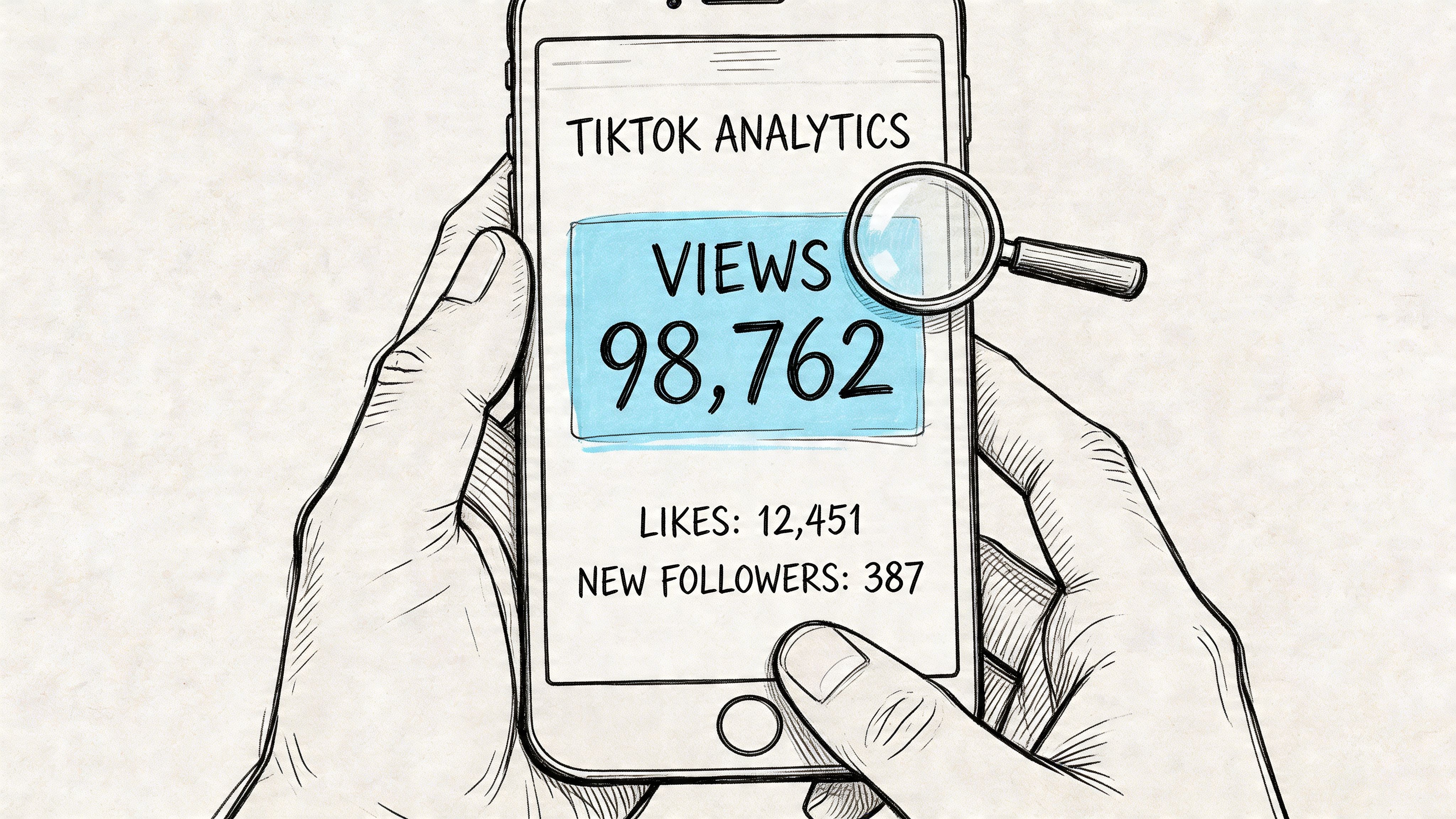
Open the account’s analytics, go into the content area, and inspect individual posts rather than account-level averages. One strong post can hide a weak content system, and one weak post can sit inside an otherwise healthy pattern.
Metrics worth checking on every post
When I review creator content, I look at the public views number last.
I start here:
- Average watch time: This shows whether the opening promise and the actual content match.
- Total play time: Useful for comparing how much aggregate attention each post generated.
- Unique viewers: This gives a better read on audience breadth than total views alone.
- Traffic source clues: These help you understand whether the post travelled via recommendation or profile intent.
A mid-level views number with stronger watch behaviour can be more commercially useful than a larger post that people abandon almost immediately. That’s especially true for product explainers, hospitality offers, and creator-led testimonials.
How to read weak and strong patterns
If a post gets an early burst of plays but weak downstream behaviour, the hook probably did its job and the body didn’t. If views are modest but watch time is strong, the creative may deserve reposting, iteration, or paid amplification.
For broader measurement discipline, this guide on the metrics that actually matter in influencer marketing is worth using as a reporting checklist.
Later in your review, it helps to watch a quick dashboard walkthrough before you finalise any conclusions:
Don’t judge a TikTok by one outcome variable. A post can be weak at awareness, strong at conversion, or the reverse.
That’s why analytics review should happen at post level, creator level, and campaign level. You want to know whether the issue sits in the asset, the creator fit, or the offer.
Translating Views into Influencer Campaign KPIs
A views target only becomes useful when it’s attached to a campaign role. Is the creator there to generate local awareness, social proof, product education, or direct response? If you don’t define that first, your KPI stack gets messy fast.
TikTok is too large and too active in the UK to treat views as a throwaway metric. Ofcom data cited in this UK TikTok usage analysis shows TikTok reached 24.8 million adult users by early 2024, or about 55% of the UK adult internet population. The same analysis cites adult usage rising from 16.4 million in 2023, a 51% year-over-year increase, and reports 102 minutes of daily usage per adult user in Q4 2023.
What views should do in a KPI stack
In creator campaigns, views work best as a leading indicator. They tell you whether the content is earning enough initial traction to justify deeper analysis.
That matters because influencer content often works in stages:
- Distribution first. The post needs enough early momentum to get served.
- Attention second. Watch behaviour tells you whether people stayed.
- Action third. Clicks, saves, code use, and bookings tell you whether the audience cared enough to respond.
If you compress all three into one target, reporting gets distorted. A creator can hit a views goal and still miss the campaign objective.
Setting KPIs that don’t break reporting
For brand managers, the cleanest approach is to build one primary KPI and a small set of supporting metrics.
Use views when the brief is about initial visibility. Add watch quality and action metrics when the brief is about revenue. For a local restaurant launch, I’d usually care whether creators earned meaningful local attention and whether that attention translated into footfall signals. For a DTC product drop, I’d care whether views led to trackable visits and code use.
A practical framework helps. This article on setting influencer marketing KPIs that drive growth gives a solid structure for separating awareness goals from performance goals.
Here’s the trade-off often overlooked. If you push creators to optimise only for views, they’ll often lean into broad hooks that attract curiosity without commercial intent. If you push only for conversion, content can become too sales-heavy and lose distribution. The best campaigns balance both. They use views as the opening signal, then judge success by what happens after the view.
Actionable Strategies for Earning High-Quality Views
You don’t need hacks to improve a tiktok views count. You need creative that earns a second watch, a pause, or enough curiosity to stop the thumb.
The first job is the hook. The second job is keeping the promise of that hook. Many TikToks fail because they do one of those well and the other badly.
Creative patterns that improve view quality
- Open with the result, not the preamble. If the video is about a bestselling dish, show the plated dish first. If it’s about a skincare outcome, show the before-and-after context immediately.
- Use on-screen text that rewards pausing. A short caption, ingredient list, price comparison, or step sequence gives people a reason to stop and absorb.
- Build the ending into the beginning. Smooth loops work because the replay feels natural rather than forced.
- Make spoken content easier to process. If the audio matters, transcribing your TikTok videos helps turn spoken lines into readable on-screen text and captions that support retention.
- Follow format familiarity, not trend panic. Trending sounds and formats help when they fit the offer. Randomly copying trends usually produces empty views.
What usually doesn’t work
Long intros underperform. Over-explaining underperforms. Creator scripts that sound approved by six stakeholders underperform.
Field note: If a creator needs ten seconds to get to the point, the view may count, but the opportunity is already gone.
A better briefing style is to give creators three fixed inputs and leave the delivery natural: the product truth, the offer or angle, and the action you want after viewing.
For teams short on concepts, this bank of video content ideas for brand campaigns is useful because it pushes beyond the usual unboxing and talking-head formula.
A simple pre-publish check
Before a post goes live, review it against this short list:
- Would someone understand the point with sound off?
- Is the first frame visually active?
- Does the caption or text create a reason to stay?
- Is there a natural replay moment or reveal?
If the answer is no to most of those, the views may come in, but they won’t be the kind you want.
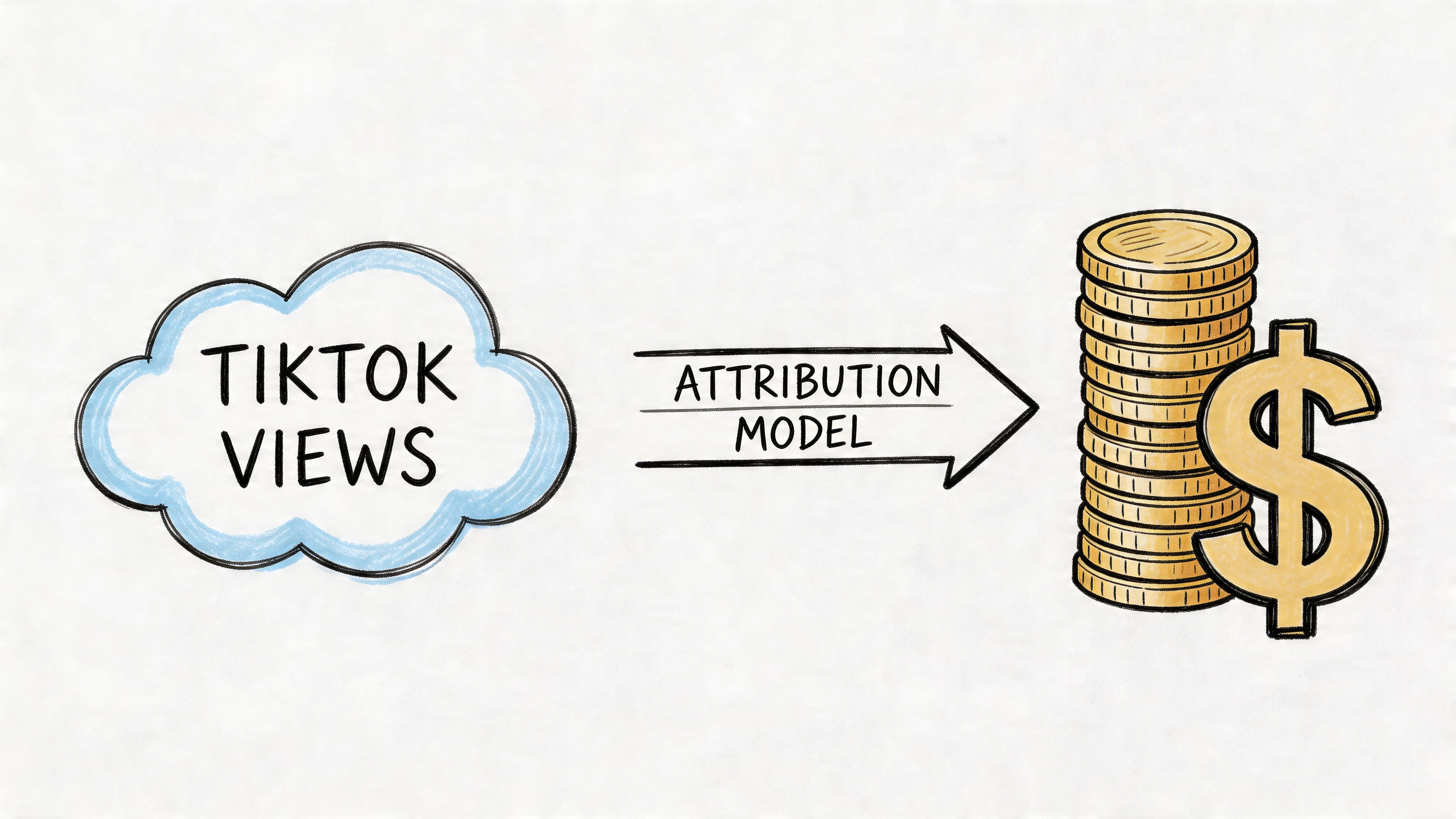
From Views to Revenue The Sup Attribution Model
Most brands don’t have a views problem. They have an attribution problem.
A creator posts. The video gets attention. The team shares a screenshot of the view count in Slack. Then everything gets fuzzy. Nobody can say which viewers clicked, which visitors bought, or whether the campaign should be scaled.
That’s where reporting usually falls apart.
Why total views aren’t enough
The key measurement issue is simple. Total views are not the same as unique people with commercial intent.
According to this analysis of TikTok competitor analysis and attribution, UK ecommerce and DTC brands face a critical gap in understanding unique viewers by video versus total views for accurate ROI measurement. The same source says that after the post-2025 TikTok Shop UK rollout, views from local awareness campaigns in hospitality spiked 40% year over year, while analytics tools often fail to segment unique UK viewers, leading to 25% ROI miscalculation. It also notes that attribution workflows can save 95% manual tracking time when unique views are connected to redemptions.
That distinction matters because repeat views can inflate the public number without increasing the pool of potential buyers.
A practical attribution framework
For brand teams, the cleanest setup is this:
| Stage | What to Track | Why It Matters |
|---|---|---|
| View | Video views and unique viewers | Shows distribution and audience breadth |
| Click | UTM-tagged link visits | Connects viewing to site traffic |
| Conversion | Promo code use, purchases, bookings | Proves commercial outcome |
A done-with-you system changes the economics of creator marketing. Instead of manually collecting screenshots, chasing creators for analytics, and stitching together spreadsheets, the campaign is built with tracking from the start.
Every creator should have:
- A unique promo code so redemptions can be tied back to the post
- A unique UTM link so traffic source is visible in analytics
- A defined conversion event such as sale, lead, booking, or reservation
- A central reporting view so the team can compare creators on outcomes, not just exposure
A lot of marketers also get distracted by creator-side earnings and platform payout discussions. That can be useful context, but it isn’t the same as brand ROI. If you need that distinction clarified, this guide on how much TikTok pays for 1 million views is helpful because it separates platform monetisation from business performance.
The best reporting question isn’t “How many views did we get?” It’s “Which views turned into trackable action?”
Once you work that way, views stop being a vanity metric. They become the top of a measurable funnel.
Conclusion Your Blueprint for Measurable Growth
A tiktok views count is easy to see and easy to celebrate. That’s exactly why brands misread it.
The useful version of the metric is more disciplined. You need to know what TikTok counts as a view, how loops and repeat plays can lift the total, and why public numbers alone don’t tell you whether the campaign worked. You also need to separate views from reach and impressions, then read each post inside native analytics instead of relying on surface-level reporting.
For influencer campaigns, views work best as an early signal. They show whether creative earned enough traction to matter. They don’t tell you, by themselves, whether people paid attention or whether the campaign generated revenue.
That’s where attribution changes the value of the entire channel. Unique links, promo codes, and consistent conversion tracking turn TikTok from a platform full of promising screenshots into a channel you can actually manage. When teams connect view data to site visits, bookings, and purchases, they stop guessing which creators are effective.
That’s the true upgrade. Not more views for the sake of it. Better measurement of the views that move the business.
Frequently Asked Questions About TikTok Views
Do my own views count on TikTok
For practical campaign analysis, don’t rely on self-checking as a way to influence performance. Brands and creators should assume their own testing behaviour isn’t a meaningful growth lever and shouldn’t be part of reporting discipline.
The safer habit is simple. Post the content, quality-check the live version once, and then monitor analytics rather than refreshing the post repeatedly.
Why do TikTok views sometimes freeze
A freeze usually means one of three things. The platform has stopped widening distribution, the content is being reviewed, or the opening response wasn’t strong enough to justify more reach.
That doesn’t always mean the post failed. Some videos plateau early and still produce useful downstream actions from a relevant audience. If the post matters commercially, check click and conversion behaviour before writing it off.
Should you buy TikTok views
No. Bought views are a reporting trap.
They can distort performance signals, make creator selection harder, and create false confidence around weak content. For brands, they’re especially damaging because they separate the metric from real business outcomes. A purchased view doesn’t help you understand local demand, product interest, or campaign ROI.
What should I report alongside views
Keep it tight:
- Unique viewers for audience size
- Watch behaviour for attention quality
- Clicks and promo code use for commercial action
- Bookings or purchases for final outcome
If those numbers move in the right direction together, the views were valuable. If only the public count rises, you’re probably looking at inflated visibility rather than growth.
If you want a cleaner way to turn creator views into trackable clicks, bookings, and sales, Sup helps brands launch and manage influencer campaigns with unique promo codes, UTM links, central reporting, and hands-on campaign support so you can measure what TikTok attention delivers.
More on tracking
See how many creators post about you and your competitors
Type in your brand's Instagram handle and we count the creators who post about you and about your five closest competitors. It takes about a minute and it is free. Or request a demo and we will show you the creators in your niche and walk you through the dashboard.
 Book a call