25 March 2026
TikTok Shop Influencer Marketing: How Ecommerce Brands Are Winning
E-commerce brands are finding huge success on TikTok Shop, and it's not by running traditional ads. They're winning by teaming up with genuine influencers who drive sales through entertaining live streams and affiliate videos, turning native content into a direct and powerful source of revenue. This move from old-school advertising to creator-led commerce is completely changing the game for UK businesses wanting fast, scalable growth.
The TikTok Shop Gold Rush in the UK
If you’ve been writing off TikTok Shop as just another passing trend, it’s time for a reality check. The platform has quietly transformed from a social media curiosity into a serious retail force, especially here in the United Kingdom. The conversation is no longer about if your brand should be on there; it’s about how you can stake your claim.
Think of it less like a standard marketplace and more like a bustling digital high street that's open 24/7, powered by thousands of individual storytellers. It's a direct-to-consumer channel with surprisingly few barriers to entry, giving you a straight line to millions of shoppers who now turn to TikTok to discover and buy.
A Market Ignited by Data
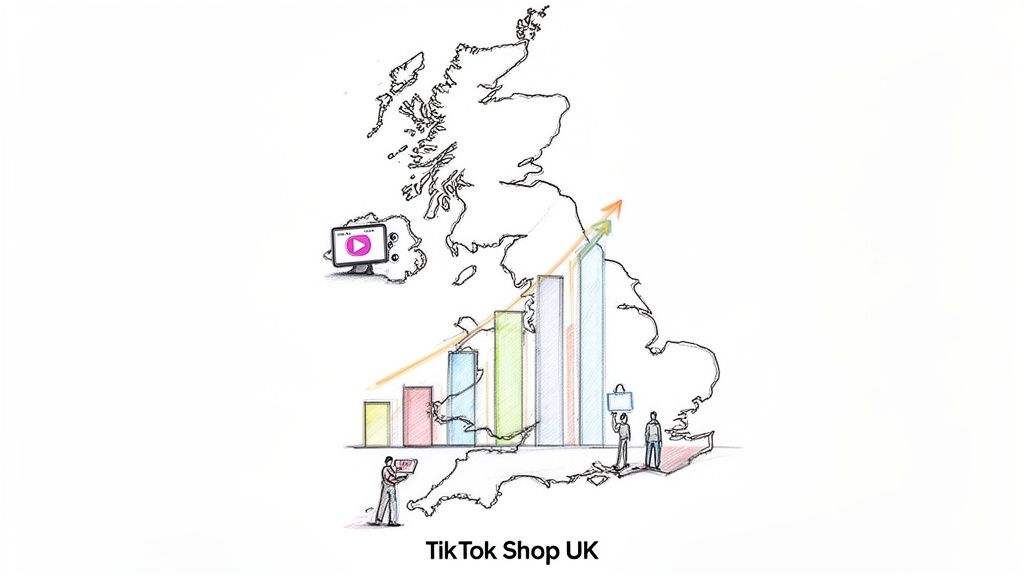
The numbers behind TikTok Shop's UK journey are, frankly, staggering. Between 2023 and late 2024, the platform didn't just grow. It exploded. The number of active sellers doubled to 200,000, the UK saw a 131% jump in shoppers, and revenue shot up by an incredible 180% year-over-year. This all came to a head on Black Friday 2024, when an item was sold every 2.7 seconds, marking the platform's biggest sales day ever in the UK. To get a sense of the platform’s foundational growth, you can read up on the rise of TikTok.
This incredible momentum has built a vibrant ecosystem where sales opportunities are everywhere you look. Two key things are fuelling this fire:
- Non-Stop Live Streams: Every day, over 6,000 TikTok Shop Lives go on air across the UK, giving brands a constant stage to demonstrate their products in a raw, real-time format.
- A Powerful Affiliate Network: There's a ready-made army of over 100,000 UK creators in the affiliate programme, all turning their authentic content into a scalable sales force for brands like yours.
The infographic below puts these headline figures into perspective.
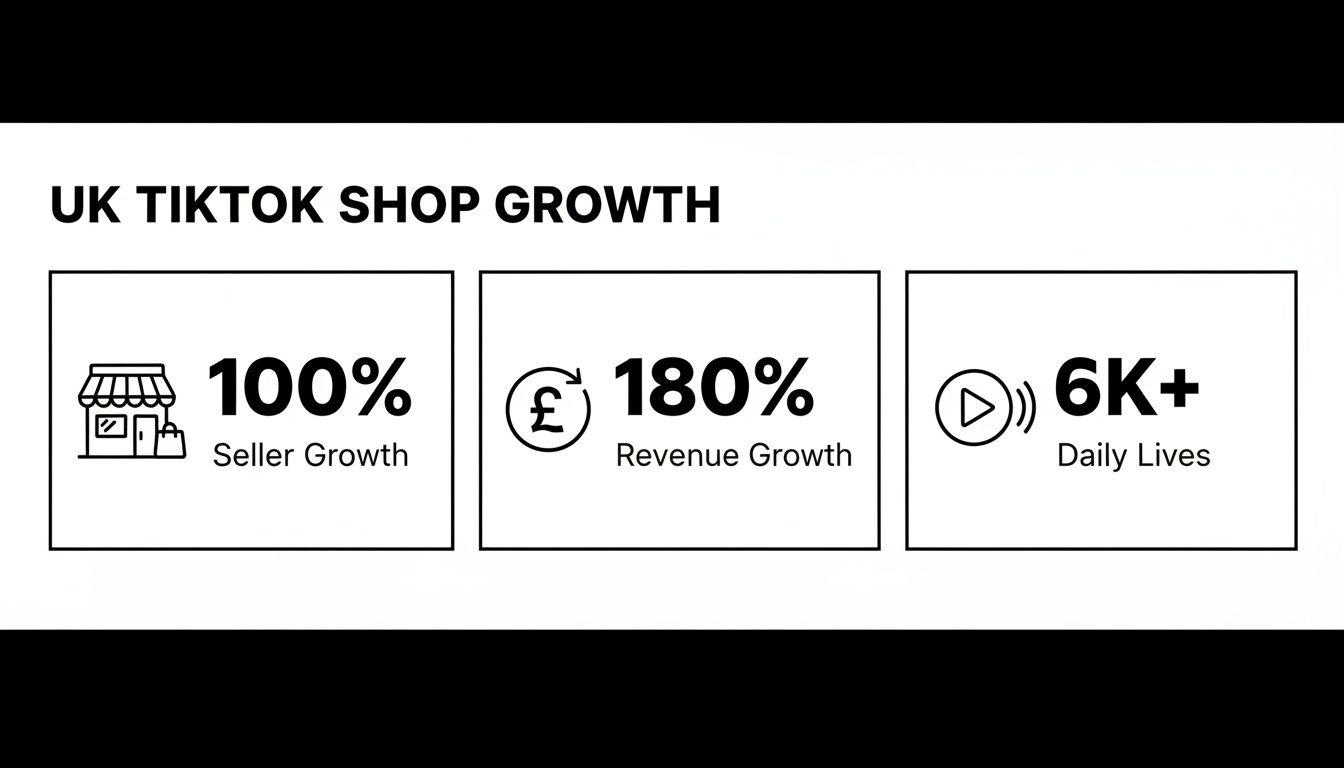
This data paints a clear picture: TikTok Shop isn't just a magnet for sellers; it's a powerful engine for generating real, substantial revenue. It has solidified its place as a critical channel for any ambitious e-commerce brand.
The table below summarises the incredible expansion that has set the stage for continued growth into 2025 and 2026.
TikTok Shop UK Growth at a Glance (2025-2026)
| Metric | Growth Figure |
|---|---|
| Year-Over-Year Revenue | 180% increase |
| Active UK Sellers | Doubled to 200,000 |
| Active UK Creators | 100,000+ |
| Daily Live Streams | 6,000+ |
These figures aren't just vanity metrics; they represent a fundamental shift in how and where UK consumers are spending their money.
What this means for e-commerce brands is that the UK's TikTok Shop landscape offers something truly unique: unprecedented accessibility with lower barriers to entry than traditional retail, combined with direct access to millions of engaged consumers ready to buy.
Ultimately, the proof is in the numbers. TikTok Shop is no longer an experiment. It's an essential battleground for UK brands that want immediate, measurable, and scalable income through influencer marketing. The gold rush is happening right now.
Why Influencers Are Your Ultimate Sales Channel
To really grasp why influencer marketing on TikTok Shop works so well, you have to stop thinking about it as traditional advertising. Influencers aren't just creating content; they are your most effective sales channel.
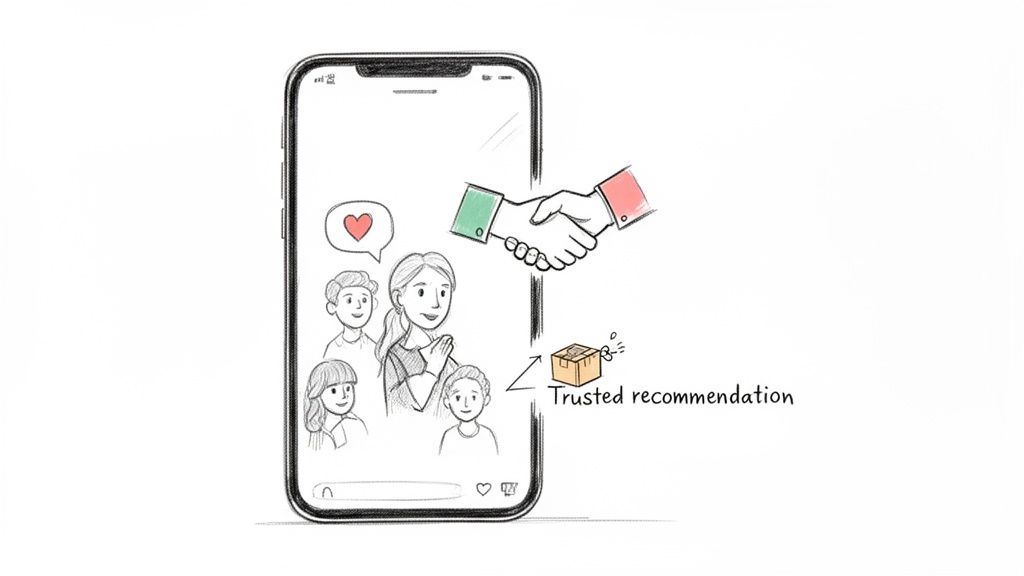
Think of it this way: who are you more likely to trust? A polished corporate advert or a recommendation from someone whose opinion you genuinely respect? It’s a no-brainer. TikTok creators are that trusted source, but they operate on a massive scale. They’ve spent years building real relationships with their audience, earning a level of trust that brands just can’t buy.
When a creator shows off a product, they’re not just rattling off features. They’re weaving it into their own life, showing how it works in a real-world setting, and giving an honest take. That authenticity is precisely what drives commerce on TikTok.
The Psychology of Trust and Conversion
At its core, the commercial power of TikTok Shop is built on the very human element of trust. People on the app want authentic, unfiltered content, and they can smell a clumsy sales pitch from a mile off. The creators who really succeed have nailed the balance between entertaining their audience and organically featuring products.
This is where the trust they’ve built with their followers gets transferred directly onto your brand. It’s not just a hunch; the numbers are undeniable.
A huge 48% of all sales on TikTok Shop come directly from influencer posts. That single figure explains why so many ecommerce brands are now treating creator partnerships as a primary channel for growth, not just a marketing add-on.
This powerful connection gets a massive boost from the platform’s own design. With shoppable videos and live streams, the journey from seeing a product to buying it is incredibly smooth. It’s a seamless shopping experience powered by genuine human connection.
Why Smaller Creators Often Deliver Bigger Results
It’s easy to get fixated on creators with millions of followers, but the data points in a different direction. For savvy UK brands, the real secret weapon is working with micro and nano-influencers. These creators have cultivated smaller, tight-knit communities that are incredibly engaged.
Their content feels more like a conversation than an advert, which results in amazing engagement and a much higher return on investment for brands.
- On TikTok, micro-influencers (with up to 50,000 followers) hit an incredible engagement rate of 30.1%.
- Nano-influencers (1,000 to 10,000 followers) aren't far behind, with an average engagement rate of 15.2%: the highest of any tier on any platform.
- When these creators share affiliate links, they see an engagement rate of 5.2%. That’s a massive 160% higher than on Instagram.
These numbers prove that focusing on smaller, hyper-relevant creators delivers far better engagement than old-school celebrity endorsements. This strategy isn’t just more authentic; it's more profitable. On average, brands are seeing a return of £5.78 for every £1 spent on influencer marketing. You can explore more on this in our breakdown of the latest influencer marketing statistics.
In the first half of 2025 alone, the TikTok creator ecosystem grew to 15.3 million people, with over 851,000 actively selling products. While a few superstars generate enormous revenue, the real opportunity for most brands is to scale their efforts with the huge number of micro-creators who offer authentic connections and exceptional results.
Your Playbook for a Winning Campaign Strategy
Alright, let's get practical. A winning TikTok Shop campaign doesn't just happen by chance. It’s the result of a deliberate plan that pieces together the right creators, a smart campaign model, and meticulous tracking. This is your game plan for turning those influencer partnerships into real, measurable revenue.
Your first, and most crucial, job is to find the right creators. This is less about chasing huge follower counts and more about playing matchmaker. You’re looking for people whose audience and personal brand genuinely click with what you’re selling. Think of them as your brand’s best advocate: someone who already speaks your customer's language.
To really nail this, you have to go deeper than the surface metrics. Look at their community, their content style, and how their past campaigns have performed. A creator's engagement rate will tell you far more about their actual influence than their follower tally ever will.
Finding Your Perfect Creator Match
Finding great micro-influencers is where the real magic happens. These creators tend to have incredibly loyal, niche communities that can be goldmines for the right brand. The trick is to spot genuine brand affinity, not just someone looking for a freebie.
Here's what to zero in on during your search:
- Audience Demographics: Do their followers actually look like your ideal customers? Check out their age, location, and what they’re interested in.
- Content Authenticity: Does their content feel real? You need creators who can weave your product into their videos without it feeling like a clunky, forced ad.
- Engagement Quality: Don’t just glance at the numbers; read the comments. Are people having real conversations, or is it a sea of emojis and bots? Real discussion is a sign of a healthy, trusting community.
- Previous Brand Partnerships: Look at their past collabs. Did they do a good job representing the brand and get people genuinely excited about the product?
A creator with 10,000 followers who hang on their every word is infinitely more valuable than one with 100,000 passive followers who scroll right past their sponsored posts. It’s all about connection, not just eyeballs.
Choosing the Right Campaign Structure
Once you’ve got a shortlist of potential partners, it's time to decide how you'll work together. The campaign structure defines how you'll pay creators and what you expect in return. Each model has its place, so pick the one that aligns with your budget and what you’re trying to achieve right now.
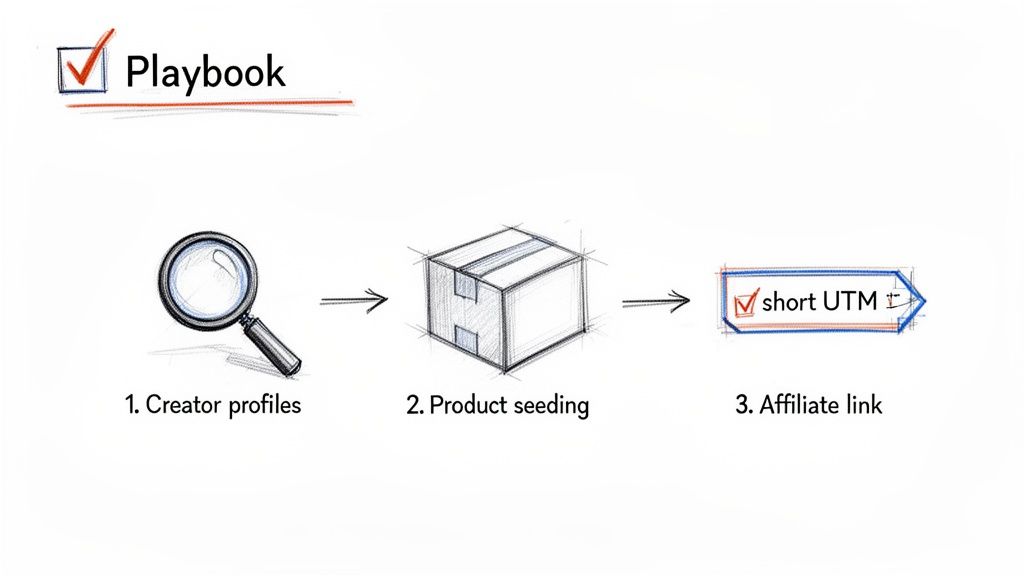
1. Product Seeding: This is a fantastic starting point. You send free products to a handpicked list of creators, with no concrete obligation for them to post. It's a low-cost way to get your product out there and hopefully generate some organic buzz and user-generated content (UGC). The catch? There’s no guarantee of coverage.
2. Affiliate Commissions: In this performance-first model, creators get a cut of every sale made through their unique link or promo code. It’s an incredibly powerful, low-risk method for driving sales because you’re only paying for actual results. This structure gives creators a direct incentive to make content that truly converts.
3. Hybrid Model: This approach is the best of both worlds, mixing an upfront flat fee with a commission on the back end. It gives creators the security of guaranteed income while still motivating them to push for sales. We often see this structure used for more established creators who have a proven history of delivering results.
The right choice really boils down to your main goal: is it brand awareness, content creation, or direct sales? For a much deeper look into structuring these deals, our guide on influencer marketing for ecommerce breaks it all down.
Crafting a Creative Brief That Inspires
Think of your creative brief as a compass, not a script. The single biggest mistake we see brands make is being far too restrictive. When you dictate every last detail, you kill the authenticity that makes influencer content work in the first place. Your job is to empower creators, not micromanage them.
A truly great brief should include:
- Clear Campaign Goals: What's the one thing you want to achieve? Sales, email sign-ups, or just getting your name out there?
- Key Talking Points: Give them 2-3 must-have messages about your product, but then trust them to say it in their own voice.
- Content Do's and Don'ts: Lay out any mandatory tags, things to avoid for brand safety, or other guardrails, but leave plenty of room for their creative spark.
To keep up with the demands of the platform, many creators use the best AI tools for content creators to help with everything from scripting to editing.
The final, non-negotiable piece of your strategy is tracking. If you aren’t tracking, you’re just guessing. Every single campaign needs to use unique promo codes and UTM parameters for each influencer. This is how you trace every click and every sale back to its source, giving you cold, hard data on your return on investment. This is what turns your TikTok Shop influencer marketing from a simple expense into a predictable engine for growth.
Measuring What Matters for True ROI
When it comes to TikTok Shop, a campaign’s success isn't about viral views or a flood of likes. While those numbers are great for the ego, they don't actually pay the bills. The real test (and where so many brands stumble) is tying your influencer efforts to tangible business value.
If you want to win over the C-suite and unlock bigger budgets, you have to move beyond the superficial. It's time to connect the dots between a creator's video and a confirmed sale, turning their content into a reliable revenue stream.
This means asking different questions. Instead of "How many people saw the video?", you need to be asking, "How many new customers did this bring in, and what did it cost us to get them?"
Shifting From Vanity to Value
The metrics you choose to prioritise will determine whether your influencer programme is seen as a cost centre or a profit engine. Vanity metrics like views and follower counts are easy to track, but they often hide a lack of real impact. Actionable metrics, on the other hand, give you a clear signal about your financial performance.
This is the key to moving from just doing influencer marketing to truly mastering it. You need a direct line of sight from a piece of content straight to your bottom line.
To get there, you need to reframe how you think about success. The table below shows exactly how to shift your focus from feel-good numbers to metrics that actually drive business growth.
From Vanity Metrics to Business Impact
| Vanity Metric (Avoid) | Actionable Metric (Focus On) | Why It Matters |
|---|---|---|
| Video Views | Product Page Clicks & Add to Baskets | Views show potential reach, but clicks and adds to basket signal genuine purchase intent. This is your first real sign of a customer. |
| Likes & Comments | Promo Code Redemptions | Engagement is encouraging, but a redeemed code is cold, hard proof that a specific influencer drove a sale. |
| Follower Growth | Customer Acquisition Cost (CAC) | A bigger audience doesn't guarantee more sales. A low CAC proves you're bringing in new customers efficiently and profitably. |
| Total Reach | Return on Investment (ROI) | Reach is an abstract concept. ROI is the ultimate KPI, telling you exactly how much revenue you earned for every pound you spent. |
Making this switch is all about accountability. It transforms your influencer marketing from an experimental spend into a powerful, data-backed growth channel. For a deeper dive, check out our guide on how to measure influencer marketing ROI.
Building a Centralised Tracking System
So, how do you actually track all of this without drowning in spreadsheets? The answer is a centralised tracking system that pulls all your critical data into one dashboard.
Imagine having a single screen showing every piece of creator content, every click, every promo code used, and every sale generated, all updated in real time. This isn't a pipe dream; it's a must-have for any serious ecommerce brand playing on TikTok Shop.
A solid tracking setup should automatically manage:
- Unique Promo Codes: This is non-negotiable. Assigning a distinct code to each creator is the cleanest way to attribute sales directly to their work.
- UTM-Tagged Links: These custom URLs let you follow the customer journey from the moment they click in a creator's bio all the way to checkout confirmation.
- Performance Dashboards: When you can visualise data for each creator, you can instantly see who your top performers are. This allows you to double down on what works and cut what doesn't.
By putting a system like this in place, you gain total visibility over your campaigns. You can optimise your strategy on the fly, report on your success with confidence, and prove that your influencer programme isn't just creating buzz. It's driving the business forward.
Real Brands Winning on TikTok Shop
It’s one thing to talk strategy, but it’s another thing entirely to see it drive actual sales. So, let’s move past the theory and look at how real UK ecommerce brands are making TikTok Shop work for them. These examples show exactly how the right creators and content can turn views into genuine revenue.
Think of these not just as success stories, but as practical blueprints. We'll break down what they did, why it worked, and the results they saw, so you can see what’s possible for your own brand.
A Beauty Brand’s Micro-Influencer Masterclass
A UK-based skincare brand found itself in a familiar spot: trying to get noticed in the incredibly crowded beauty world. Their aim wasn't just to make a bit of noise; they wanted to get their products into people's hands and spark some real, authentic conversation.
Instead of pouring their budget into one or two big-name beauty gurus, they went a different route. They handpicked a group of 50 micro-influencers, each with a following between 5,000 and 20,000. The plan was beautifully simple.
- The Campaign: They used a hybrid model, mixing product seeding with affiliate marketing. Every creator was sent a full skincare routine and given a unique 15% discount code. For every sale made with their code, they earned a 10% commission.
- The Content: The creative brief was deliberately relaxed. They asked creators to film honest "Get Ready With Me" (GRWM) and morning routine videos, letting them fit the products into their existing content style. This felt natural to their audience, not like a forced ad.
- The Results: It worked brilliantly. In just one month, the campaign generated over 200 unique pieces of UGC. More importantly, affiliate sales delivered a direct 7:1 Return on Ad Spend (ROAS). That authentic, user-led content proved far more powerful than any glossy, polished advertisement ever could be.
This just goes to show that for generating high-quality UGC and a strong, measurable return, a targeted group of micro-influencers can often outperform a single macro-influencer.
A Food Company's Live Shopping Success
A challenger snack brand was gearing up for a new product launch and wanted to make a serious impact. The goal was simple: drive a massive volume of sales in a very short space of time, creating a real sense of excitement and urgency. Their big bet? A single, high-energy live shopping event.
The brand teamed up with a popular foodie creator known for their fun and engaging live streams. The entire strategy was built around creating an unmissable event.
They organised a one-hour "Launch Day Live" stream hosted by the influencer. It was packed with exclusive live-only discounts and special bundle deals. The creator tasted the new snack on air, took questions from the audience in real-time, and turned the whole thing into a genuinely fun, interactive shopping experience.
The outcome blew their forecasts out of the water. During that single 60-minute live stream, the creator sold over 1,200 units of the new snack. The combination of the creator’s genuine excitement and the time-sensitive offers created a powerful dose of FOMO (fear of missing out) that pushed viewers to buy right there and then. It’s a perfect example of how live shopping can be an absolute powerhouse for product launches, especially when you find the right creator who can hold an audience’s attention.
Common Mistakes and How to Avoid Them
Getting into TikTok Shop can be incredibly profitable, but I’ve seen too many brands stumble over the same few hurdles. It’s easy to make mistakes that can sink your campaign before it ever gets a chance to shine.
Think of this as your guide to sidestepping the most common landmines. Getting these things right from the start protects your budget and massively boosts your odds of seeing a fantastic return. Let's walk through the big three.
Choosing Vanity Metrics Over Real Alignment
The classic rookie error? Picking an influencer based purely on their follower count. A huge audience is completely useless if it’s the wrong one for your brand. I guarantee a creator with millions of followers who couldn't care less about your niche will deliver far worse results than a micro-influencer with a small but passionate, perfectly aligned community.
You have to prioritise relevance over sheer reach. Look for creators who genuinely love what you do and whose audience looks exactly like your ideal customer.
- Wrong: "This creator has 2 million followers, let's work with them."
- Right: "This creator has 15,000 followers who are obsessed with sustainable fashion, our exact niche. Their engagement rate is also a massive 30%."
An influencer partnership is like a recommendation from a trusted friend. You need to make sure your brand is being recommended by the right friend to the right group of people.
Writing Overly Restrictive Creative Briefs
Alright, you've found the perfect creator. The next place brands go wrong is by handcuffing them with a rigid, script-like brief. Influencers built their audience by being themselves. When you force them to sound like a corporate brochure, that all-important authenticity just evaporates. The content feels clunky, their audience spots the ad a mile off, and they scroll right past it.
Your brief should be a guide, not a straitjacket. Give creators the freedom to talk about your product in their own voice.
- Give them the key messages to hit, but never a full script.
- Clearly outline the "do's and don'ts" to keep your brand safe.
- Trust their expertise. They know what makes their followers tick better than anyone.
This is how you get content that feels natural and actually drives engagement and, more importantly, sales on TikTok Shop.
Launching Without a Solid Tracking Plan
This last one is probably the costliest mistake of all: launching a campaign without properly tracking your results. If you don't give each influencer a unique promo code or UTM link, you're essentially flying blind. You will have no idea which partnerships are actually driving sales and which ones are just eating up your budget.
Setting up your tracking isn't a "nice-to-have"; it’s absolutely fundamental to proving Return on Investment (ROI). It’s the only way to see exactly which creators are your top performers, so you can double down on what’s working and build a smarter, more effective TikTok Shop strategy for the future.
Your TikTok Shop Questions Answered
Getting started with TikTok Shop can bring up a lot of questions. That’s completely normal. We hear the same ones from countless ecommerce brands, so let's clear up a few of the most common hurdles right now.
What Is a Good Budget for TikTok Shop Campaigns?
This is the big question, isn’t it? While there’s no single right answer, we are seeing a clear trend: many successful brands now earmark around 25% of their total marketing spend for influencer partnerships. That’s a huge signal of where the industry is heading.
For your very first campaign, you don’t need to go all-in. Start with a test budget you're comfortable with. Focus it on low-risk activities like a broad product seeding programme or a small-scale affiliate trial. The goal is to gather data quickly, see what resonates, and then double down on the creators who are driving real results.
How Long Does It Take to See Results?
Everyone hopes for that one viral video that sells you out overnight, and it absolutely can happen. But the real, sustainable growth comes from playing the long game. You'll definitely see initial buzz and engagement within a few days of a post going live, but the true momentum builds over time.
Give your first proper campaign at least 30-60 days before you try to measure its full impact. This gives the TikTok algorithm enough time to work its magic and for authentic user-generated content to start popping up. Remember, consistent, ongoing effort is what turns this from a fun experiment into a predictable revenue channel.
The UK market’s trust in this channel is soaring. A massive 83% of brands now rate influencer marketing as effective, with 82% stating it produces the highest quality leads over other marketing channels. This trust is backed by a spend increase of over £540 million in recent years, showing a clear shift towards creator-led commerce. You can explore more data on UK influencer marketing trends from ourownbrand.co.
How Do I Pay Influencers on TikTok Shop?
One of the best things about TikTok Shop is the flexibility in how you can structure payments. There's no one-size-fits-all model, which means you can find an approach that works for both your budget and the creator's expectations.
Here are the four most common models we see working for ecommerce brands right now:
- Product Seeding: Simply sending free products to creators with no strict obligation to post. It’s a fantastic, low-cost way to get your products into the right hands and start building genuine relationships.
- Affiliate Commissions: Paying creators a percentage of every sale they generate through their unique link or code. This is a pure performance play. You only pay for what works.
- Flat Fees: A set payment for a specific list of deliverables, like three videos and one live stream. This is standard practice when working with more established creators who have a proven track record.
- Hybrid Model: A mix of a smaller flat fee plus a commission on sales. This is a great middle-ground that gives the creator some financial security while still incentivising them to drive as many sales as possible.
More on channels
See how many creators post about you and your competitors
Type in your brand's Instagram handle and we count the creators who post about you and about your five closest competitors. It takes about a minute and it is free. Or request a demo and we will show you the creators in your niche and walk you through the dashboard.
 Book a call