24 May 2026
Best Influencer Campaign Management Software for 2026
If you're running influencer campaigns from a spreadsheet, your process probably looks familiar. One tab holds creator handles. Another tracks shipping. Someone on the team is searching old Instagram DMs to confirm whether a post went live. Finance wants to know who still needs paying. The founder wants to know what revenue came from the campaign. Nobody has one clean answer.
That setup works for a handful of creators. It breaks when campaigns become recurring, local, multi-platform, or accountable to budget owners. The problem isn't just admin. It's that manual workflow makes it hard to prove what happened, hard to repeat what worked, and hard to scale without operational drag.
Beyond Spreadsheets and DMs
Teams often don't start with influencer campaign management software. They start with whatever is available. A spreadsheet for outreach. Email for briefs. DMs for follow-ups. Shared folders for content. A notes column for promo codes. It feels scrappy and efficient until volume increases.
Then the cracks show. Creators receive the wrong brief version. Two team members contact the same person. One post goes live without approval. Another is missed entirely because nobody logged the date properly. At reporting time, the team can describe activity, but not business impact.
Why this has become urgent
This isn't a niche workflow problem anymore. Influencer marketing is already mainstream, and the category around it is expanding fast. Statista estimates the global influencer marketing market will reach over 32 billion U.S. dollars in 2025, while the broader influencer marketing platform market is projected to grow from USD 1.15 billion in 2026 to USD 2.03 billion by 2031, a 12.0% annual growth rate according to MarketsandMarkets research on influencer marketing platforms. The same source context notes UK-focused reporting that says over 75% of brands now incorporate influencer marketing into digital strategy, and campaigns can return as much as £4.20 for every £1 spent.
When a channel reaches that level of adoption and scrutiny, improvisation stops being acceptable. Finance expects attribution. Brand teams expect compliance. Regional teams expect speed. Agencies expect client-ready reporting.
Practical rule: If your team can't tell, from one system, who was briefed, what went live, what was paid, and what revenue was attributed, you don't have a programme. You have activity.
What software changes
Good influencer campaign management software isn't just a nicer dashboard. It replaces fragmented manual handling with a single operational layer. That layer should track creator discovery, outreach, content review, links, codes, reporting, rights, and payments in one place.
The shift matters because it changes how the team works. Instead of chasing information across tools, the campaign itself becomes the source of truth. That is what turns influencer marketing from a set of one-off collaborations into a repeatable growth channel.
The Operating System for Your Creator Programme
Think of influencer campaign management software as the operating system for your creator programme. Not a contact list. Not a social listening add-on. Not a reporting skin over platform metrics. An operating system coordinates moving parts that would otherwise live in separate tools and separate people's heads.
Used well, it becomes the control centre for the whole lifecycle.
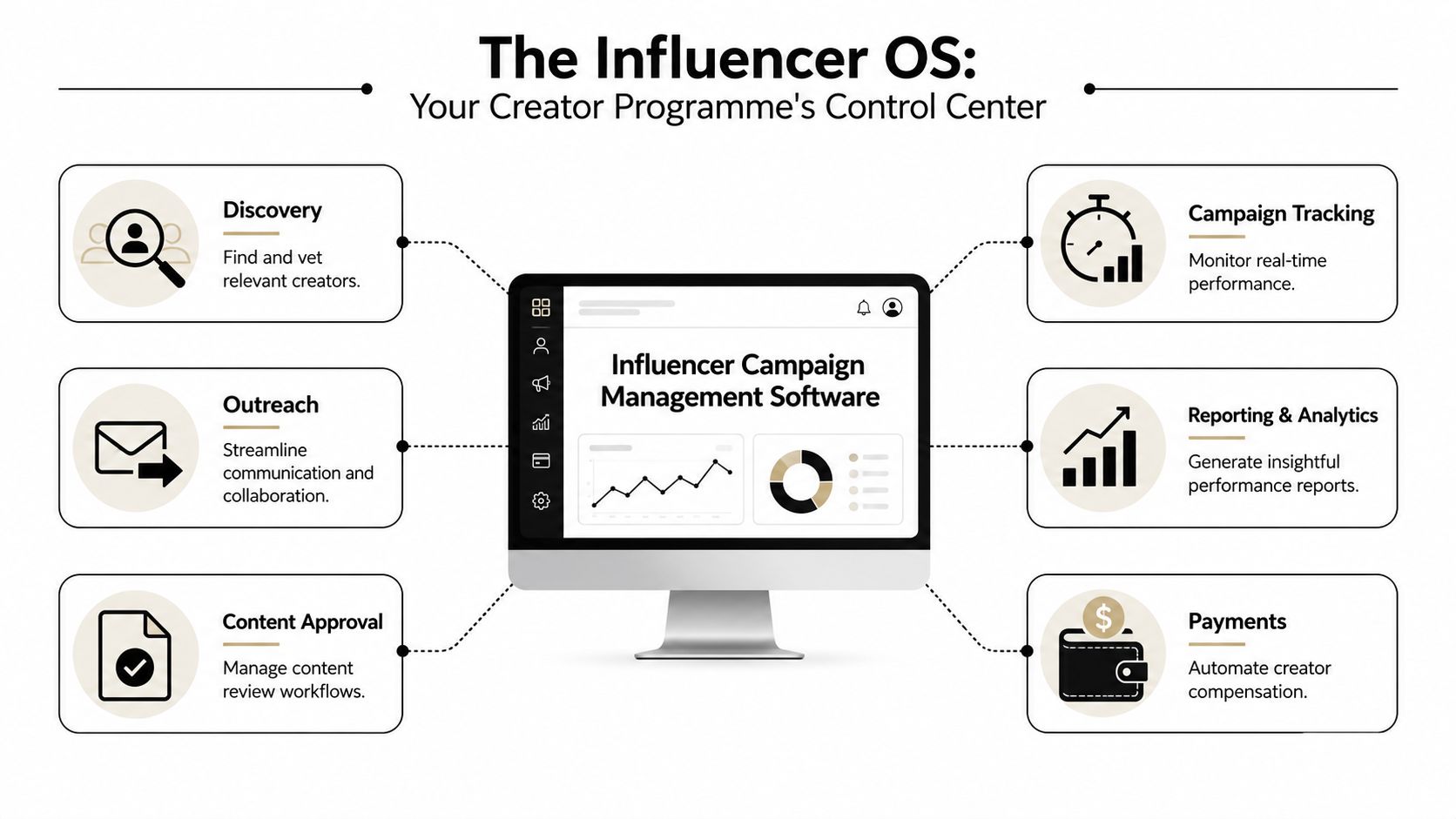
The four pillars that matter
Creator discovery and CRM
Many teams often underbuy. They choose a tool with a large creator database but weak relationship management. Discovery matters, but once a creator is in your world, the primary work starts.
You need records for:
- Identity and fit: niche, audience relevance, location, past brand work
- Operational status: contacted, replied, negotiating, approved, live, paid
- History: past deliverables, previous rates, performance, usage rights
- Local relevance: postcode, city, travel radius, branch alignment
A spreadsheet can store some of this. It can't reliably manage it across multiple campaigns and multiple operators.
Campaign management and automation
This is the layer that removes the repetitive admin. Briefs, deadlines, approval states, reminders, and live content checks should sit inside one workflow. If outreach lives in inboxes and approval lives in chat messages, errors aren't a possibility. They're guaranteed.
What works is structured workflow. One owner. One status model. One place where deliverables are confirmed.
Performance attribution and ROI
Weaker tools hide behind engagement dashboards. Impressions and views matter for context, but they don't answer the core commercial question. Did this creator drive bookings, purchases, code redemptions, or some other defined conversion?
The stronger platforms connect links, codes, and conversion events into one campaign record. That gives operators something better than a pretty report. It gives them a basis for budget decisions.
Software that only tells you what happened on social platforms is reporting media activity. Software that connects creator activity to conversion data is reporting business impact.
Content and asset management
Brands often forget that creator output has value beyond the initial post. If your tool doesn't organise approved content, rights status, filenames, and usage windows, your team will lose reusable assets inside shared drives and message threads.
A useful system makes content searchable and operational. Paid social can pull from it. Local branches can reuse it. Agencies can export it for clients. Legal can confirm what usage was agreed.
A Typical Campaign Workflow in Action
The easiest way to judge influencer campaign management software is to follow one campaign from start to finish and look at what the tool removes from the team's plate.
Here is what a working process looks like in practice.
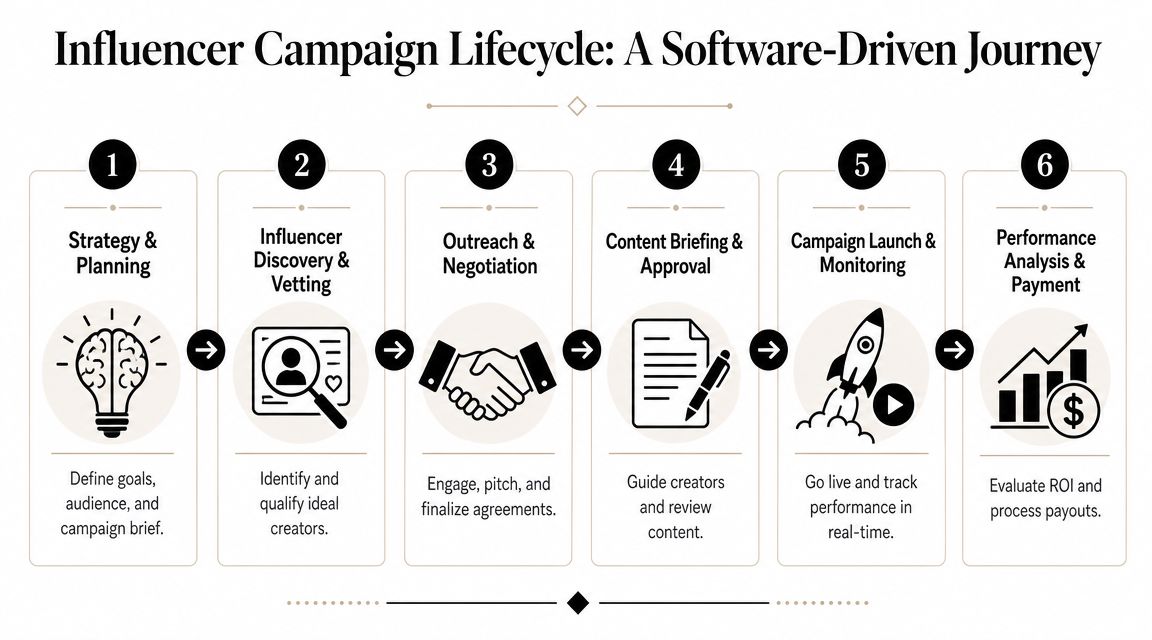
Start with the campaign record, not the creator list
A solid workflow begins by setting the campaign itself. Objective, audience, offer, required content, approval rules, links, codes, and reporting windows should all be defined before outreach starts.
That sounds basic, but teams often do the opposite. They begin by messaging creators, then patch the operational details together later. That's how you end up with inconsistent deliverables and impossible reporting.
A better sequence looks like this:
- Create the brief: define audience, offer, deliverables, timing, and success metric.
- Load the tracking setup: assign UTMs, promo codes, landing pages, and any booking logic.
- Set workflow rules: approval stages, payment conditions, content rights, and internal owners.
Move discovery and vetting into a repeatable process
Once the campaign record exists, discovery becomes focused. You're not just hunting for creators with decent content. You're looking for creators who fit a campaign requirement set.
For a restaurant opening, that might mean local TikTok and Instagram creators within a realistic travel radius. For a DTC launch, it might mean creators who can drive product education and conversion, not just aesthetics. For an agency, it might mean creators already cleared for brand safety criteria.
The vetting stage should log:
- Relevance: audience fit, content style, location
- Operational risk: responsiveness, previous missed deadlines, unclear pricing
- Commercial fit: likely ability to drive the target action
- Reuse potential: quality of raw content for organic and paid reuse
Teams that want to scale beyond a handful of partnerships usually need a more structured operating model. This guide on scaling influencer marketing from 5 to 500 creators is a useful companion if you're building process rather than just running one-off activations.
Replace chasing with status management
This is the point where software saves the most time. Manual outreach isn't just slow. It's hard to audit. People forget to follow up, miss replies, or negotiate terms in scattered threads.
In a central system, outreach and negotiation become trackable states. You can see who was contacted, who replied, what terms were agreed, and what still needs approval. That changes manager visibility immediately.
The campaign usually doesn't fail because strategy was unclear. It fails because the team lost control of execution details.
Keep launch and live monitoring in one place
When creators begin posting, the tool should collect live content, attach it to the campaign record, and show whether the deliverable matched the brief. That matters for more than quality control. It affects payment, rights, and attribution.
The old way involves someone checking social apps manually, taking screenshots, updating a spreadsheet, and trying to reconcile the result later. The better way is a dashboard that ties each live post to the creator, the brief, the trackable link or code, and the eventual payment state.
Close the loop with reporting and payment
The campaign isn't finished when the post goes live. It's finished when the team can answer five questions clearly:
| Question | What the software should show |
|---|---|
| Who delivered? | Creator-level completion status |
| What was published? | Asset links and content records |
| What happened? | Clicks, conversions, redemptions, bookings, revenue where available |
| What do we owe? | Payment status and agreed terms |
| Should we rebook them? | Creator-level performance and operational notes |
That final point matters. The best creator database isn't the one with the most profiles. It's the one that gets smarter after every campaign.
Key Features That Actually Drive Results
Most buyer guides flatten everything into a generic feature list. Discovery. Outreach. Analytics. Payments. That doesn't help much, because it treats all capabilities as equal. They aren't.
The useful way to evaluate influencer campaign management software is by the result each feature produces. Some features save time. Some make ROI defensible. Some let the business run local campaigns without operational collisions.
Features that reduce manual work
These are the features that stop the team drowning in coordination.
- Centralised creator CRM: Keeps contact history, rates, notes, deliverables, and prior performance in one record. Without this, the same mistakes get repeated every quarter.
- Template-based briefs and outreach: Helps the team move quickly without rewriting everything from scratch. The trade-off is rigidity. If the software forces every campaign into one template, quality drops.
- Approval workflows: Essential when legal, brand, and local operators all need visibility. Lightweight approval steps work better than long chains that delay go-live.
- Content collection: The platform should pull live assets into the campaign record. If staff still need to save screenshots manually, the workflow isn't really centralised.
- Payment triggers: Useful when payment depends on post verification or deliverable completion.
What doesn't work is automation that creates hidden exceptions. If reminders go out automatically but nobody can see why a creator is blocked, the team still ends up in Slack untangling it.
Features that prove commercial value
This is where most software claims more than it delivers. "Analytics" can mean almost anything. For a performance-minded team, it needs to mean creator-linked outcomes.
Look for features such as:
- Unique promo code issuance
- UTM generation by creator and campaign
- Conversion event mapping
- Revenue or booking capture where your stack allows it
- Creator-level reporting, not just campaign totals
A dashboard full of platform metrics may look polished, but it won't help when leadership asks why one creator should be rebooked and another should be cut.
If reporting stops at views, likes, and comments, you still have a content programme. You don't yet have a measurable acquisition channel.
Features that support scale across locations and teams
This is the category that gets ignored until complexity arrives. A single-brand national campaign is one thing. A hospitality group, franchise network, or regional retailer has a different problem set.
The software should help with:
- Location-based creator matching
- Branch-level reporting
- Audience overlap control
- Offer variations by location
- Multi-user permissions for local and central teams
Some platforms also support workflow segmentation for agencies or operators managing several client brands. That's useful, but only if reporting, rights, and campaign ownership remain cleanly separated.
Nice-to-have versus must-have
A practical buying lens is simple:
| Must-have | Nice-to-have |
|---|---|
| Deterministic tracking setup | AI suggestions with little transparency |
| Creator CRM with status history | Vanity scoring systems |
| Approval and payment workflow | Overdesigned media dashboards |
| Content library with rights visibility | Large creator marketplace without operational controls |
| Location handling if you run local campaigns | Generic trend alerts |
One platform mention is worth making here. Tools such as Sup combine creator sourcing, outreach workflow, promo code and UTM tracking, payments, and content collection in one system, which is directly relevant for teams that need campaign operations and attribution tied together rather than split across multiple apps.
How to Choose the Right Software for Your Business
The wrong buying process usually starts with a demo that looks smooth and ends with a team discovering six weeks later that the platform can't support how the business operates. Attractive UI matters. It just isn't the deciding factor.
The better approach is to force vendors into operational specificity. Ask how the software handles your real constraints, not their idealised use case.
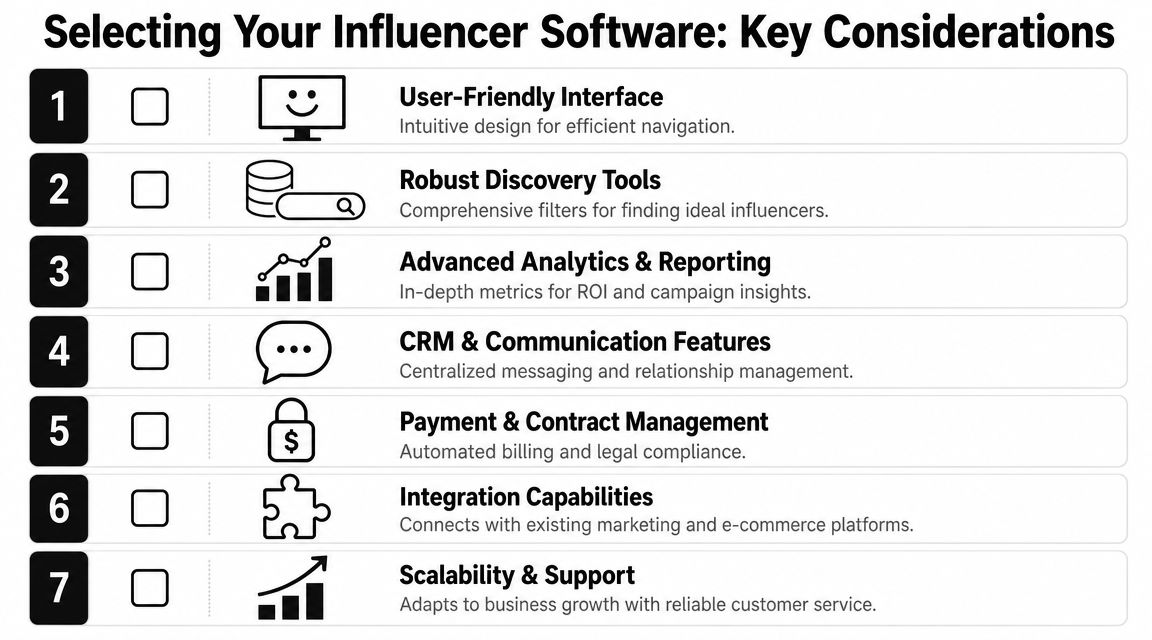
The questions that expose weak platforms
Start with attribution. If a vendor answers vaguely here, keep digging.
- How do you connect creator activity to conversions? Ask whether the system supports unique codes, UTM structures, and platform-side event capture in one record.
- Can reporting isolate creator impact from other channels? If paid social, organic search, and influencer traffic all blur together, optimisation becomes guesswork.
- What happens when conversion happens offline? Restaurants, clinics, salons, and retail locations need more than ecommerce checkout reporting.
Then move to operating model.
- Is creator sourcing open, closed, or hybrid? Closed marketplaces can be convenient. They can also restrict your ability to build long-term creator relationships outside the platform.
- Can the software support local operators without losing central control? This matters for franchises and regional brands.
- How does approval work across multiple stakeholders? Brand, legal, client, and local teams often need different levels of access.
- What data can be exported? If you can't extract campaign and creator history cleanly, you're more locked in than you think.
Match the software to the business model
Different businesses should score tools differently. An ecommerce brand should care significantly about conversion tracking and content reuse. A restaurant group should care about local creator matching and branch-level reporting. An agency should care about permissions, client separation, and reporting exports.
That's why generic software comparison pages often mislead buyers. They compare feature presence, not implementation quality.
A simple scoring model helps:
| Buying criterion | Why it matters |
|---|---|
| Attribution design | Determines whether ROI is defendable |
| Workflow fit | Decides if the team will actually adopt it |
| Integration depth | Affects how much manual reconciliation remains |
| Local campaign support | Crucial for multi-location or regional brands |
| Data ownership | Protects reporting continuity and portability |
For a broader evaluation framework, this guide on how to choose between influencer marketing platforms is worth reviewing before vendor demos.
Look sideways at adjacent software categories
A useful trick in software selection is to study adjacent martech categories. Reputation tools, review platforms, and local marketing systems often face the same problems: distributed execution, reporting clarity, permissions, and local ownership. This overview of reputation management software trends is useful because it highlights the same pressure points buyers now have in creator operations, especially around workflow consolidation and client-facing reporting.
What usually goes wrong in procurement
Three mistakes come up repeatedly.
- Buying for discovery alone: Teams get excited by profile search depth and ignore workflow limitations.
- Accepting platform-native reporting as enough: Native metrics are useful, but they're not a full attribution model.
- Underestimating local complexity: Multi-location programmes fail when the software can't distinguish branch campaigns cleanly.
Buy for the hard part of the job. Discovery gets attention in demos. Attribution and operations determine whether the platform survives the first quarter.
Implementation Blueprints for Specific Industries
Software only boosts efficiency when the workflow matches the business. The same platform can feel excellent for one operator and clumsy for another because the campaign logic is different.
For UK brands, this is especially visible in local marketing. The local creator operations angle is critical outside London. ONS data shows firms are prioritising local customer acquisition, and place-based discovery matters for hospitality. Yet most software content ignores whether tools can match creators by postcode, manage campaigns for individual branches, or prevent audience overlap for franchises, as noted in this G2 category context on influencer marketing platforms.
Ecommerce brands
For ecommerce, the strongest implementation starts with product, offer, and measurement design.
Use the software to:
- Segment creators by product fit: not every creator should push every SKU
- Assign creator-specific links and codes: this avoids reporting collisions
- Collect content into a reusable library: useful for PDPs, paid social, email, and organic social
- Track rebook decisions by outcome: some creators drive direct sales, others produce better reusable UGC
The common mistake is blending seeding, affiliate activity, and paid creator campaigns into one reporting bucket. Keep those programme types distinct inside the system.
Restaurants and hospitality venues
Restaurants don't just need reach. They need bookings, walk-ins, redemptions, reviews, and local awareness. That changes what "good software" looks like.
The workflow should be branch-first:
- Create one campaign per venue or catchment
- Match creators by realistic travel radius
- Issue venue-specific offers and codes
- Track bookings or redemptions at location level
- Store content by branch so local teams can reuse it
Manual spreadsheets become painful fast. One central team cannot sensibly manage dozens of branch-specific creator lists, offers, posting dates, and follow-ups without structured software.
Multi-location chains and franchises
Chains need two things at once. Standardisation and local variation.
That means the software should support:
- Shared templates: brand-safe briefs, approval logic, rights terms
- Local flexibility: branch-specific creator pools, dates, and offers
- Conflict prevention: avoid the same creator being booked by nearby branches without coordination
- Reporting by branch and parent brand: central teams need roll-up visibility, local teams need actionability
What doesn't work is one national creator list reused lazily across locations. It creates audience waste and weak local relevance.
Local creator programmes fail when every branch invents its own process. They also fail when head office forces one national model onto local demand patterns.
Agencies
Agencies have a different burden. They need operational consistency across clients while keeping each account ring-fenced.
The best setup usually includes:
- Separate client workspaces or clear account partitions
- Reusable outreach and brief templates
- Client approval checkpoints
- Exportable reporting
- A content library per client with rights visibility
Agencies should also insist on a system that records who approved what and when. Client-side confusion usually starts when approval history lives in email, not in the campaign record.
Proving Influencer ROI with Deterministic Attribution
The hardest conversation in influencer marketing isn't about creative. It's about proof. Leadership rarely asks whether the content looked good. They ask whether it generated revenue, bookings, or some other commercial result.
That is where deterministic attribution matters.
What deterministic attribution actually means
In practical terms, the strongest attribution layer combines unique promo codes, UTM parameters, and platform-side conversion events into one campaign record. The technical goal is simple. Every creator touchpoint should map into a shared structure such as creator ID, post ID, click ID, code redemption, booking or purchase, and revenue. Meltwater's discussion of influencer management tools aligns with this operational need, and UK privacy guidance from the ICO supports data minimisation and clear purpose limitation in marketing workflows, which makes aggregated campaign reporting more defensible than unnecessary individual profiling, as summarised in this Meltwater overview of influencer management platforms and tools.
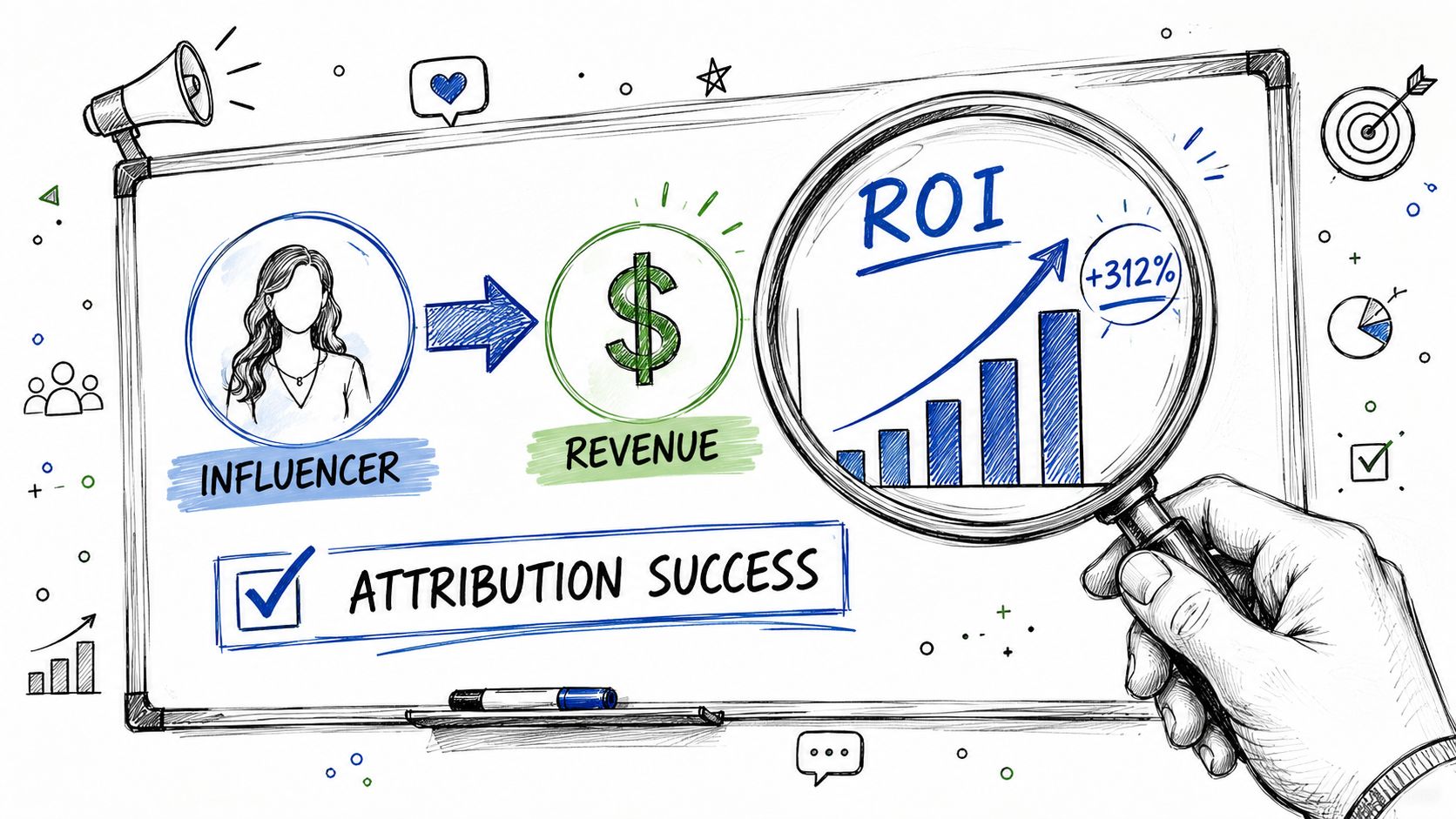
That approach is stronger than relying on platform-native engagement or loose last-click logic. It keeps attribution inside a closed loop from brief to code issuance to redemption logging.
Why the attribution gap is the real buying issue
Most software content spends too much time on discovery and not enough on proof. That leaves a major gap. In the UK, fragmented media consumption and privacy constraints make it more important to connect creator posts to in-store redemptions, bookings, and sales. The key question isn't whether a platform has analytics. It's whether it can attribute incremental revenue and separate creator impact from other channels, which is exactly the problem described in this guide to must-have features in modern influencer platforms.
For marketers who want a plain-English refresher on attribution models more broadly, this explainer on referral sales attribution is useful context.
What to report to leadership
A finance-ready report is usually narrower than marketers expect. It should answer:
- Which creators drove attributable conversions
- What revenue or booking value was connected to each creator
- What each creator cost
- Which creators should be rebooked, tested again, or stopped
- How influencer contribution compares with other tracked channels
If your team needs a more tactical walkthrough, this guide to tracking influencer marketing attribution with promo codes is a practical next read.
Engagement tells you whether people noticed the content. Deterministic attribution tells you whether the campaign changed commercial outcomes.
If you're trying to move influencer marketing out of spreadsheets and into a system the wider business can trust, Sup is built for that operating model. It combines creator sourcing, outreach, campaign setup, promo codes, UTM tracking, payments, and content collection in one workflow, which is useful for restaurants, ecommerce brands, agencies, and multi-location teams that need both execution control and measurable attribution.
More on tools
See how many creators post about you and your competitors
Type in your brand's Instagram handle and we count the creators who post about you and about your five closest competitors. It takes about a minute and it is free. Or request a demo and we will show you the creators in your niche and walk you through the dashboard.
 Book a call