16 April 2026
How to Calculate the True Cost Per Acquisition from Influencer Marketing
You’ve probably had this conversation already.
A creator campaign goes live. The content looks strong. Comments are positive. Reach is healthy. The team feels good. Then someone asks the only question that really matters for budget planning: how many new customers did that spend acquire?
That’s where most influencer reporting falls apart. The deck is full of views, likes, saves, shares, and maybe a few screenshots from Instagram or TikTok. What it often doesn’t show is a reliable cost per acquisition, tied to actual sales, bookings, or leads, with all true costs included.
If you want to scale influencer marketing like a serious acquisition channel, you need a harder standard. Not “did people engage with it?” but what did it cost to acquire a customer, and was that customer worth it?
How to Calculate the True Cost Per Acquisition from Influencer Marketing starts with a simple formula. The messy part is everything around it: defining conversions correctly, setting up tracking before launch, including hidden costs, and not giving too much credit to the last click.
This is the system I’d use if I had to defend an influencer budget in front of a finance team tomorrow.
Beyond Likes and Views Moving to True Business Impact
A creator campaign can look like a win by lunchtime and look overpriced by the time revenue closes.
The post gets strong reach. Engagement comes in fast. Stakeholders start asking whether to put more budget behind that creator or roll the concept into the next campaign. Then the harder question lands. How many customers did that spend buy?
That gap between social proof and commercial proof is where influencer reporting usually breaks. Views, likes, saves, and comments help you judge whether the content caught attention. They do not tell you whether the campaign produced sales, bookings, or qualified leads at a cost your business can afford.
If you want influencer to sit inside the acquisition budget, not the vague awareness bucket, you need a metric that ties spend to outcomes you can verify. That metric is CPA.
Attention is useful. Acquisition is what gets funded.
A high-performing post can still be a poor investment. I see this often with campaigns that generate cheap engagement but weak buying intent. On the other side, a creator with a higher fee can turn out to be efficient because their audience converts, spends more, or books faster.
So the working question changes. Stop asking whether the content performed well on-platform. Ask whether the campaign produced customers at a cost that makes sense against your margin and payback window.
For teams trying to connect top-line creator metrics to revenue, this guide on influencer marketing metrics that actually matter is a useful companion. The point is simple. Social engagement is context. It is not the outcome you budget against.
CPA is simple on paper and messy in practice
The base formula is straightforward:
CPA = total campaign cost ÷ new customers acquired
What turns it into a reliable business metric is the discipline around both halves of that equation.
“Total campaign cost” is rarely just the creator fee. It often includes product seeding, paid amplification, agency or internal management time, editing, usage rights, whitelisting, gifting fulfilment, and discount costs tied to the offer. “New customers acquired” is also easy to overstate if you count every conversion that touched the content, instead of the conversions the campaign can reasonably claim.
That is why vanity metrics create false confidence. They make weak economics look stronger than they are.
Influencer marketing becomes an acquisition channel when spend is tied to verified customer actions, not platform applause.
Why this changes budget decisions
Once CPA becomes the standard, budget conversations get sharper.
- Creator selection improves: you can separate creators who drive action from creators who mainly drive attention.
- Spend allocation improves: budget moves toward formats, audiences, and offers that produce efficient acquisitions.
- Forecasting improves: you can estimate what another £10,000 is likely to return in customers, not just impressions.
- Leadership reporting improves: performance discussions move closer to margin, payback period, and contribution to revenue.
That shift also exposes trade-offs that social reports tend to hide. A creator may be excellent for reach and still be the wrong fit for conversion. A smaller creator may deliver fewer sessions but better CPA because their audience trusts them enough to buy. Neither outcome is visible if reporting stops at likes and views.
The job is not to dismiss engagement metrics. The job is to put them in their proper place. They are leading indicators. Budget decisions need lagging indicators tied to business results.
Laying the Foundation for Accurate Campaign Tracking
A creator goes live on Friday. By Monday, the team is celebrating strong reach, healthy engagement, and a spike in site traffic. Two weeks later, finance asks a simple question: how many customers did that spend buy? If the campaign launched without a clean tracking plan, you do not have an answer. You have fragments.
That gap between platform performance and business performance is where influencer CPA gets distorted. Views and clicks can suggest momentum while sales data stays vague, split across direct traffic, organic search, email, and offline purchases. The fix starts before contracts are signed.
Define the conversion before you brief the creator
Set the conversion event first. Then build the campaign around it.
For some brands, that event is a completed purchase. For others, it is a booking, a redeemed offer, a qualified lead, or a location-specific sale. The right answer depends on how the business makes money, not on what the platform reports most easily.
A practical setup looks like this:
- E-commerce brands: completed purchase
- Restaurants and hospitality: booking, walk-in redemption, set-menu claim, or voucher use
- Lead gen businesses: completed lead form, demo booking, or qualified enquiry
- Multi-location brands: location-specific purchase, booking, or code redemption
This sounds basic. It is also where campaigns go wrong.
If the creator brief says “drive awareness” but the budget is being judged on acquisitions, the reporting will collapse into soft metrics because no one agreed on the business outcome up front. For budget planning, that means you cannot tell whether a £5,000 creator fee produced efficient demand or just attention.
Use both UTMs and promo codes
Relying on one tracking method leaves holes. Use two.
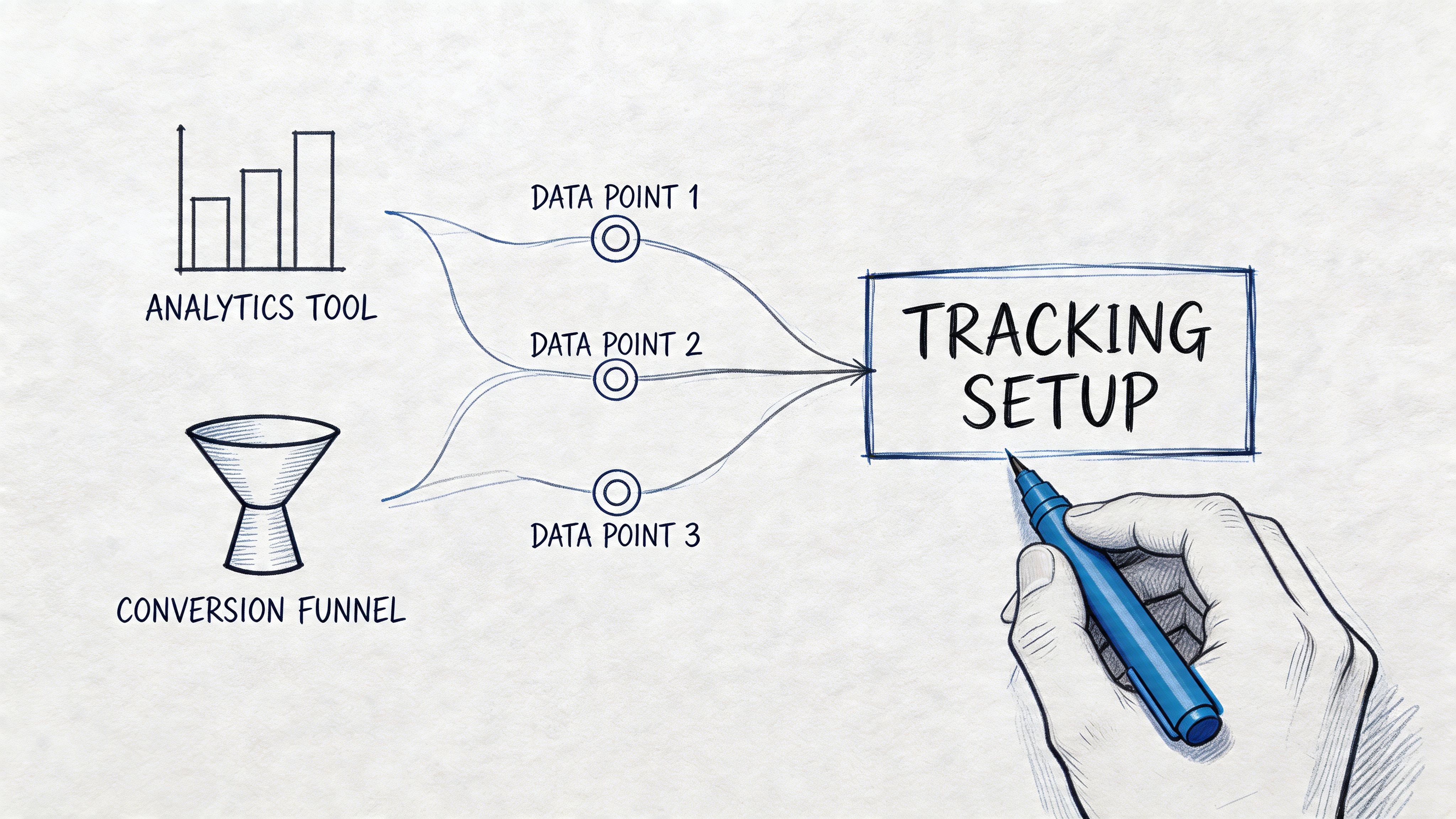
UTM parameters tell you who sent the traffic, what content drove the visit, and how those sessions behaved on site. Promo codes catch conversions that happen later, on another device, or in-store after the click path disappears.
That matters because influencer traffic rarely behaves like paid search. Someone sees a Story, remembers the offer, Googles the brand later, then buys through a branded search ad or walks into a store on the weekend. If you only track the last click, influencer performance gets undercounted. If you credit every sale during the posting window to the creator, it gets overstated.
A simple UTM structure that stays clean
Use one naming convention across every creator and platform. Boring naming wins because it keeps reporting usable.
A practical format:
- utm_source: influencer
- utm_medium: instagram, tiktok
- utm_campaign: spring_launch or brunch_push
- utm_content: creatorname_format
Examples in plain language:
- A skincare brand might send each creator to the same product page with creator-specific UTMs
- A restaurant group might use a booking page for a single location
- A franchise brand might route traffic to separate landing pages by city or branch
Consistency matters more than detail. If one creator uses “IG”, another uses “instagram”, and a third has no UTM at all, you will spend reporting time cleaning data instead of reading it.
Build codes people can remember and staff can recognise
Promo codes need to work in real-life scenarios, not just in a spreadsheet.
Keep them short, readable, and tied to the creator or location so customer support, store staff, and analysts can all identify them quickly.
| Business type | Better code style | Why it works |
|---|---|---|
| E-commerce | CREATORNAME10 | Easy to remember and map back |
| Restaurant | AMYBRUNCH | Useful for booking notes or in-person mention |
| Multi-location chain | LEEDSAMY | Helps tie redemptions to place and creator |
Offline and delayed conversions are where these codes earn their keep. A customer may never click the link, but they might remember the code at checkout, use it when booking, or mention it in-store. If your business has any offline component, code design affects measurement quality and conversion rate at the same time.
Practical rule: if a campaign can only be measured by screenshots of Story views, it was not set up to measure acquisition.
Make attribution part of campaign operations
Tracking setup cannot live in a separate analytics document that no one checks once the campaign starts. It has to sit inside campaign operations.
Every live campaign sheet should include:
- Creator name and platform
- Unique UTM link
- Unique promo code
- Offer used
- Landing page or booking page
- Conversion definition
- Post date and content format
I treat this as budget protection, not admin. Missing one of those fields is how teams end up arguing over whether a creator “performed” when the issue was broken attribution.
If you want a cleaner framework for separating signal from noise before launch, review the metrics that actually matter in influencer marketing.
Track the full cost base before results come in
CPA gets misread when conversion tracking is clean but cost tracking is incomplete.
Creator fees are only the starting point. Gifted product, shipping, paid usage rights, whitelisting, editing support, agency fees, and internal team time all affect what the acquisition cost the business. A campaign can look efficient on a creator-fee-only basis and become much less attractive once the rest of the spend is included. That is why cost inputs should be logged before reporting starts, using one shared cost sheet tied to the same creator IDs and campaign names as your attribution data.
For a useful breakdown of the true cost of influencer marketing, compare your campaign plan against every cost category that can sit outside the media line.
Why clean setup changes the CPA number
The math itself is simple. The setup is what determines whether the answer is reliable.
A useful starting formula is total campaign spend divided by attributable conversions. In practice, the hard part is deciding which conversions the campaign can fairly claim and which costs belong in the numerator. Analysts at Reach Influencers note that proper tagging matters because marketers often misattribute multi-touch conversions without it, which is the exact problem clean UTMs, unique codes, and defined conversion rules are meant to reduce.
So what does this mean for your budget?
It means tracking discipline changes spend decisions. It helps you spot which creators generate customers instead of noise, which offers drive profitable action, and whether influencer should get more budget, less budget, or a different role in the mix. Accurate CPA starts with campaign architecture, not post-campaign reporting.
Calculating Your Raw and Adjusted Influencer CPA
A creator posts. Engagement looks strong. Sales come in, but not enough to explain the spend. Finance asks for CPA, and the first number on the sheet makes the campaign look far better than it really was.
That happens when teams measure creator efficiency instead of acquisition cost.
The fix is simple. Report two CPA numbers every time:
- Raw CPA
- Adjusted CPA
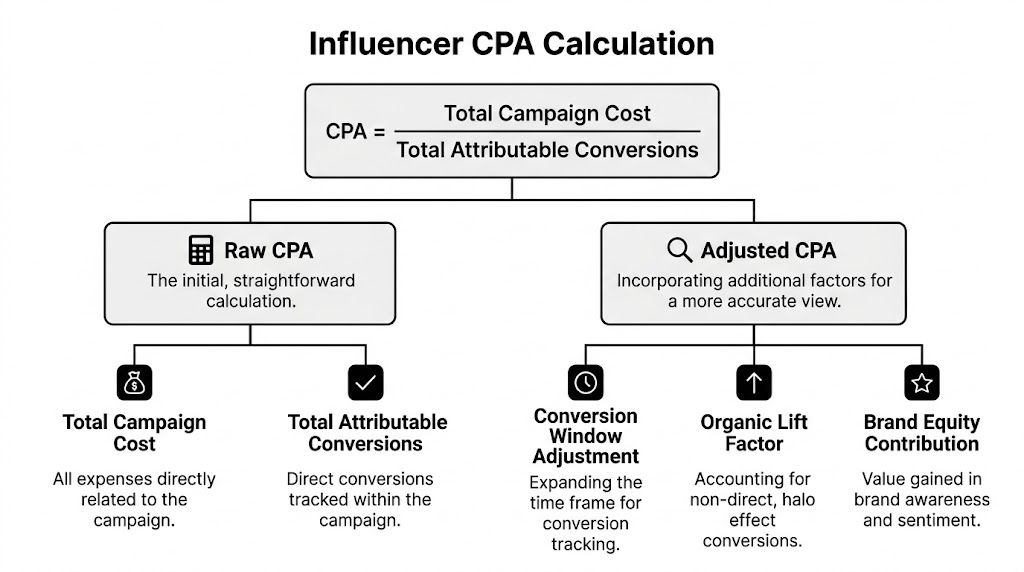
Raw CPA gives you a quick read on direct response. Adjusted CPA tells you what each acquired customer cost once the campaign touched real budgets across product, operations, creative, and team time.
Raw CPA is useful for speed
Start with the basic formula:
Raw CPA = direct creator fee ÷ attributable conversions
Use it to compare creators running the same offer, in the same period, under the same tracking rules. If one creator charged £2,000 and drove 40 verified purchases, the raw CPA is £50. That number is useful because it gives you a fast way to spot who is driving action versus who is mostly driving attention.
It is still an incomplete budget number.
Raw CPA leaves out the costs that sit outside the invoice. If you sent product, paid for shipping, bought usage rights, had an account manager handle approvals, or asked your team to build custom landing pages, those costs belong in the campaign economics even if they do not show up on the creator contract.
Adjusted CPA is the number that should guide budget decisions
Adjusted CPA uses the same conversion count, but a fuller cost base:
Adjusted CPA = total campaign investment ÷ attributable conversions
This is the number to use when deciding whether to scale a creator, repeat a format, or cut spend. It closes the gap between top-line influencer metrics and actual business outcomes. A campaign with strong views and acceptable raw CPA can still be unprofitable once the full delivery cost is included.
What should go into total campaign investment
Include every cost that exists because the campaign ran.
That usually means:
- Creator fees: flat fees, retainers, bonuses, whitelisting payments
- Gifted product value: based on the campaign expense method your finance team uses
- Shipping and fulfilment: including packaging and international delivery where relevant
- Agency or platform fees: sourcing, negotiation, approvals, reporting
- Production support: editing, design, landing page work, paid media adaptation
- Usage rights and licensing: especially if content is repurposed in ads or on-site
- Internal team time: campaign management, legal review, briefing, approvals, reporting
For a practical checklist of costs teams often miss, review the true cost of influencer marketing.
Use a worksheet that separates signal from spend
The cleanest setup is a creator-level sheet with two blocks: conversions and costs.
On the cost side, keep a line item for each spend category. On the performance side, log verified conversions only. If you need a tighter framework for code and link-based tracking, this guide to tracking influencer attribution with promo codes is a useful companion.
A simple structure works:
| Cost line | Included in raw CPA | Included in adjusted CPA |
|---|---|---|
| Creator fee | Yes | Yes |
| Gifted product | No | Yes |
| Shipping | No | Yes |
| Agency or management fee | No | Yes |
| Production support | No | Yes |
| Internal handling time | No | Yes |
Then add:
- creator name
- campaign name
- attributable conversions
- raw CPA
- adjusted CPA
That view makes trade-offs obvious. Two creators can produce similar engagement and even similar tracked sales, while one carries far more hidden cost because the partnership needed heavier support.
Why the gap between raw and adjusted CPA matters
The distance between those two numbers tells you how much overhead your influencer program is carrying.
A small gap usually means the campaign model is operationally efficient. A wide gap means the program depends on extra labor, product cost, or support spend that is easy to ignore in reporting and painful to absorb in budget reviews.
I use that gap to make practical decisions. If a creator has a competitive raw CPA but adjusted CPA jumps once usage rights and internal hours are added, that creator may still be worth keeping for awareness or content production. They are just not a clean acquisition play. Budget them accordingly.
How to use both numbers in practice
Use raw CPA for in-flight checks and quick creator comparisons.
Use adjusted CPA for decisions that affect spend:
- quarterly budget planning
- creator tier mix
- agency evaluation
- campaign format selection
- scale, pause, or cut decisions
The goal is not to force every influencer campaign into a perfect direct-response box. The goal is to stop confusing surface efficiency with true acquisition cost. That is the point where likes, views, and creator output become something finance and growth teams can use.
Factoring in LTV and Multi-Touch Attribution
Last-click CPA is useful. It just isn’t the whole story.
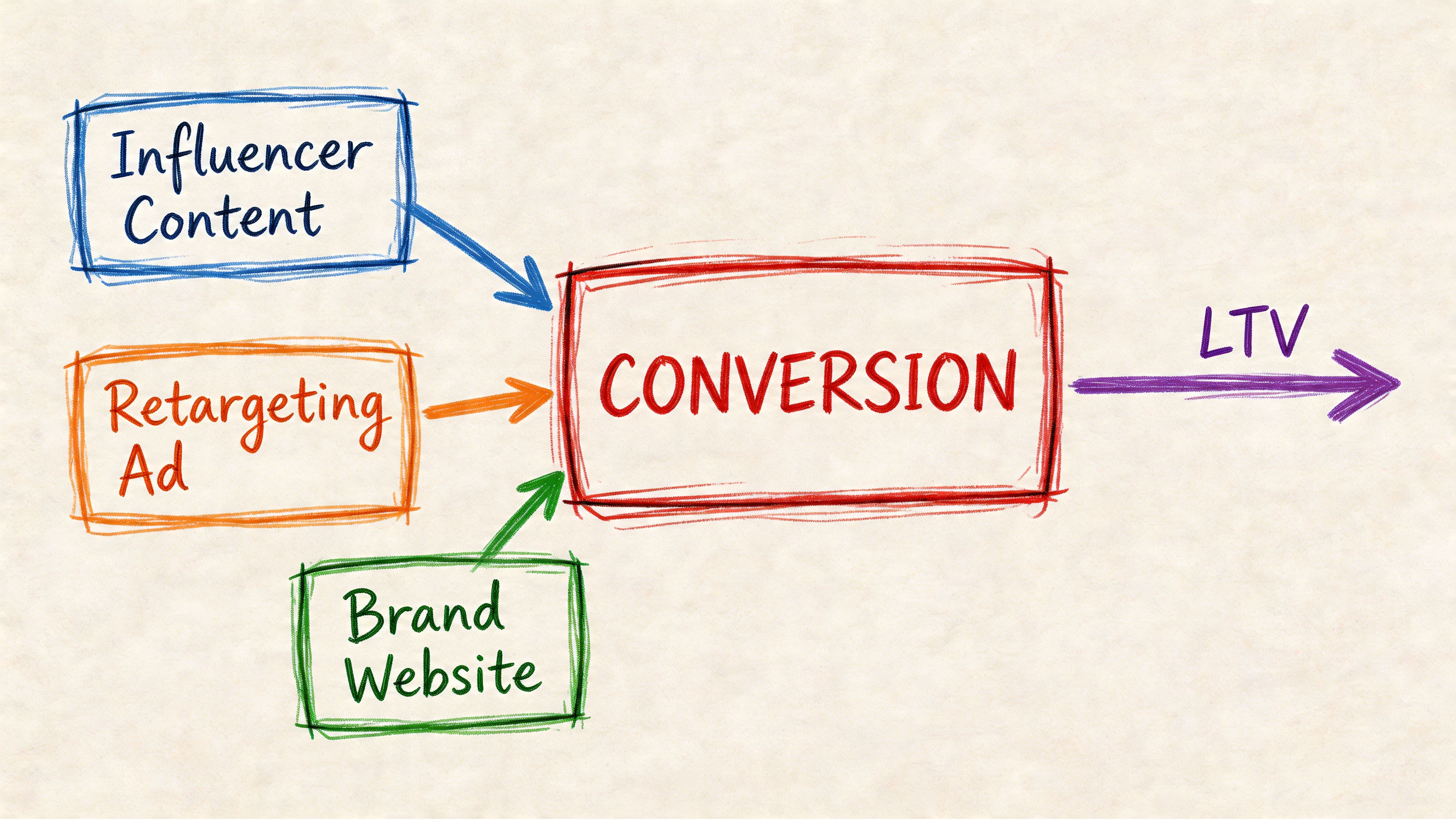
Influencer campaigns often introduce demand earlier than they capture it. Someone sees a creator post, visits the site, leaves, comes back through a retargeting ad, joins your email list, then buys later. If you only credit the final click, you’ll understate the influencer’s role and make bad budget decisions.
Why influencer attribution rarely fits a single click path
Influencer content behaves differently from paid search.
Paid search often captures intent that already exists. Influencer content often creates or shapes intent. That means a creator might deserve partial credit even when the final purchase came through another channel.
Here, many teams get too rigid. They insist on a pure last-click rule because it feels cleaner. Clean, however, isn’t always accurate.
Use more than one attribution lens
You don’t need to turn attribution into a data science project. You do need to look at campaigns from more than one angle.
Three useful views:
- Last-touch attribution Good for strict direct-response reporting. It tells you which touchpoint closed.
- First-touch attribution Useful when you want to see which creator introduced a customer to the brand.
- Shared-credit thinking Whether you model this formally or review it manually, this is how you avoid over-crediting channels that were merely later.
For influencer campaigns, I’d usually review both direct tracked conversions and assisted paths. If one creator produces modest code redemptions but repeatedly appears early in profitable customer journeys, that creator may still deserve budget.
If you need a more detailed operational view on creator-level codes and assisted tracking, this guide to influencer marketing attribution with promo codes is a practical reference.
LTV changes what counts as an acceptable CPA
A customer acquired through influencer marketing isn’t just a transaction. They’re a revenue stream with a lifespan.
That’s why lifetime value matters. A CPA that looks uncomfortable on first purchase can still be a good decision if the customer returns, upgrades, or spends more over time.
The same is true in reverse. A cheap CPA can still be a poor result if those customers never buy again or always buy low-margin products.
Questions worth asking after first purchase
- Do creator-acquired customers return?
- Do they buy across categories or stick to one low-value entry item?
- Do some creators bring in better customers, not just more customers?
- Does the offer used in the campaign attract one-time discount hunters?
When calculating true cost per acquisition, basket quality matters as much as conversion quantity. If you’re trying to improve the value of each acquisition after the first sale, this article on How to Increase Average Order Value is useful because CPA becomes much easier to justify when post-click spend improves.
The best influencer programme doesn’t always produce the cheapest first purchase. It produces customers the business wants more of.
Review delayed conversions on purpose
Some influencer campaigns convert immediately. Others take time.
That’s especially true for products with a longer consideration period, restaurant visits that happen later in the week, or branded offers customers save for payday. If you close reporting too early, you’ll undercount conversion volume and misread creator performance.
A short review cycle can still work for operational monitoring, but serious budget decisions should include a second pass after enough time has passed for late conversions to show up.
Here’s a useful explainer on the broader attribution problem:
What this means for your budget
If you only use last-click CPA, you’ll probably overfund channels that close demand and underfund channels that create it.
A better budgeting habit is to segment influencer results into three buckets:
| Bucket | What it tells you | Budget implication |
|---|---|---|
| Direct tracked conversions | Who clearly closed | Keep or scale if efficient |
| Assisted conversions | Who influenced profitable paths | Review before cutting |
| Higher-value customer cohorts | Who brings better customers | Accept a higher CPA if value holds |
That’s how you stop treating influencer marketing like a one-post sales event and start treating it like part of a revenue system.
Common CPA Calculation Pitfalls to Avoid
You approve a creator report on Friday. The post pulled strong views, comments looked healthy, and code redemptions came in fast. By Monday, the campaign looks profitable on paper. Two weeks later, finance rolls in shipping costs, your team flags that a chunk of orders came from existing customers, and the CPA you celebrated is no longer the CPA you should budget against.
That gap is where bad influencer decisions happen.
The problem usually isn’t the formula. It’s what gets counted, what gets ignored, and which campaigns get compared as if they did the same job.
Mistaking engagement for efficiency
High engagement can still produce an expensive acquisition.
This shows up constantly in creator selection. A brand sees strong saves, active comments, and a high view count, then pays a premium on the assumption that attention will convert into efficient sales. Sometimes it does. Often it produces awareness with weak purchase intent.
According to Influence Flow’s 2025 influencer pricing guide, engagement rate influences pricing decisions, while tracked acquisition efficiency often differs sharply by creator tier. That matters because teams can end up paying more for visible engagement signals that do not translate into lower CPA.
So what does this mean for your budget? Treat likes, saves, and views as diagnostic metrics, not buying goals. If the campaign objective is acquisition, price creators against tracked customer outcomes or against a benchmark that has a clear path to revenue.
Forgetting costs that sit outside the creator invoice
The creator fee is only one line of spend.
True CPA should include every cost required to generate the conversion. In practice, that usually means adding:
- Gifted stock
- Shipping and handling
- Approvals and account management
- Extra editing or landing page support
- Paid usage rights
Leave those out and your reported CPA gets artificially low. That makes one creator look efficient, even though the programme around them consumed far more budget than the report shows.
Budget errors frequently start this way. A team scales what looks like a £22 CPA creator, then discovers the all-in number was closer to £35 once operational costs were included.
Counting all redemptions as new customer acquisitions
Promo code usage is not the same as new customer growth.
If existing customers use an influencer code, those orders can still be commercially useful, but they should not sit inside new-customer CPA. Otherwise you are measuring cost per redemption or cost per order, not acquisition.
This matters most in categories with repeat buyers, local businesses with regular footfall, and brands running broad discount-led offers.
Separate three numbers every time:
- New customer conversions
- Returning customer conversions
- Total redemptions
Only the first number belongs in acquisition CPA. The other two still matter, but they answer different budget questions.
Letting leaked codes distort creator performance
Codes travel fast. They get shared in group chats, posted on deal pages, forwarded in DMs, and reused well after the original content drops.
That can inflate one creator’s reported impact or make a campaign look broader than it was. It can also hide the difference between genuine creator influence and discount-driven demand.
Use promo codes alongside link clicks, post timing, geo data where available, and customer status. Some teams also track earned media value in influencer marketing separately so visibility stays in the awareness column instead of being mistaken for acquisition proof.
A code redemption shows demand. It does not always show who created it.
Comparing campaigns with different goals
A direct-response offer, a local awareness push, and a UGC production campaign should not share one CPA benchmark.
This is a common reporting mistake in multi-objective influencer programmes. The spreadsheet has one column for CPA, so every campaign gets forced into the same frame. The result is predictable. Conversion-led campaigns look stronger than awareness-led campaigns, even when the awareness work improved branded search, assisted later sales, or produced content the paid team reused profitably.
Use like-for-like comparisons instead:
| Compare this | With this |
|---|---|
| Direct-response product launch | Other direct-response product launches |
| Local booking campaign | Other local booking campaigns |
| UGC acquisition campaign | Other content-led campaigns with the same commercial goal |
CPA is still one of the best control metrics in influencer marketing. It only stays useful when the comparison is fair and the cost base is complete.
Operationalising Your CPA Measurement for Scale
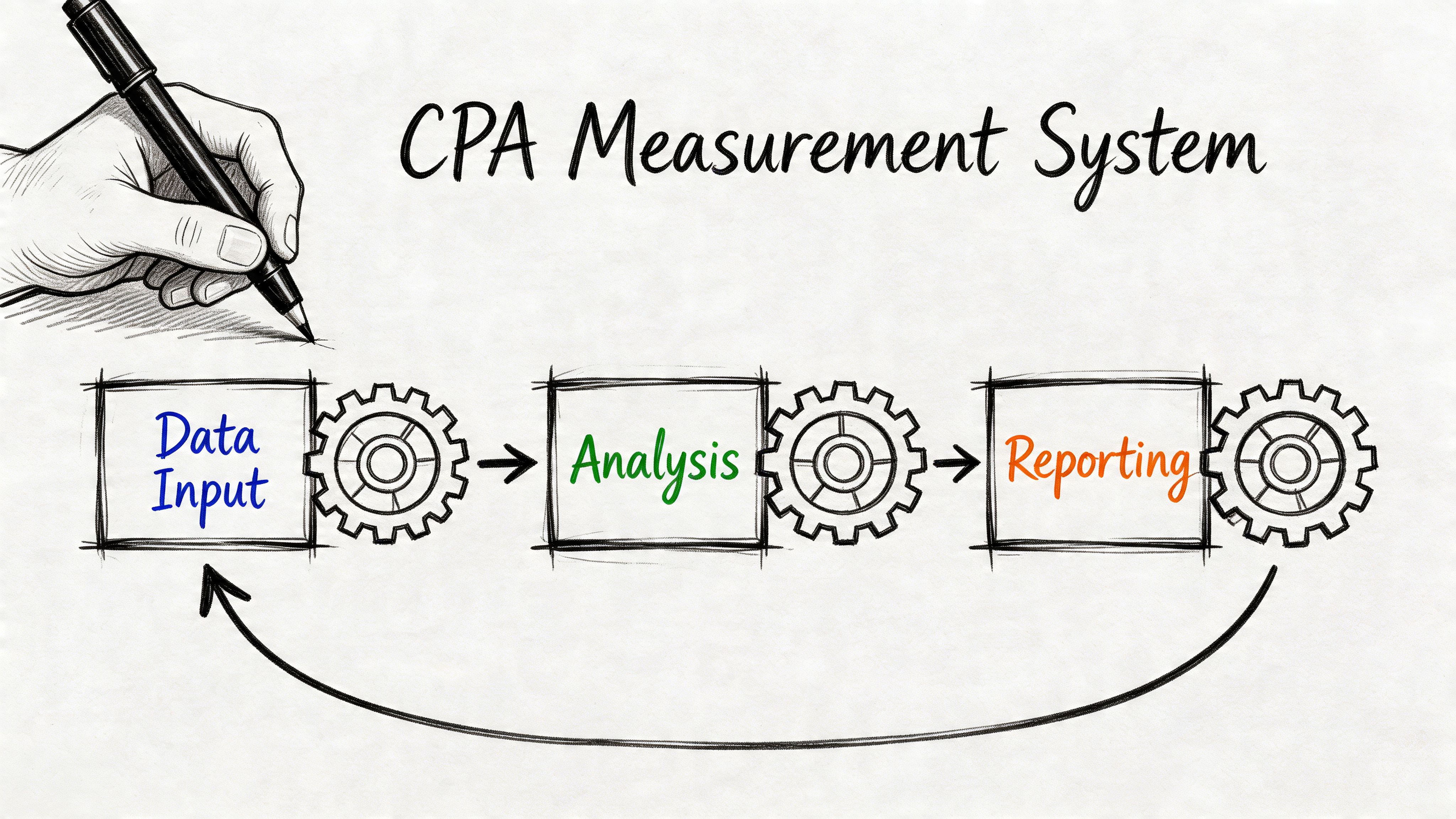
Calculating CPA once is useful. Calculating it every campaign, every month, across every creator is what turns influencer marketing into a repeatable channel.
Manual tracking breaks first at the exact moment the programme starts working. One or two creators can live in a spreadsheet. A growing roster across platforms, locations, products, and campaigns can’t.
Spreadsheets fail when volume rises
The problem isn’t that spreadsheets are bad. The problem is that people rely on them for jobs they weren’t built to handle.
When campaigns scale, manual systems create familiar problems:
- links get copied incorrectly
- code usage isn’t reconciled quickly
- creators are named differently in different tabs
- revenue and spend live in separate files
- no one trusts the final report fully
That slows decisions. And slow decisions cost budget because underperforming creators stay active for too long, while efficient creators don’t get scaled fast enough.
Build a repeatable review rhythm
The teams that get reliable CPA data don’t just collect it. They review it on a schedule.
A solid operating cadence looks like this:
Weekly campaign check
Use this for live monitoring.
Look for:
- creator links with clicks but no conversions
- code redemptions without matching traffic
- unusual spikes that may indicate code leakage
- missing post dates or incomplete deliverables
Monthly performance review
Use this for budget movement.
Review by:
- creator tier
- platform
- offer type
- location
- campaign objective
Patterns emerge. You may find one content format drives stronger acquisition, or one location consistently converts better with local nano creators than broader regional names.
Quarterly budget planning
Use this for structural decisions.
Ask:
- which creator types keep producing acceptable CPA
- where overhead is too high
- which campaigns deserve larger tests
- which partnerships should move from one-off to ongoing
The system should show you who to scale and who to cut
A useful CPA reporting setup should let you answer five questions quickly:
- Which creators drove the lowest acquisition cost?
- Which creators drove the highest-quality customers?
- Which offers converted cleanly without hurting margin?
- Which campaigns looked good socially but weak commercially?
- Which operational costs are inflating adjusted CPA?
If your current process can’t answer those without a half-day of manual work, it’s not a scalable process.
What this means for your budget
The whole point of operationalising measurement is speed with confidence.
When reporting is centralised, you can move spend faster toward what works, stop defending poor-fit creators with soft metrics, and build an influencer programme that behaves more like paid acquisition and less like a collection of one-off collaborations.
That’s when CPA stops being a retrospective number and starts becoming a planning tool.
Frequently Asked Questions About Influencer CPA
Should I calculate CPA per creator or per campaign
Both.
Per-creator CPA tells you who performs. Campaign-level CPA tells you whether the overall concept, offer, and execution were commercially sound. If you only look at campaign totals, weak creators get hidden inside stronger ones.
What counts as an acquisition in influencer marketing
It depends on the business. For e-commerce, it’s usually a completed purchase. For restaurants, it might be a booking or verified redemption. For lead generation, it should be a qualified lead action, not just a landing page visit.
The key is consistency. Don’t change the definition halfway through the campaign because one metric looks better than another.
Should gifted product be included in CPA
Yes, if the product was sent because of the campaign.
If the campaign wouldn’t have happened without the gifting, it belongs in the cost base. The same logic applies to shipping, usage rights, and external support.
What if a creator drives sales but no tracked link clicks
That can happen, especially in hospitality, local campaigns, or when followers remember a code rather than click immediately.
In that case, don’t ignore the sales. Review promo code usage, timing, and customer path context. Just don’t over-credit a creator based on redemptions alone if there’s evidence the code spread beyond the original audience.
Is a lower CPA always better
No.
A lower CPA is only better if the customer is valuable enough and the campaign remains commercially healthy. A slightly higher CPA can be the right call if those customers return, spend more, or fit the brand better over time.
How often should I recalculate influencer CPA
At minimum, once during the campaign, once shortly after it ends, and once again after delayed conversions have had time to come through.
That gives you an operational view, a direct-response view, and a more mature profitability view. If you only report once, you’ll usually miss part of the picture.
If you want a cleaner way to launch creator campaigns with built-in promo codes, UTM tracking, and a dashboard that ties content to clicks, bookings, conversions, and revenue, take a look at Sup. It’s built for teams that want influencer marketing measured like a real growth channel, not a reporting headache.
More on tracking
See how many creators post about you and your competitors
Type in your brand's Instagram handle and we count the creators who post about you and about your five closest competitors. It takes about a minute and it is free. Or request a demo and we will show you the creators in your niche and walk you through the dashboard.
 Book a call