23 April 2026
10 User Acquisition Strategies for 2026 Growth
Customer acquisition costs keep rising, and that changes the standard for what counts as a good channel. More traffic alone does not fix growth. Brands need acquisition systems that produce first purchases, repeat purchases, and content they can reuse across paid, organic, and lifecycle campaigns.
That shift has hit ecommerce, hospitality, and agencies especially hard. Broad paid social still has a place, but it gets expensive fast when targeting is loose, attribution is partial, and creative wears out every few weeks. Creator-led acquisition has become more attractive because it combines trust, distribution, and content production in one motion.
The catch is execution. A lot of teams still run influencer campaigns like one-off sponsorships, then wonder why results are uneven. The better approach is to treat creators as a measurable acquisition channel with clear inputs, tracking rules, and retention logic. That means unique links, promo codes, audience matching, repost rights, and post-campaign analysis tied back to revenue.
I have seen this work best when local relevance is built into the plan from the start. A multi-location restaurant group needs creators who can drive visits in specific trade areas. A DTC brand needs niche creators who can produce believable product education, not just top-of-funnel reach. Agencies need repeatable systems they can roll out across multiple client accounts without rebuilding the process every month.
That is the angle here.
These ten strategies focus on influencer-led acquisition that can scale, be measured, and be repeated. They cover how to source the right creators, structure campaigns, track performance, and turn creator content into a broader growth asset. Platforms such as Sup make that process easier to run at volume, but the underlying discipline matters more than the tool.
If you need a practical foundation before scaling, this $micro-influencer marketing guide for small businesses/$ is a useful starting point. For teams comparing channel formats and partnership models, these $influencer marketing use cases/$ help frame where creator programs fit inside a wider acquisition mix.
The goal is simple. Build acquisition programs you can attribute, improve, and scale without guessing which creators, offers, or local markets are producing customers.
1. Micro and Nano Influencer Partnerships

For many consumer brands, a small creator program outperforms a bigger creator buy on efficiency. The reason is simple. Audience fit usually matters more than borrowed reach.
I start here because micro and nano partnerships are easier to test, easier to attribute, and easier to scale without burning budget. That matters in ecommerce, where margin disappears fast if CAC climbs, in hospitality, where local relevance decides whether someone visits, and in agencies, where repeatable execution matters as much as campaign creativity.
The trade-off is volume. Smaller creators rarely give you instant scale from one post. They give you better signal. That is usually the better starting point.
What strong micro-influencer acquisition looks like
The selection criteria should be tighter than "good engagement" or "nice content." Look for creators who already influence the category you sell in and who can move a specific audience segment to act. For a skincare brand, that might be creators who explain routines in detail. For a restaurant group, it might be local food accounts whose followers reside nearby. For an agency managing multiple clients, it means building a shortlist by vertical, audience profile, content quality, and expected cost per deliverable.
A practical model looks like this:
- Start with buyer fit: Review recent posts, comments, and audience cues. Prioritise creators whose followers ask purchase-intent questions, save recommendations, or reference real use cases.
- Set one conversion goal per campaign: Use sales, booked visits, email captures, or trial signups. Mixed goals make creator performance harder to compare.
- Assign unique tracking: Give each creator a dedicated code, landing page, or tracked link. Sup and similar tools help organise this at scale, but the operating discipline matters more than the platform.
- Test in small batches: Run 5 to 10 creators at a time, compare output, then renew the top performers instead of replacing everyone each month.
- Reuse what works: Winning creators often improve on the second or third post because the audience has already seen the product once.
One rule holds up in practice. A smaller creator with credible category authority usually acquires better customers than a larger generalist account.
This approach also produces cleaner learnings than a broad awareness campaign. You can see which hooks convert, which formats create intent, and which creator segments deserve more budget. That is why these partnerships work well as a mini-playbook, not just a line item in the media mix.
If your team needs a practical setup for outreach, briefing, pricing, and tracking, this $micro-influencer marketing guide for small businesses/$ gives a strong starting structure.
You can also review $influencer marketing use cases/$ to compare how smaller creator programs are applied across ecommerce, hospitality, and service businesses.
2. Location-Based Creator Targeting
Store-level acquisition wins or fails on relevance. A creator can produce strong engagement and still drive weak results if their audience lives 40 minutes away from the venue, shop, or service area.
Location-based creator targeting works best for businesses where geography affects conversion. Ecommerce brands use it for city launches, same-day delivery zones, retail pop-ups, and regional product pushes. Hospitality brands use it for bookings and walk-ins. Agencies use it when clients need demand in specific markets, not broad awareness that looks good in a report and goes nowhere operationally.
The setup starts with market mapping, not creator outreach. Separate locations by buying pattern, average order value, local competition, and traffic windows. A business lunch district needs different creators than a residential neighbourhood. A boutique hotel near a convention centre needs different content angles than a weekend resort property. That distinction is where local programs usually get sharper.
Then build a creator list city by city. Use TikTok and Instagram location tags, local hashtags, venue mentions, Google Maps reviews that reference social handles, and competitor tagged posts. The goal is not reach at any cost. The goal is credible local attention from people who can convert.
I usually filter local creators on four signals:
- Audience fit by radius: Commenters, tagged followers, and story viewers should show real local density.
- Routine-based content: Creators who post where they eat, shop, stay, or work tend to drive stronger local action than broad lifestyle accounts.
- Content context: A polished feed matters less than proof that followers trust their recommendations nearby.
- Operational reliability: Fast replies, clean deliverables, and willingness to use tracked offers matter more than vanity metrics.
Platforms like Sup prove helpful. They make it easier to sort creators by region, organise outreach, and keep branch-level tracking clean. The platform is useful. The key advantage lies in running each market like its own acquisition test.
Measurement has to stay local too. If three branches share one offer code, the reporting will blur together and budget decisions will get worse. Use separate codes, booking links, or landing pages for each creator-location pair. For hospitality, track bookings, repeat visits, average party size, and daypart performance. For ecommerce, track regional conversion rate, cost to acquire a customer in the target area, and whether local creator traffic lifts paid social retargeting later.
A practical rollout looks like this:
- Start with one city or cluster: Prove the model before expanding nationally.
- Match the offer to local behavior: Lunch specials, opening-week perks, local delivery thresholds, or event-based packages usually outperform generic discounts.
- Brief for place-specific content: Show the street, the neighborhood cue, the in-store experience, or the arrival moment.
- Review by market, not only by campaign: A creator who underperforms in London may work well in Manchester because the local audience and content habits differ.
- Renew creators who produce repeatable store traffic: One strong local partner is often worth more than five one-off posts.
There is a useful crossover here with $User Generated Content Campaigns/$. The best local creator posts rarely stay local in value. Strong footage from one branch can be repurposed into paid ads, landing pages, and regional remarketing, as long as the original campaign was tracked cleanly.
The trade-off is scale. Local targeting takes more coordination than hiring one large creator for a national push. But it usually gives better signal quality, cleaner attribution, and a more realistic path to repeatable acquisition in the markets that matter most.
3. User-Generated Content Campaigns with Tracking
Tracked UGC outperforms untracked UGC because it gives you two outputs at once: acquisition data and reusable creative.
Before the mechanics, here’s the core asset in play:
Build UGC as an acquisition asset, not a posting calendar
The mistake is treating creator content as a one-time social deliverable. Strong teams build a content library that keeps producing value after the first post goes live. One review video can drive direct sales through a creator link, support retargeting ads a week later, and improve a product page for months.
That matters in ecommerce, hospitality, and agency work for the same reason. Content usually outlasts the campaign that paid for it.
A useful setup starts with a clear measurement plan. Every creator asset should tie back to a source, an offer, and a destination. That means creator-specific codes, UTMs, landing pages, or booking links attached at the asset level, not only at the campaign level. If three creators all post about the same product and only one format converts, your team should be able to see that without guessing.
For a practical framework, this guide on $tracking influencer marketing attribution with promo codes/$ covers the mechanics clearly.
What to put in place before creators post
Four parts make this work:
- A brief with conversion intent: Tell creators what proof points to show, what objection to answer, and what action the viewer should take.
- Usage rights in writing: Secure permission for paid ads, email, landing pages, and organic reuse before content is delivered.
- Asset-level naming and tagging: Label by creator, offer, product, audience, format, and publish date so the winning assets are easy to find later.
- A reporting view that connects content to results: Track clicks, conversions, CPA, revenue, booking volume, or assisted conversions by asset.
The trade-off is admin load. Better tracking creates more setup work at the start. It also gives a much clearer picture of which creators, formats, and messages can scale.
Match the content format to the buying decision
Different businesses need different proof.
For ecommerce, the best UGC usually answers product hesitation fast: fit, texture, routine, comparison, shipping expectation, or before-and-after use. For hospitality, the creative has to reduce uncertainty around the experience itself: what the room looks like in real lighting, how service feels, what the food portion is, how busy the venue gets, or what arrival looks like. Agencies should standardize these patterns across clients so reporting is comparable and top-performing briefs can be reused.
$User Generated Content Campaigns/$ offers practical inspiration for structuring that content and turning creator assets into material you can reuse across channels.
Good UGC feels specific. It shows a real use case, a clear point of view, and enough proof to help someone buy.
4. Performance-Based Partnerships and Integrated Attribution
Only a small share of creator partnerships produce repeatable acquisition. The difference is rarely the content alone. It is the deal structure and the tracking behind it.
A creator program starts acting like a real growth channel when payout ties to a business result you can verify. For ecommerce, that usually means revenue, first-order CPA, or new-customer rate. For hospitality, it is bookings, covers, package sales, or off-peak demand filled profitably. For agencies managing multiple client accounts, it means building one attribution model that can compare creators, channels, and offers without manual cleanup every week.
Pay for outcomes, not just activity
Flat fees still have a place. They help secure better talent, protect content quality, and make sense when a creator’s production value is part of the value you are buying. But flat fees alone create a blind spot. They reward delivery, not performance.
The practical model is a hybrid structure:
- A base fee for content creation and guaranteed placement
- A variable payout tied to tracked sales, bookings, or qualified leads
- A bonus threshold for creators who beat CPA, ROAS, or revenue targets
- A renewal trigger for creators who keep converting after the first campaign window
This structure changes behavior. Creators keep mentioning the offer in Stories, comments, DMs, follow-up posts, and pinned links because there is a reason to keep driving action after the first publish date.
Build attribution before the campaign goes live
Attribution falls apart when teams try to bolt it on after launch. Set it up before contracts are signed.
Use a simple stack that can survive real-world messiness:
- Creator-specific promo codes for direct-response tracking
- UTM links by creator, channel, and campaign
- Dedicated landing pages when the audience or offer needs a specific message
- Post-purchase surveys to capture view-through or word-of-mouth influence
- Assisted conversion reporting in GA4, Shopify, your booking engine, or your CRM
For teams building this for the first time, this guide on $tracking influencer marketing attribution with promo codes/$ covers the setup details well.
Last-click reporting will undercount creators. That matters most in hospitality and higher-consideration ecommerce, where someone may see a creator video on Friday, revisit through search on Sunday, and book on Tuesday. If you only credit the final click, you will cut creators who are doing the top-of-funnel work that makes the sale possible.
What to measure by business model
The metrics should match the buying cycle.
For ecommerce, track new-customer revenue, blended CPA, AOV, repeat purchase rate, and code redemption rate by creator. For hospitality, watch booking volume, table fills, stay packages sold, average booking value, and whether creators shift demand into slower days or less visible offers. Agencies should add margin by client, speed to reporting, and how often winning creator partnerships can be rolled out across similar accounts.
Sup is useful here because it gives teams one operating layer for matching creators, tracking outputs, and tying campaign activity back to commercial results. That matters more as volume increases.
Keep reporting tight enough to make budget decisions
The reporting standard does not need to be complicated. It needs to be trusted.
Use one scorecard per creator:
- Spend
- Clicks or visits
- Redemptions, bookings, or leads
- Revenue or booking value
- CPA or ROAS
- New-customer share
- Assisted conversions
- Content that influenced the result
That last line matters. A creator might miss on direct code redemptions but still produce the best converting whitelisted ad creative or the landing-page video that improves conversion rate across paid traffic. If you separate media performance from asset performance, budget decisions get sharper.
The trade-off is discipline. Someone has to maintain naming rules, code logic, payout terms, and reporting hygiene. Teams that do that work can scale creator acquisition with much more confidence, because they know which partnerships produce profitable growth and which ones only look busy.
5. Niche Creator Matching by Audience Demographics
A creator can look like a perfect fit and still send the wrong buyers.
That usually happens when teams screen for style, follower count, or category labels instead of audience composition. For acquisition, demographic matching needs to answer a harder question. Does this creator reach the people who can afford the offer, care about it now, and buy in the way your business converts?
For ecommerce, that often means checking age band, gender split, location, and income proxy against product price and reorder potential. A £20 impulse item can tolerate broader reach. A £180 skincare bundle cannot. In hospitality, local concentration matters more than total audience size, especially if the goal is weekday bookings, brunch traffic, or premium room packages. Agencies need one more layer. They have to match creators to the client’s actual customer base, not the audience the client wishes they had.
Match for commercial fit
A sustainable fashion brand should prioritise creators whose followers already engage with price, fabric quality, fit, and repeat wear. A premium restaurant should look for creators whose audience is concentrated within travelling distance and regularly acts on recommendations for nights out. A gadget brand usually gets better results from creators whose comments are full of buying questions, setup advice, and comparison requests.
Demographics are only the filter. Buying context is what makes the filter useful.
I usually screen creators on four points before outreach:
- Audience composition: Age, gender, location, language, and spending fit
- Category relevance: Does the creator post in a way that makes the product or venue feel natural?
- Buyer behaviour: Do followers ask where to buy, what to book, or whether something is worth the price?
- Operational reliability: Can the creator follow a brief, use tracking correctly, and deliver again if the first campaign works?
That process takes more time upfront. It saves budget later.
What good matching looks like by vertical
For ecommerce, the strongest matches often sit in narrow pockets. Petite workwear, vegan runners, new mums buying time-saving products, men upgrading home coffee setups. The audience is smaller, but intent is clearer and conversion rates are easier to improve.
For hospitality, broad lifestyle creators often look attractive and underperform. A local creator with fewer followers but a high share of nearby professionals or couples planning weekend meals can drive more bookings than a larger account with scattered national reach.
For agencies, niche matching improves repeatability. Once a creator profile works for one medspa, hotel group, or DTC skincare brand, that pattern can be reused across similar accounts. Sup is useful here because it helps teams sort creators by audience traits and keep those matches organised at scale.
The strongest creator match is the one whose audience already looks like your next profitable customer.
Broad seeding still has a place if the goal is reach or content volume. It is a weak approach for efficient acquisition. Niche demographic matching usually produces less noise, stronger first-party learnings, and a shorter path from campaign spend to revenue.
6. Campaign Pre-Building and Templates
Teams that can launch creator campaigns in days usually beat teams that need weeks of internal setup. Speed is not a vanity metric here. It changes how many tests you can run, how quickly you can spot a winner, and how much budget gets wasted on admin before a post even goes live.
Pre-building campaigns fixes a common acquisition problem. Every launch should not require a fresh brief, a new naming system, a new rights clause, and a new approval process. Reusable templates cut that repeated work so the team can spend time on the parts that affect performance, such as creator selection, offer fit, content angle, and local relevance.
This approach pays off fastest for ecommerce brands with frequent product drops, hospitality groups running branch-level promotions, and agencies managing similar campaigns across several clients. Sup is useful here because it helps teams keep outreach, creator status, deliverables, and tracking organised in one operating flow instead of across scattered docs and message threads.
Build repeatable campaign kits
A good campaign kit covers the full path from outreach to reporting. That includes the first message, acceptance steps, the brief, deliverables, posting dates, tracking links or codes, usage rights, approval checkpoints, and the report format. With that structure in place, the team only needs to swap the offer, creator shortlist, and location details.
Operationally, this is important because setup speed affects output. Faster assembly usually means more campaigns launched, fewer handoff mistakes, and cleaner attribution once results start coming in.
Pre-built does not mean generic.
The strongest templates create consistency behind the scenes while leaving room for the creator to sound natural. If every campaign reads like a brand form letter, response rates drop and content quality usually follows.
What to standardise and what to keep flexible
Standardise the parts that protect execution. Keep creator-facing expectations, code naming rules, deadlines, reporting fields, and rights language consistent across campaigns. Keep the variables flexible. The offer, hook, local context, visual style, and creator talking points should change based on audience and channel.
A practical template library usually includes:
- New product launches: Awareness campaigns with creator-specific links or codes tied to first-purchase revenue.
- Local footfall pushes: Branch or venue campaigns built around nearby creators, booking windows, and location-level redemption tracking.
- Always-on seeding: Rolling outreach and fulfilment workflows for niche creators who can be tested, measured, and rebooked.
- UGC capture campaigns: Briefs that secure the content format you need and set usage rights before the creator posts.
There is a trade-off. Strong templates increase speed, but old templates can subtly reduce performance. Offers expire. Platform norms shift. Creators ignore briefs that feel too rigid. Review your top-used templates on a fixed schedule and update them based on response rate, content quality, approval speed, and conversion performance.
That discipline turns templates into a growth system rather than a pile of old docs.
7. Multi-Channel Content Amplification
Creator content often does more to improve conversion than to drive the first click. That is why strong acquisition teams do not judge a post only by its native reach. They judge it by how many places it can influence a buying decision.
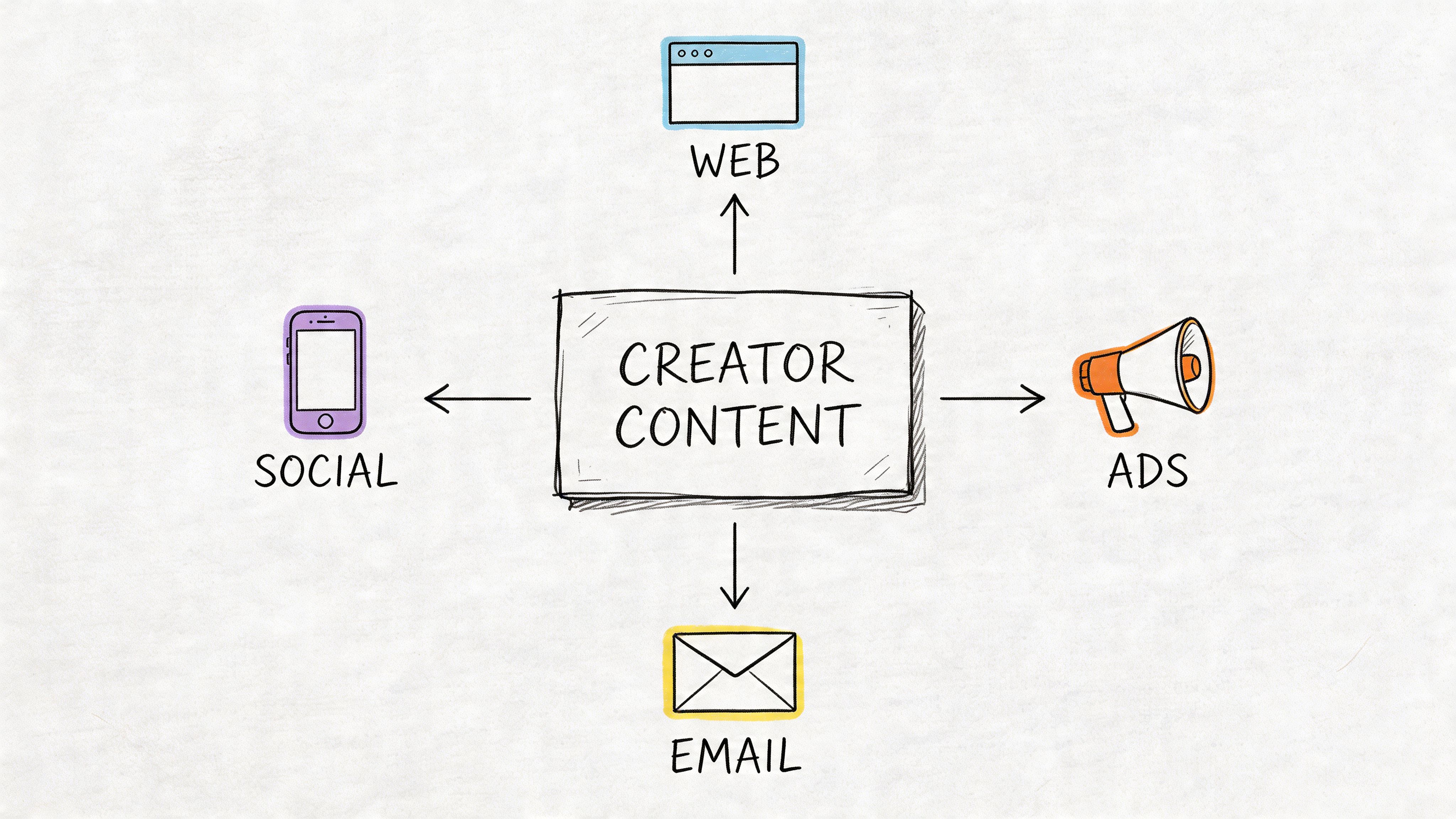
The practical shift is simple. Treat each approved creator asset as media inventory.
For ecommerce, that might mean turning one unboxing video into a paid social ad, a PDP testimonial block, a cart recovery email module, and a retargeting creative set. For hospitality, the same creator visit can appear in local paid campaigns, booking pages, Google Business photo updates, and short-form social cutdowns tied to a reservation window. Agencies should build this into campaign planning from day one, because amplification usually creates more value than the original post alone.
Use content where purchase intent is highest
Different channels do different jobs. Short-form social is usually better for attention. Product pages, landing pages, and email usually do more of the closing work. Reuse should follow that logic.
A creator clip that performs well organically can be recut into several versions with different jobs:
- Top of funnel: Native-looking video for TikTok, Instagram Reels, or paid prospecting
- Mid funnel: Retargeting creative with a clearer product angle, offer, or proof point
- Bottom of funnel: Product page video, testimonial section, or booking-page asset that reduces hesitation
- Owned channels: Email, SMS, and post-click landing pages where familiar creator faces improve trust
Measurable amplification is paramount. If the same asset lowers CAC in paid social, lifts conversion rate on a product page, and improves click-through in email, you are no longer running a creator campaign. You are building a reusable acquisition system.
Set reuse rules before the campaign starts
Amplification breaks down when rights, file formats, and tracking are handled after content goes live. By then, the legal back-and-forth slows distribution and the performance window may already be closing.
Set the operating rules upfront:
- Usage rights: Define organic, paid, whitelisting, website, and email usage in the original agreement
- Editable deliverables: Ask for raw cuts or source files if your team plans to resize, caption, or test hooks
- Channel-specific versions: Prepare vertical, square, and short cutdown formats before launch
- Tracking structure: Tag reused assets by creator, offer, audience, and channel so performance stays visible
Platforms like Sup are useful here because they help teams keep creator assets, campaign metadata, and performance records tied together instead of scattered across folders, inboxes, and ad accounts.
The trade-off is control versus speed. Heavy editing can improve fit by channel, but too much polishing strips out the creator voice that made the content persuasive in the first place. Keep the core proof intact. Change the frame, CTA, and placement to match the channel.
8. Creator Relationship Management and Retention
Brands that treat creator work as a one-off buy keep paying the setup cost. New outreach, new briefing, new negotiation, new performance uncertainty. Retention reduces that waste and gives you a clearer view of which creators can bring in profitable customers.
The best creator relationships work like repeatable acquisition channels. A creator who has already learned your product, offer, tone, and audience usually needs less hand-holding and produces stronger content faster. That matters in ecommerce, where product launches move quickly, in hospitality, where timing and local relevance shape demand, and in agency environments, where account teams cannot afford to restart the process every campaign.
Manage proven creators like revenue contributors
A creator who consistently drives tracked sales, qualified leads, bookings, or high-intent traffic should not sit in the same workflow as an untested partner. Treat proven creators as part of your acquisition mix.
That means giving them a predictable operating model:
- Clear payment terms: Fast, reliable payment keeps strong creators available
- Early campaign visibility: Share launches, seasonal pushes, and audience priorities before the brief lands
- Performance feedback: Tell creators what converted, not just what looked good
- Repeatable offers: Bring them back on formats, hooks, and promos that already worked
- Light admin: Store briefs, usage terms, contacts, and past results in one place so repeat campaigns do not restart from zero
Sup is useful here because it keeps creator history, performance data, and campaign operations connected. That makes it easier to spot who deserves another booking and who only looked promising on the surface.
Build a retention system, not an ambassador programme
Teams generally do not require a complicated loyalty structure. They need a simple way to separate experiments from dependable partners.
A practical tier model works well:
- Test creators: One campaign, narrow brief, strict tracking, small budget
- Repeat creators: Hit baseline performance targets, get invited back with clearer context and better turnaround
- Core partners: Deliver efficient acquisition consistently, get first access to campaigns, stronger rates, and more input on creative direction
This structure helps teams make better budget decisions. It also protects against a common mistake. Paying “top creator” rates before a creator has proven they can drive the right outcome.
If you are building that process across a larger programme, this guide on $scaling influencer marketing from 5 to 500 creators/$ is a useful reference for setting repeatable systems.
Watch for concentration risk
Retention has a ceiling. If too much spend sits with a small group of creators, performance often softens. Audiences get used to the message. Content starts to feel familiar. CAC creeps up.
Keep a split between retention and testing. A practical model is to let proven creators carry the bulk of spend while a smaller share goes to new talent each month. That keeps the programme stable without turning stale.
Reliable creators are operational assets. They cut setup time, improve consistency, and make acquisition less volatile. The teams that retain them well usually spend less time chasing replacements and more time scaling what already works.
9. Agency and Brand Collaboration at Scale
A creator programme can survive on hustle at five partnerships. At fifty, hustle turns into delay, missed approvals, broken tracking, and reporting that no client trusts.
That shift hits agencies, franchise groups, and multi-location brands first. The challenge is no longer finding creators. It is running one acquisition system across different stakeholders, markets, and approval rules without slowing everything down.
Build one operating model across every account
The teams that scale this well standardise the parts that should stay fixed. Brief templates, usage rights, discount code rules, payment terms, naming conventions, approval paths, and reporting definitions all need one clear system.
Creative still needs room to adapt by product, audience, and location. The operating model should not.
That distinction matters. Central teams need consistency because they are managing risk, budgets, and attribution. Local teams need flexibility because they know what will convert in their market. If you force every campaign into one generic message, performance drops. If every location runs its own process, admin costs rise and reporting becomes hard to compare.
If you are building that structure across multiple clients or markets, this guide on $how to scale influencer marketing from 5 to 500 creators/$ is a useful reference for setting up repeatable workflows.
What breaks first at scale
The first problem is usually approval speed.
A hospitality group might need local sign-off on offers, central sign-off on brand language, and legal sign-off on content usage. An ecommerce agency may need separate approval from the client lead, paid social team, and ecommerce manager before content can go live. Without a defined path, campaigns stall in inboxes and Slack threads while CPA targets slip.
The second problem is fragmented reporting. One client wants bookings. Another wants first purchases. A third cares about qualified leads by location. If each account reports performance differently, account teams spend more time rebuilding dashboards than improving acquisition.
The systems scaling teams actually need
A workable setup usually includes:
- Role-based permissions: Central, local, and client teams can approve what they own without blocking the whole campaign.
- Account-specific dashboards: Each stakeholder sees the metrics tied to their market, location, or client.
- Batch campaign workflows: Similar launches move together, which cuts coordination time.
- Shared success definitions: Teams agree upfront on what counts as a conversion, assisted conversion, qualified lead, or efficient CAC.
- Rights and asset tracking: Teams know what content can be reused in ads, email, landing pages, or location pages.
Sup fits into this kind of setup because it gives brands and agencies a single place to organise creator activity, approvals, and reporting instead of managing the programme through scattered spreadsheets and message threads. The platform matters less than the operating discipline behind it. Scale comes from clear ownership, consistent process, and reporting everyone can act on.
That is the trade-off. More structure reduces chaos, but too much process slows campaign output. The goal is controlled speed. Keep the rules tight around attribution, approvals, and rights. Keep the creative brief flexible enough for creators and local teams to produce content that still feels native.
10. Community-Driven Reviews and Social Proof
Some of the strongest acquisition work doesn’t look like acquisition at first. It looks like trust-building.
Reviews, creator testimonials, and community proof shorten decision-making. They also improve performance across channels because prospects arrive pre-sold on credibility. That’s why social proof belongs on any serious list of user acquisition strategies.
Turn creator activity into visible trust signals
For hospitality, that can mean creator reviews that support Google Business visibility, booking page confidence, and local search behaviour. For ecommerce, it often means testimonial clips, product page quotes, or review-led ad creative.
Community-led acquisition is still underused. According to $Aimers on user acquisition channels that are working for clients/$, UK ecommerce teams have seen a 52% CAC reduction through employee-shared authentic content, and those efforts outperformed paid Meta ads by 3.4x in conversions.
That insight matters beyond employee advocacy itself. It shows that authentic, distributed proof often beats polished paid messaging when trust is the primary blocker.
A practical review engine
A reliable review workflow is simple:
- Ask directly: Give creators and customers a clear review action, not a vague suggestion.
- Feature proof prominently: Move strong reviews onto landing pages, menus, product pages, and booking flows.
- Respond consistently: Active responses show that the business is paying attention.
- Reuse carefully: Pull the best review language and visuals into paid and owned assets where terms allow.
This works especially well for new openings, seasonal launches, and brands with local competition. Prospects often don’t need more awareness. They need one reason to trust you more than the alternative nearby.
The trade-off is that review systems need governance. Keep them authentic, platform-compliant, and tied to real experiences. Manufactured proof breaks trust fast.
10-Point Comparison of User Acquisition Strategies
| Strategy | Implementation Complexity 🔄 | Resource Requirements ⚡ | Expected Outcomes 📊 | Ideal Use Cases 💡 | Key Advantages ⭐ |
|---|---|---|---|---|---|
| Micro and Nano Influencer Partnerships | Medium, manage many creators | Low monetary cost; high management time | High engagement & conversion; limited reach | Local/niche campaigns, DTC, restaurants | High authenticity, strong ROI, loyal audiences |
| Location-Based Creator Targeting | Medium, geographic sourcing & coordination | Medium, location data and multiple creators | Increased foot traffic and local conversions | Multi-location businesses, hospitality, local openings | Hyperlocal relevance, measurable local impact |
| UGC Campaigns with Tracking | High, tracking, rights, library management | Medium–High, tracking infra + content ops | Reusable assets, measurable ROI, scalable content | Brands needing content scale, retargeting, ecommerce | Measurable ROI, reduced content cost, social proof |
| Performance-Based Partnerships & Integrated Attribution | High, attribution systems & integrations | Medium, tracking tools and automated payouts | Pay-for-results, transparent creator ROI | Ecommerce, bookings, affiliate-style programs | Aligns incentives, guaranteed ROI, scalable |
| Niche Creator Matching by Audience Demographics | High, audience analysis & vetting | Medium–High, analytics tools and vetting effort | Higher conversion, lower wasted spend | Premium/niche products, precision targeting | Better LTV, precise audience fit, brand consistency |
| Campaign Pre-Building and Templates | Low, initial setup then repeatable | Low, template creation time | Faster launches, consistent tracking and messaging | Agencies, franchises, repeatable campaigns | Rapid deployment, consistency, fewer setup errors |
| Multi-Channel Content Amplification | Medium, rights + platform integrations | Medium, distribution effort and ad spend | Extended reach, higher ROI from creator content | Brands repurposing UGC in ads, email, web | Maximises content ROI, extends content lifespan |
| Creator Relationship Management and Retention | Medium, ongoing relationship ops | Medium, people, payments, incentives | Improved quality, reliability, lower sourcing costs | Brands building ambassadors, recurring collaborators | Higher consistency, creator loyalty, predictable output |
| Agency and Brand Collaboration at Scale | High, complex workflows & platform needs | High, robust platform, training, support | Operational efficiency, consolidated reporting | Agencies, multi-location brands, franchises | Scalable processes, centralised management, reporting |
| Community-Driven Reviews and Social Proof | Medium, review systems & moderation | Low–Medium, outreach and monitoring | Better conversion rates, improved local SEO | Local businesses, hospitality, product pages | Strong credibility, increased trust and conversions |
Your Next Move From Strategy to Action
The best user acquisition strategies all share one trait. They reduce guesswork.
That doesn’t mean they’re simple. It means they’re measurable. You know which creator drove the booking, which UGC asset improved conversion, which local campaign brought in repeat buyers, and which relationship deserves more budget next month. That level of visibility is what turns acquisition from a series of experiments into an operating system.
Not every organization requires all ten strategies at once. In fact, trying to launch everything together usually creates noise. The smarter move is to pick the one that matches your bottleneck right now. If you run a hospitality brand with multiple locations, start with location-based creator targeting and review generation. If you’re an ecommerce brand struggling to justify influencer spend, start with performance-based partnerships and tracked UGC reuse. If you’re an agency, fix the process layer first so campaigns can scale without falling apart operationally.
Start small, but build it properly. That means clear offers, unique promo codes, UTM discipline, rights management, and reporting that your team will use. Weak infrastructure is why many creator programmes get labelled as “hard to measure” when the underlying issue is that no one set them up for attribution in the first place.
There’s also a retention lesson running through this whole list. Acquisition quality improves when trust is already present. That’s why micro and nano creators are so effective in niche and local markets. It’s why UGC keeps outperforming over-produced brand creative in many placements. It’s why repeat creator relationships often beat constant sourcing. Better acquisition usually starts with better context, not louder promotion.
If I were building a fresh acquisition engine today, I’d prioritise three layers. First, niche or local creator matching so the audience fit is right. Second, attribution so every collaboration can be judged against outcomes. Third, content reuse so each campaign produces assets that continue working after the initial post. That combination gives you a practical feedback loop. Launch, track, compare, refine, repeat.
It also helps protect you from the biggest mistake in growth marketing right now, which is treating channel volatility as normal and unfixable. It isn’t. Some volatility is real, but a lot of it comes from weak inputs. Wrong creators. Vague offers. No tracking. No post-campaign analysis. No reuse. Fix those and performance becomes much less random.
If you want a platform that supports this model, Sup is one relevant option for restaurants, ecommerce brands, agencies, and multi-location chains. Based on its published product details, it combines AI with a human team, sources niche and location-matched creators on Instagram and TikTok, prebuilds campaigns, and tracks results through promo codes, UTM links, and a central dashboard. That won’t replace strategy, but it can reduce the operational friction that stops good strategy from being executed consistently.
The key point is this. Don’t chase more users first. Build a channel that attracts the right users, proves its own value, and gets easier to scale every month. That’s how user acquisition starts compounding instead of resetting every quarter.
If you want a faster way to launch measurable creator-led acquisition, $Sup/$ helps teams source micro and nano creators, prebuild campaigns, track promo codes and UTM links, and reuse UGC without relying on manual DMs or spreadsheets.
Book a strategy call today
We'll show you the creators in your niche, build a campaign plan, and walk you through the dashboard. All within 15 minutes, no commitment.