22 March 2026
Influencer Marketing vs PR for Restaurants: Which Should You Choose? 2026 Guide
Trying to figure out where to put your marketing budget (influencer marketing or traditional PR) is a common puzzle for restaurateurs. The truth is, there's no single right answer. It all comes down to what you need to achieve right now.
If you're looking for an immediate, measurable lift in bookings or want to pack the house for a new menu launch, influencer marketing is your go-to. But if you’re playing the long game (building an iconic brand and earning that coveted industry respect), then PR is where you should focus your efforts.
Choosing Your Restaurant's Growth Strategy
When you're weighing up influencer marketing against PR, it's not about which is "better" in a vacuum. It’s about which one is the right tool for the job at hand. This decision dictates everything: your budget, your timeline, and the kind of buzz you'll generate.
Influencer marketing connects you directly with your target audience through creators they already trust. A well-timed post from a local food blogger can turn a quiet weeknight into a fully booked service. It's direct, it's fast, and the results are often easy to see.
Public relations, on the other hand, is about building your restaurant's legacy. It works by securing validation from trusted media sources, a slower but incredibly powerful process. A glowing review in a major newspaper doesn't just get you bookings for a week; it builds a foundation of credibility that can last for years.
To make the choice clearer, let’s break down the core purpose of each.
Quick Comparison Influencer Marketing vs PR
This table gives a high-level overview to help you decide which approach aligns with your restaurant's most pressing goals.
| Choose This Strategy... | When Your Goal Is... |
|---|---|
| Influencer Marketing | Driving immediate footfall, promoting limited-time offers, filling off-peak tables, or launching a new dish with instant buzz. |
| Public Relations (PR) | Building long-term brand credibility, earning prestigious reviews, managing your restaurant's reputation, or attracting investors. |
Understanding this fundamental difference is the first step. Think of influencer campaigns as tactical missions designed for short-term wins and measurable spikes in covers. They are targeted strikes meant to provoke an immediate response.
A single influencer campaign can ignite a viral trend around a unique dish, creating a wave of user-generated content and social proof that traditional media struggles to replicate. This is how you turn digital chatter into real-world customers.
In contrast, a PR strategy is a long-term investment in your brand's story. It’s about convincing the gatekeepers (the journalists, editors, and critics) that what you’re doing is newsworthy. While the return on investment isn't always as direct, the "halo effect" from a respected media feature provides a level of authority that can elevate your restaurant’s status for years to come.
As you plan your next move, it's useful to see how these two powerful strategies fit within a wider marketing plan. For more inspiration, have a look at our guide on restaurant marketing ideas that actually drive covers. The most successful restaurants rarely just pick one; they find clever ways to make them work together.
A Head-to-Head Comparison of Key Differences
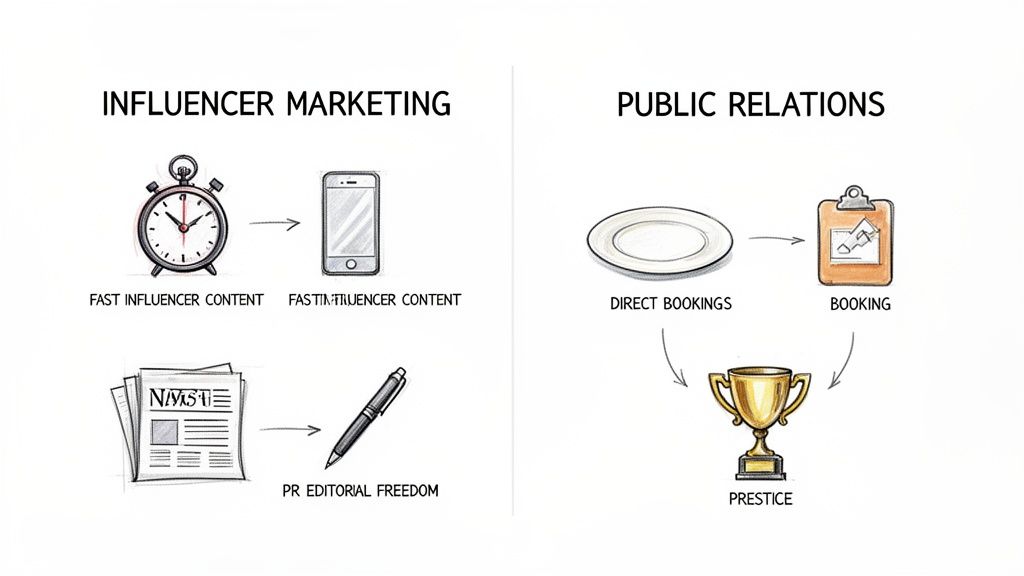
To really decide between influencer marketing and PR, you have to look past the textbook definitions and get into the nitty-gritty of how they work on the ground. Each approach asks for different resources, runs on a different clock, and delivers different kinds of results. Getting these distinctions right is crucial if you want to match your marketing to what your restaurant can actually handle and what you want to achieve.
Perhaps the starkest contrast is the pace. Influencer marketing moves at the speed of a social media scroll, often bringing in results within days or weeks. Traditional PR, on the other hand, is a slow burn. It can take months of careful relationship-building to land just one powerful piece of press.
Speed and Campaign Agility
Influencer marketing is all about immediacy. You could invite a local food blogger for dinner on a Monday, and by Wednesday, their stunning photos and a snappy reel are already live on Instagram, driving bookings for the coming weekend. This kind of nimbleness is invaluable for jumping on opportunities, like promoting a last-minute event or a new seasonal menu.
PR is a different beast entirely; it’s a game of patience. A journalist might love their visit, but their review could be earmarked for a "Best Of" guide that isn't scheduled for publication for another three months. This kind of long-lead time is just how things work for print magazines and major online publications that map out their content calendars far in advance.
Message Control and Authenticity
When you work with an influencer, you get a significant say in the final message. A well-written brief allows you to guide the conversation, ensuring they mention your sustainable sourcing or the story behind a signature dish. The creator still brings their own authentic flair, but you're steering the narrative.
With PR, that control completely disappears. A journalist or critic’s first loyalty is to their readers, not your restaurant. They have total editorial freedom and will write about their honest experience (good, bad, or indifferent) without any input from you.
With influencer marketing, you're a co-creator of the story. With PR, you are the story, and the narrative is entirely in the hands of the journalist. This distinction is fundamental to managing risk and expectations.
Of course, this lack of control is the price you pay for the incredible credibility that comes with earned media. An impartial, glowing review from a respected food critic is often seen as far more trustworthy than any paid-for post.
Audience Targeting and Reach
Influencer marketing shines when it comes to precision targeting. You can fine-tune a campaign to connect with a specific demographic right down to the neighbourhood. For instance, you could team up with a few vegan micro-influencers in East London to get the word out about your new plant-based menu, making sure your message lands with the exact people most likely to be interested.
PR, by its nature, casts a much wider net. A feature in a national newspaper or a popular city-wide magazine reaches a huge, varied readership. This is fantastic for building general brand awareness, but it's less direct if your immediate goal is to attract a specific type of customer. That newspaper article will be read by everyone from students to retirees, not just the young professionals you’re hoping to bring in for after-work cocktails.
To make this even clearer, let's break down how these two strategies stack up side-by-side in their day-to-day operations.
Operational Deep Dive: Influencer Marketing vs Traditional PR
This table gives a direct, side-by-side analysis of the core operational attributes, goals, and metrics for each strategy, helping you see where they truly diverge.
| Attribute | Influencer Marketing | Traditional PR |
|---|---|---|
| Core Goal | Drive immediate action & generate authentic content | Build long-term credibility & manage reputation |
| Timeline | Fast (days to weeks) | Slow (months to years) |
| Message Control | High (via collaborative briefs) | Low (full editorial control) |
| Audience | Niche and highly targeted | Broad and general readership |
| Measurement | Direct & trackable (promo codes, UTMs) | Indirect (impressions, brand mentions) |
Ultimately, choosing isn't just about what you want to achieve, but how you want to achieve it. Your decision rests on whether you need the immediate, controlled, and targeted impact of an influencer campaign or the slower, broader, and more authoritative brand-building power that only traditional public relations can offer.
Matching Your Goals to the Right Timeline
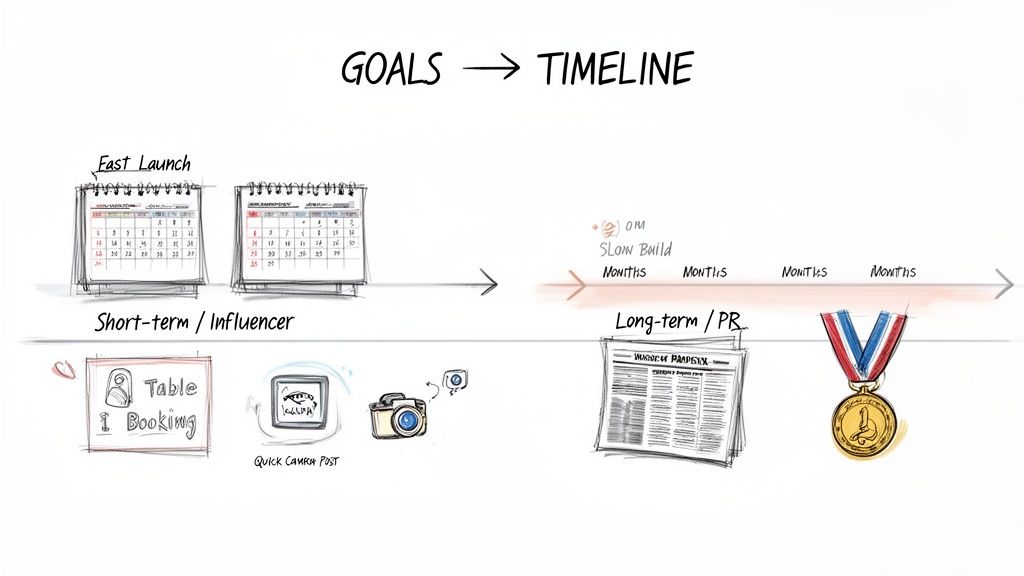
The choice between influencer marketing and PR often comes down to one simple question: how quickly do you need to see results? Each strategy operates on a completely different clock, and understanding their respective paces is key to spending your marketing budget wisely. Your most pressing needs should always steer your decision.
Influencer marketing is the sprinter in this race. It’s a strategy built for speed, designed to deliver a quick, measurable impact. Campaigns can be thought up and launched in a matter of days, not months. This makes it an incredibly powerful tool for hitting short-term, tactical goals where timing is everything.
Public relations, on the other hand, is a marathon runner. It's all about patiently building a rock-solid foundation of credibility that pays off for years to come. The results take longer to appear, but they are often deeper and far more lasting. Think of PR as a long-term investment in your restaurant’s legacy.
Goals Best Suited for Influencer Marketing
When you have an immediate commercial need, influencer marketing is the rapid-response tool you're looking for. It gives you a direct line to a specific audience, letting you drive action within a very tight window.
It’s a precision instrument for solving immediate business problems. Some of the most common and effective uses I've seen include:
- Filling tables on off-peak nights: A few well-chosen local food influencers can be all it takes to turn a quiet Tuesday into a buzzing service. Their followers see the experience in real-time and are nudged to book a table.
- Launching a new menu or special: Got a new weekend brunch or a limited-time dish you need to shout about? An influencer campaign can spark immediate interest and get people through the door before the opportunity is gone.
- Generating a wave of user-generated content (UGC): Partnering with creators to showcase a photogenic new cocktail or dessert can quickly fill your social media feeds with authentic, appealing content that serves as fantastic social proof.
The biggest advantage here is speed-to-market. You can spot a problem, get a campaign live, and see tangible results (like a spike in online bookings or a surge in promo code redemptions) all within the same week. This makes influencer marketing a potent lever for impacting your bottom line right now.
Goals Best Suited for Traditional PR
Public relations is the engine you fire up for your most ambitious, brand-defining goals. These are the kinds of achievements that don’t happen overnight but can fundamentally alter your restaurant's position in the market.
PR is about earning validation from authoritative, third-party sources, a methodical and often slow process. You should lean on PR when your goals are centred on building serious brand equity and a lasting reputation.
PR is how you go from being a popular local spot to a true culinary destination. It’s the strategy that gets your story told on a grander scale, building a legacy that outlives social media trends.
Consider these long-term ambitions where PR truly shines:
- Establishing your chef as a culinary authority: Securing features where your chef shares their expertise in respected food publications builds their professional profile, which in turn elevates your entire restaurant's prestige.
- Securing a glowing review in a national newspaper: A positive write-up from a well-regarded critic can cement your reputation for years, attracting an entirely new calibre of diner. This often takes months of careful relationship-building with journalists.
- Earning a coveted industry award: Accolades like a Michelin star or a James Beard Award are rarely a fluke. They are often the result of a sustained, strategic PR effort to keep your restaurant top-of-mind with industry voters and the media.
Ultimately, your timeline dictates your strategy. If your main goal is to make an impact this month, influencer marketing gives you the tools to do it. But if your ambition is to build a brand that endures for the next decade, a patient and persistent PR strategy is absolutely essential.
Analysing Costs and Measuring Return on Investment
For any restaurant, the budget is always front and centre. When it comes to marketing, understanding the financial side of influencer collaborations versus traditional PR is non-negotiable. These two approaches operate on entirely different cost models and, crucially, deliver returns in fundamentally different ways. Making the right call means knowing exactly what you're paying for and how you'll measure success.
Influencer marketing costs are remarkably flexible. A campaign could be as simple as gifting a meal to a nano-influencer for a post, or it could involve a multi-thousand-pound partnership with a major food creator. This scalability is a huge advantage, making it accessible for restaurants of all shapes and sizes.
Figuring out what to budget can feel like a bit of a minefield for many operators. You can get into the nitty-gritty in our complete guide on how much influencer marketing costs for restaurants. The key takeaway is that you can start small, see what works, and then scale up your investment as the results roll in.
The Clear ROI of Influencer Marketing
The real magic of modern influencer campaigns lies in how easy they are to measure. Unlike the broad-stroke approach of older marketing methods, today's creator partnerships offer direct, quantifiable returns. This is where the debate often lands a clear winner for restaurants focused on getting bums on seats, fast.
By using a platform like Sup, every campaign is armed with trackable tools that do the hard work for you:
- Unique Promo Codes: Giving a specific code to each influencer (like "FOODIE15") shows you exactly how many orders or bookings their content is driving.
- UTM Links: These are special trackable links that tell you precisely how many clicks and, ultimately, conversions came directly from an influencer's post or story.
This kind of direct attribution turns your marketing spend into a straightforward calculation. You can draw a straight line from the money invested in a creator to the revenue they generated, proving your ROI in black and white.
The core difference is this: Influencer marketing is a performance channel where spend is directly tied to measurable actions like bookings and sales. PR is a brand-building investment where the value is immense but often intangible and harder to quantify on a balance sheet.
The Ambiguous ROI of Public Relations
PR costs, on the other hand, are typically more structured. You're usually looking at monthly retainers for an agency or one-off project fees. A retainer can range from a few thousand to tens of thousands of pounds per month, depending on the agency's reputation and the scope of work.
Here’s the catch: measuring the direct ROI of PR is notoriously difficult. Its success is gauged through far less direct metrics:
- Advertising Value Equivalency (AVE): This tries to estimate what your earned media coverage would have cost if you’d paid for it as advertising space.
- Share of Voice: This metric tracks how often your brand is mentioned in the media compared to your competitors.
- Brand Mentions and Sentiment: Essentially, monitoring the volume and tone of media mentions to see if people are saying good things.
While getting a feature in a major publication absolutely drives awareness and builds credibility, it’s nearly impossible to track how many diners booked a table specifically because of that article. The value is real, but it’s in long-term brand equity, not immediate, trackable sales.
Data reveals an interesting shift in diner behaviour, too. While a huge 45% of diners discover new spots on social media, only 11% directly credit influencers for the find. This points to a trend where savvy operators now invest 40% of their budgets in brand collaborations rather than just solo influencer posts. Earned media from PR builds trust, but it lacks the trackable codes that turn impressions into measurable bookings. This makes scalable, local collaborations vital for driving tangible footfall.
To really get to grips with the financial impact of your campaigns, especially on the influencer side, it’s worth digging into resources like A Creator's Guide to Measuring Social Media ROI. It provides a brilliant framework for connecting what you do on social media to actual business outcomes.
When to Choose Influencer Marketing vs PR
Deciding between influencer marketing and PR often comes down to a simple question: are you trying to solve a problem for this week, or are you building a legacy for the years to come? Getting this right from the start saves a lot of headaches and wasted budget.
Think of it this way. Influencer marketing is your direct line to immediate action: getting people through the door, now. PR, on the other hand, is the slow, steady work of building a brand that commands respect and stands the test of time. Let's break down where each one really shines.
Choose Influencer Marketing for Immediate Impact
When you need to see a direct, measurable return on your marketing spend and you need it fast, a well-aimed influencer campaign is your best bet. It’s the most effective way I’ve seen to translate online buzz into actual bums on seats.
You should go with influencer marketing when you need to:
- Launch a new restaurant or menu: You have one shot to make a big first impression. Getting local food creators in can create that instant wave of bookings you need to hit the ground running.
- Boost off-peak traffic: Is your restaurant a ghost town on a Tuesday night? Partnering with influencers to push a "Taco Tuesday" special can fill those empty tables when you need it most.
- Drive demand for a limited-time offer (LTO): An LTO lives and dies by its sense of urgency. Influencers are brilliant at communicating that scarcity to their followers and encouraging them to visit before it’s too late.
The real strength here is the direct path to the consumer. In the UK, diners spend over 90 minutes a day on social media, and a staggering 49% admit to trying new restaurants based purely on what influencers recommend. When a creator like Toby Inskip (2.1M followers) features a dish, it generates a kind of immediate, focused excitement that traditional PR just can’t replicate.
Choose PR for Long-Term Brand Equity
Public relations is the long game. This is your strategy when the goal isn't just to fill tables tonight, but to build a prestigious brand that people talk about for years. It’s a slow burn, but it builds a rock-solid foundation of credibility.
Opt for PR when your goals are more ambitious:
- Securing a prestigious review: If you’re dreaming of a feature in a major newspaper or a rave review from a top critic, that’s the work of a PR professional who has cultivated those relationships over years.
- Establishing your chef as an expert: PR can get your head chef seen as a culinary authority through expert interviews, commentary, and opinion pieces in the right publications.
- Winning industry awards: Earning accolades like a Michelin star or an AA Rosette is a marathon, not a sprint. It’s heavily influenced by the consistent, positive media presence that a good PR strategy builds over time.
This decision between short-term ROI and long-term brand value is one every restaurateur has to make. The chart below is a great way to visualise which path aligns with your main objective.
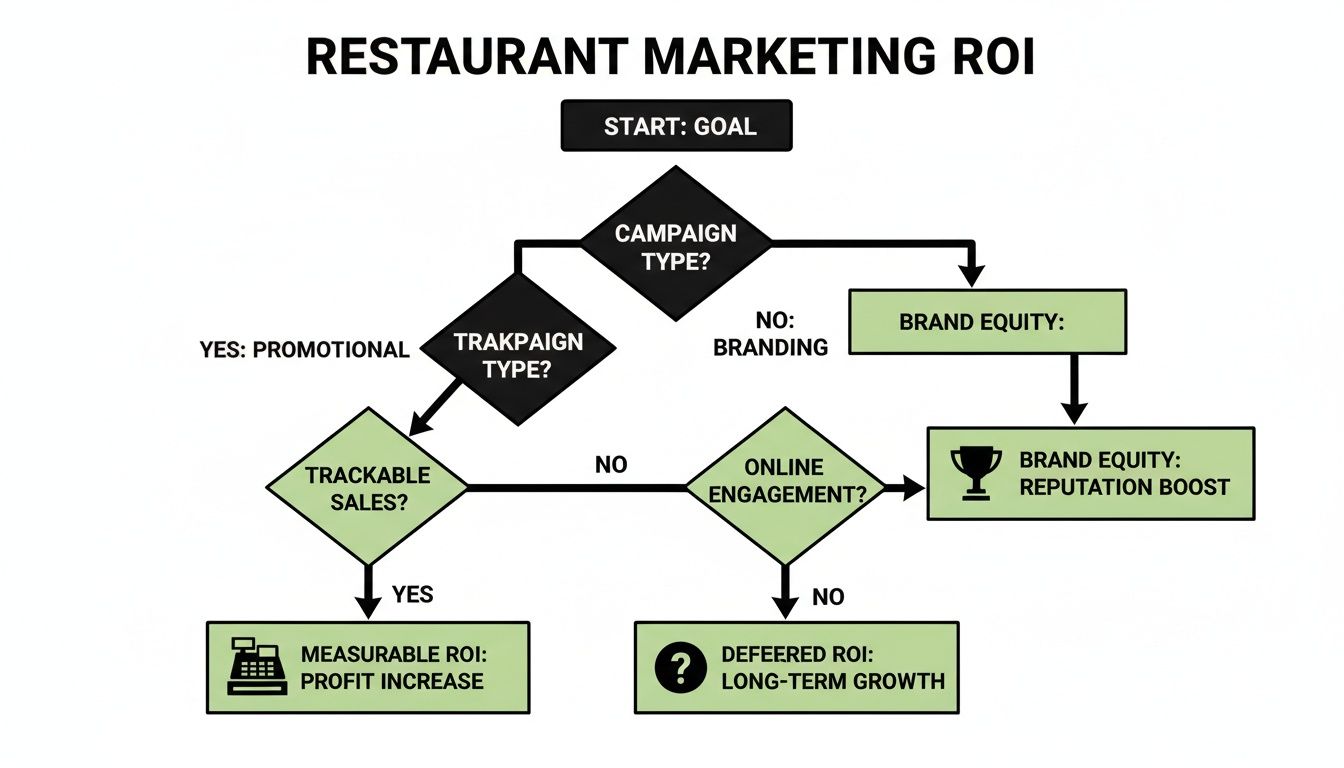
As the flowchart shows, if you need to track direct returns and see immediate results, influencer marketing is the clear choice. If you’re playing the long game to build brand value, PR is the way forward.
The Power of a Hybrid Strategy
Of course, the smartest restaurants don't see this as an either/or choice. They blend the two, using the authority from PR to fuel the fast-moving engine of influencer marketing.
Imagine your PR team lands you a fantastic feature in a top food magazine. That's a huge win for credibility. Now, you give that article to a dozen influencers to share with their followers, adding their own excitement and a direct link to book a table. You’ve just merged third-party validation with a direct sales driver.
This integrated approach is becoming the new standard. It’s why so many PR agencies are now scrambling to figure out how to add influencer marketing as a service. They know it creates a complete marketing machine. As you build out your strategy, especially with video content, understanding effective video marketing social media strategies is crucial for making content that actually connects and converts.
Frequently Asked Questions
Deciding between influencer marketing and PR often brings up some tricky questions. Let's dig into a few of the most common ones we hear from restaurant owners trying to figure out where to put their marketing spend.
Can a Small Restaurant With a Limited Budget Use PR?
Yes, but you’ll need to get your hands dirty. Instead of bringing on an expensive agency, your best bet is what we call "DIY PR". This means you'll be the one building relationships directly with local journalists, food critics, and bloggers.
Think about what makes your restaurant special: is it your chef's incredible backstory? Your commitment to local suppliers? Craft a compelling story around that and send out genuinely personalised pitches. It certainly takes more time, but it's an incredibly effective way to build credibility and land media mentions without the hefty price tag of a retainer.
Is It Better to Pay Influencers or Offer a Free Meal?
This really comes down to the influencer's audience size and what you're trying to achieve. For nano and micro-influencers (those with under 10,000 followers), a gifted meal or a great experience is often the perfect exchange. It leads to authentic, unscripted content and is a fantastic, low-cost way to get some social proof out there.
On the other hand, if you need guaranteed posts, control over the key message, and want to tap into a larger, more established audience, a paid partnership is the way to go. Paying an influencer makes it a professional transaction, allowing you to set clear expectations and track results more formally.
A gifted meal buys you goodwill and a potential post. A paid partnership buys you guaranteed content, specific deliverables, and a professional working relationship.
How Do I Measure the ROI of a PR Campaign?
This is the classic PR puzzle. Measuring the return on investment from PR is much less direct than with a digital campaign. Success isn't about linking a newspaper article directly to a specific number of sales. Instead, you're tracking metrics that signal a rise in your brand's reputation and awareness over time.
A few key things to watch:
- Brand Mentions: Keep an eye on how often your restaurant's name pops up in online articles, print, and on social media.
- Website Traffic: Look for noticeable spikes in visitors to your website right after a big feature goes live.
- Customer Surveys: It can be as simple as asking new diners, "How did you hear about us?"
- Advertising Value Equivalency (AVE): This is a rough estimate of what that earned media coverage would have cost if you’d paid for it as traditional advertising.
Should I Use Both Influencer Marketing and PR at the Same Time?
Absolutely. In the influencer marketing vs PR debate, the winning move is often to use both. A hybrid strategy is almost always the most powerful approach because the two disciplines feed into each other beautifully.
Think of it like this: You can use PR to build that initial, rock-solid credibility with a placement in a well-respected magazine. Then, you can bring in influencers to pour fuel on that fire. Imagine an influencer sharing a screenshot of your glowing review and adding their own personal call-to-action, telling their followers to book a table. It's the perfect combination of third-party validation and a direct nudge to convert.
Ready to turn influencer marketing from a guessing game into a measurable growth engine? Sup combines AI with a human team to launch, manage, and attribute creator campaigns that drive real footfall. See how we help over 650+ brands get more collabs, views, sales, and reviews at https://sup.co.
More on industries
See how many creators post about you and your competitors
Type in your brand's Instagram handle and we count the creators who post about you and about your five closest competitors. It takes about a minute and it is free. Or request a demo and we will show you the creators in your niche and walk you through the dashboard.
 Book a call